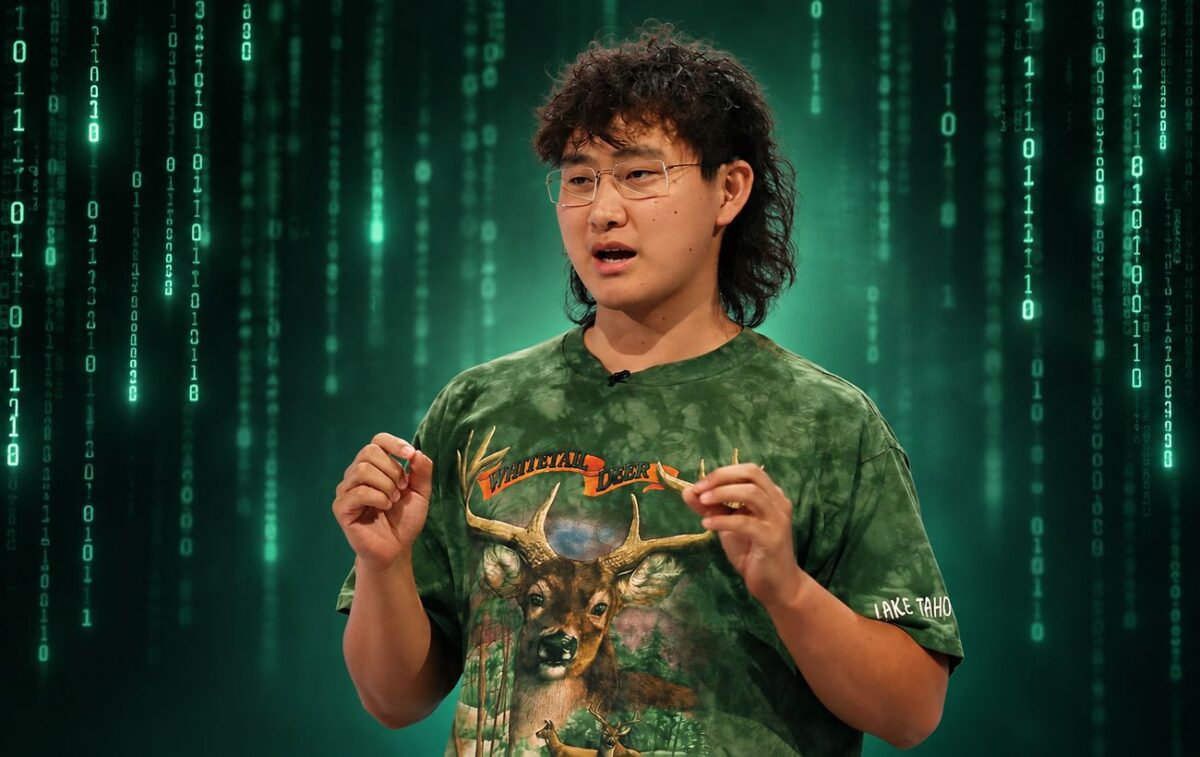
Alexander Wang warns of losing control over superintelligence that surpasses humans by 1000 times
Head of Meta Superintelligence Labs Alexander Wang stated that artificial intelligence is transitioning to a stage of self-improvement and may become 1000 times smarter than humans. The coming year will be decisive for maintaining control over these technologies. This was reported by RBC-Ukraine (Ольга Завада), according to the portal PromPolitInform.
In an article published on the social network X, head of the Meta Superintelligence Labs division Alexander Wang described the transition of AI to a stage of self-improvement. He asserts that the coming year is a critical period for humanity to maintain control over systems capable of rapid development.
Proof of the Riemann Hypothesis
Wang called the proof of the Riemann hypothesis the beginning of major changes in science. Leading researchers have worked on this mathematical problem for about 150 years, and he compared its complexity to tasks that significantly exceed the intellectual level of even creating an atomic bomb. A sort of “alien mind” joined the solution, the capabilities of which people are not yet able to fully comprehend.
The first signs of such a turning point appeared as early as December 2024. Then models of the o3 series began to successfully solve problems of the AIME math olympiad. Although teenagers participate in this competition, its most difficult tasks, according to Wang’s estimate, require a higher level of thinking than most everyday work tasks of engineers, cybersecurity specialists, and business professionals.
Acceleration of Scientific Discoveries
Over the last 2 years, AI models have made significant progress in programming, cybersecurity, and independent execution of complex tasks. This was facilitated by the gradual removal of practical limitations – lack of specialized knowledge, insufficient context, and infrastructure constraints. Wang considers research into AI itself intellectually simpler than proving the Riemann hypothesis, so current models may already have sufficient abilities to automate part of their own research and gradually improve without constant human participation.
According to the head of Meta Superintelligence Labs, this could sharply accelerate the development not only of artificial intelligence, but also biology, economics, defense technologies, and other scientific fields. The main obstacles to surpassing human capabilities in various areas are now associated not so much with the intelligence of models, but with a lack of specialized knowledge, setting up workflows, and the need to conduct real experiments.
Threat of Losing Control
If these limitations can be overcome, scientific and technological progress could accelerate so much that people will not have time to understand and track everything that happens. Wang warns that humanity will find it difficult to maintain control over systems capable of continuous improvement, or over superintelligence that would surpass humans by 1000 times in every field.
Since he considers the main scientific and technical obstacles to such development almost overcome, issues of AI safety, alignment of its goals with human ones, and protection of systems from abuse come to the forefront. Wang also considers the decision on which direction to develop these technologies equally important.
The head of Meta Superintelligence Labs criticized the widespread “lazy thinking” in the AI industry. He calls this an approach where the emergence of artificial superintelligence (ASI) is considered inevitable, and the main discourse is reduced to how to make it safe. Society should not passively agree to handing over control of its future to artificial intelligence.
Photo: RBC-Ukraine