What does a public confirmation of military success give a state, how much does a pause cost, and why does every released detail require a separate justification? This is what Ivan Arefiev writes about exclusively for the Prompolitinform portal.
On November 23, Ukraine publicly confirmed its involvement in an operation near the Libyan port of Benghazi. The President and the SBU reported it. The Ukrainian side announced the destruction of the russian corvette “Merkury” and damage to the freighter MV ANGARA. In the released satellite images, the corvette is seen capsized and partially submerged. And here, a question arises, separate from the assessment of the operation itself: What did Ukraine gain by officially confirming its participation exactly then and in such detail?
One statement, multiple audiences
The Ukrainian society perceives such a statement as news about the result of its military’s work. Russia receives official confirmation of Ukraine’s responsibility. Foreign governments assess what this event means for their relations with Kyiv. For the state off whose shores everything happened, the first questions might be about the circumstances of the incident, the safety of the port, and civilian shipping. The same announcement is read in Kyiv, Moscow, and Benghazi with different questions.
An official statement can have a significant purpose. The state sets the framework within which it explains its actions and takes responsibility for what is said. A timely comment can reduce the space for rumors, especially when images are already in the public domain and the event has gained international publicity. Public recognition can also be a deliberate political signal. Its value depends on whom it is addressed to and what reaction Kyiv expects from that audience.
A pause also has a cost. While the state remains silent, others explain the event. Under certain circumstances, this creates more problems than a brief official statement. At the same time, the fact that an image has already flown around the world does not automatically create a need to publish all known details. Between confirming participation and providing an extended account of the operation, there is room for decision-making. Gratitude to the people who performed the task can also be expressed separately, in a closed manner.
What information is needed before a statement
At the military level, the credibility of the result and the sensitivity of the information that might be released are assessed. At the intelligence level, they determine what is already in the public domain and where a public statement would add new information. Diplomats assess the likely reaction of the state involved and Ukraine’s partners. Lawyers check whether the wording corresponds to the established circumstances. The political leadership must determine what result the state wants to achieve with the statement itself and whether it is worth the predicted consequences.
In the Benghazi case, this means answering three questions separately. What does the confirmation of Ukraine’s participation give? What do the released details add to it? What would have changed if the statement had been made later? Every decision has its price. A delayed comment can provide time for fact-checking and diplomatic contacts. A concise comment can fulfill a political task. A detailed statement requires a separate basis for every significant detail.
What is relevant to recall here from Sun Tzu
In the first chapter of “The Art of War,” Sun Tzu suggests comparing several factors before making a decision, including the situation, time, quality of command, and organization. For modern state communication, a simple principle follows from this. The same action produces different results under different circumstances. The decision on publicity also requires an assessment of the situation, time, and consequences.
My assessment: The public confirmation in the case of Benghazi could have been justified if Ukraine had a clear political goal and had assessed the diplomatic consequences in advance. From open reports, we know what exactly Ukraine announced. We can only judge the reasons for the choice of time and scope of the statement to a limited extent. Therefore, I would evaluate this decision based on a specific criterion: if a political goal can be achieved with a short statement, every additional detail must give the state something substantial. If the goal is better achieved by a pause, one must know how to maintain that pause.
Author: Ivan Arefiev
Photo collage by Andriy Atlantov
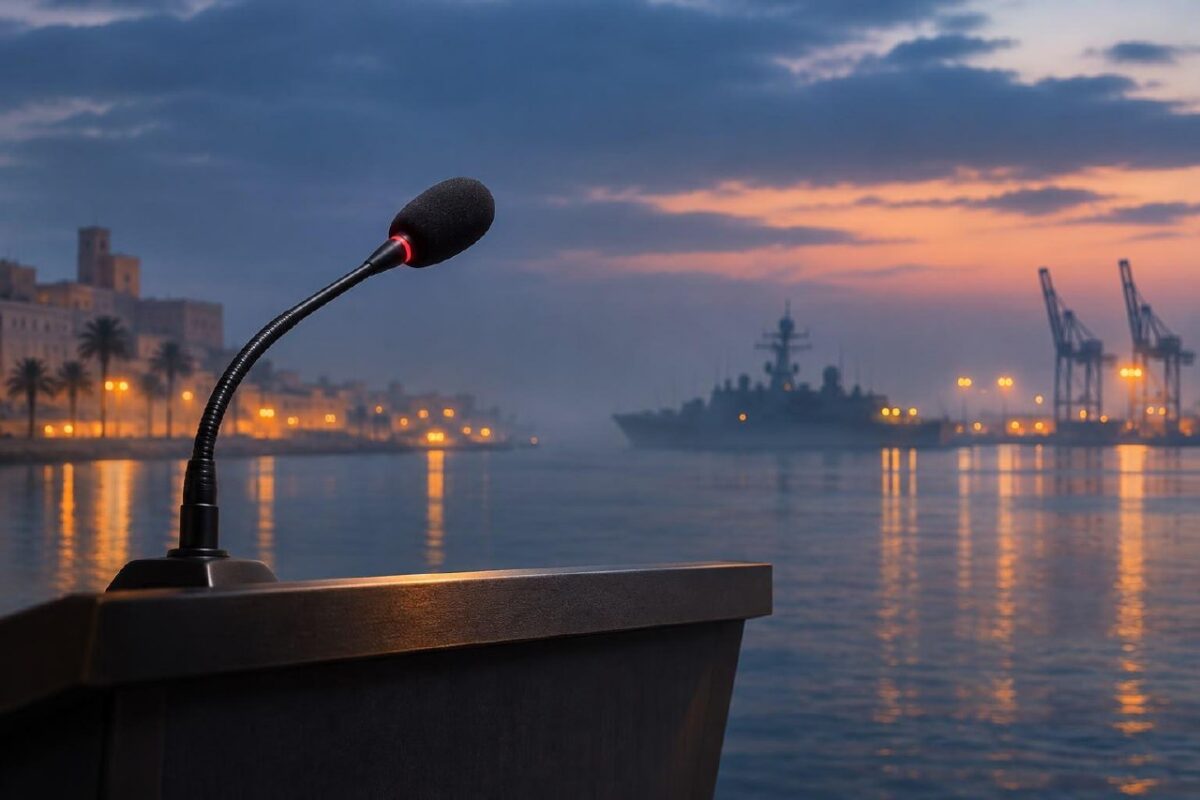
Photo: Публічний мікрофон