Generator imports fell 40%, while battery imports rose 3.6-fold
In 2025 Ukraine imported $1.69 bn worth of generators, 2.3 times the 2024 figure. A repair market has emerged: 350 active OLX listings, 2,223 sole proprietors with relevant codes since 2023. Repair demand grew 55% in the 2025–2026 season, but supply outpaces it: in October 2026 requests fell 9% while mechanics rose 81%. This was reported by Economichna Pravda citing the State Customs Service of Ukraine, according to the portal PromPolitInform.
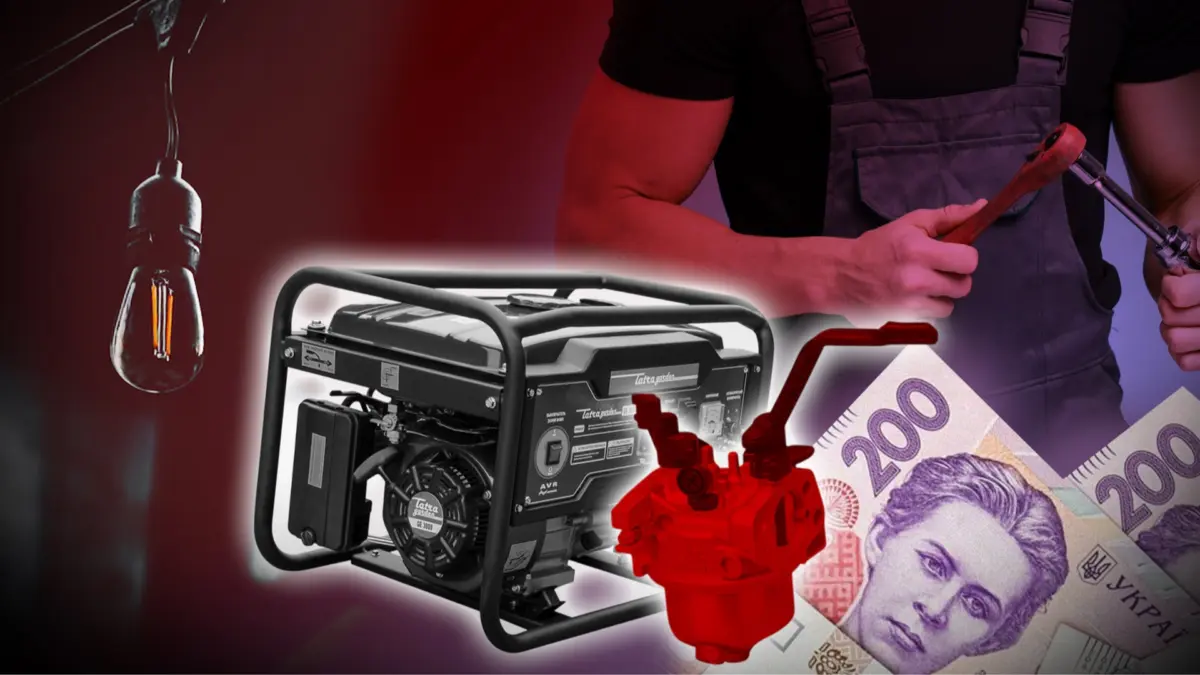
Over four wartime winters, electric generators have become mass-market equipment for households and businesses. In 2025 alone, according to the State Customs Service, generator imports reached $1.69 bn, 2.3 times the 2024 level. Cheap petrol stations bought in a panic in 2022 have exhausted their service life, spawning a dedicated repair market.
Mechanics up 15-fold
By late October 2026, the OLX platform listed 350 active generator repair ads — 81% more than a year earlier (193). At the start of the full-scale invasion, in October–December 2022, the monthly average was just 24 ads, meaning supply has grown roughly 15-fold. The sharpest jump came at the turn of 2024–2025: the quarterly average rose from 34 to 195 per month, with a peak of 399 recorded in February 2026.
The seasonal “floor” rises every year: in July–September 2023 OLX had 17 ads per month, 2024 — 31, 2025 — 117, 2026 — 186. Nearly half of all offers (142 of 307) are concentrated in Kyiv region, followed by Dnipropetrovsk (35) and Odesa (30) regions. Other regions show 12–15 ads each.
Registry data confirm the scale: YouControl reports 2,223 sole proprietors registered with generator repair codes since early 2023. Over half (1,193) appeared from January 2025. The most new entrepreneurs are in Kyiv (276) and Dnipropetrovsk region (269), followed by Kharkiv region (198) and Kyiv region (188). Kharkiv region has 198 such proprietors but only 13 OLX ads, indicating other client-acquisition channels.
Demand tracks blackout schedules, but supply runs ahead
Repair demand spikes during mass blackouts. The first surge came in November–December 2022 (706 and 877 OLX requests), the second in July 2024 (688 requests). A record was set in January 2026 — 1,046 requests. Over the 2025–2026 heating season, mechanics received 3,353 requests, 55% more than the previous season and four times the 2023–2024 figure.
Yet supply grew much faster. In late 2022 each ad attracted over two dozen requests per month; in the coldest months of 2026 — two or three; from April to September — less than one. Off-season, a mechanic waits about two months for a client on average. October 2026 reinforced the trend: ads up 81% year-on-year, but requests down 9% (211 vs 232). Mechanics prepared for winter; clients did not.
Most common failures: overloads and deferred maintenance
Grotsber Ukraine sales manager Denys Bibik notes that many faults stem from overload, overdue maintenance, low oil, dirty fuel, and improper connection. Weak points vary by type: petrol units — carburettor, fuel system, ignition, starting; diesel — fuel apparatus, injectors, starter, battery, cooling; inverter — power electronics and inverter module, the most complex and costly component to fix.
Mechanic Petro cites the most frequent petrol generator fault — a carburettor clogged by deposits from long-term fuel storage. In diesel units, winter causes summer fuel to wax, blocking filters. Cheap equipment has limited life: a budget petrol generator runs 500–1,500 engine hours before major overhaul, better models 3,000–5,000, portable diesel 4,000–8,000. At intensive use (four hours daily) that is about 1,460 hours per year, so a cheap set may need repair within a year or two. Up to 70% of petrol generators imported into Ukraine belong to the budget segment, per Rental Power estimates. Darex Trading Solutions service head Oleksandr Volokhov stresses: a brand does not guarantee trouble-free operation without proper maintenance.
Repair prices: from UAH 500 for diagnostics to UAH 40,000 for overhaul
The median OLX ad price is UAH 500, but this is mostly a diagnostics fee. Of 307 active ads, 189 list no price at all. The market has split into three tiers. Mass market — private mechanics and small shops for 2–15 kW sets: carburettor cleaning UAH 600–2,500, voltage regulator replacement UAH 800–4,000. Second tier — services like Grotsber Ukraine: simplest repair UAH 10,000–15,000, full overhaul from UAH 40,000. Third tier — supplier service centres for diesel units (Darex), where estimates are custom after diagnostics.
Grotsber says the costliest jobs are engine, alternator, or inverter module overhauls. Rental Power estimates an engine seized from old oil costs 30–50% of a new unit. Basic maintenance (oil, filters, plugs) — UAH 1,200–1,500. Private mechanic Petro quotes mass-market prices: carburettor cleaning UAH 700–1,000, voltage regulator replacement UAH 900–1,200, starter repair UAH 900–2,000. Major faults cost more: piston group repair from UAH 3,500, rewinding from UAH 4,500, engine overhaul from UAH 7,000. Parts are extra. Diesel is pricier: fuel system diagnostics from UAH 3,000, generator-end repair UAH 1,500–15,000. If a new set costs UAH 12,000–15,000 and repair UAH 8,000–10,000, the owner must decide whether to invest.
Parts: Chinese units in stock, branded — up to three weeks
Basic parts for budget generators are cheap and available. Voltage regulator for 2–3 kW — UAH 265–490, for 6–8 kW — UAH 900. Carburettor for a small set — UAH 1,000–1,100. Diesel parts cost more: injector UAH 2,000, electric starter UAH 3,000. For common Chinese engines 168F or 190F, almost everything is on the market. Branded equipment is trickier: “We stock main materials, but some parts must be ordered,” says Bibik. From the equipment warehouse — three days; on order — two to three weeks. Hardest are rare models and inverter generators: control boards often unavailable, requiring a wait. Darex acknowledges parts supply is a market-wide issue; no universal lead times exist due to the highly diverse fleet. For a business, three weeks without a generator during peak blackouts means lost revenue and clients.
Main client — business shifting to prevention
Service firms earn most from B2B, not households. At Grotsber Ukraine, business clients account for 80%, private — 20%. In peak months the company repairs and services 30–40 generators, off-season — 20. Steadier flow comes from scheduled maintenance for enterprises. The Vash Lavash bakery chain spent over UAH 300,000 on generator maintenance and repair in October 2025 alone, and replaces about 20% of units annually. Volokhov notes: the generator has moved from backup to mission-critical equipment; what matters is whether it starts when needed, driving demand for prevention over emergency repair.
Market saturated, demand shifting to battery storage
Fewer new generators are bought: in January–October 2026 imports fell 40.2% to $835 m per State Customs Service. Meanwhile, battery imports over the same period rose 3.6-fold to $3.77 bn (a large share — drone batteries). The generator market is saturated, and part of demand has moved to charging stations and energy storage. For service, this means two things: the 2022–2025 generator fleet is ageing and will need ever more repairs, and OLX has already spawned an adjacent niche — inverter board and charging station repair. The season has begun: from November, regional blackout schedules are in force. Whether winter will bring enough work for all mechanics will become clear in January, but the golden rule, as mechanic Petro puts it, is: “The best saving is timely maintenance, not trying to save on oil, fuel, or repairs.”
Photo: Economichna Pravda