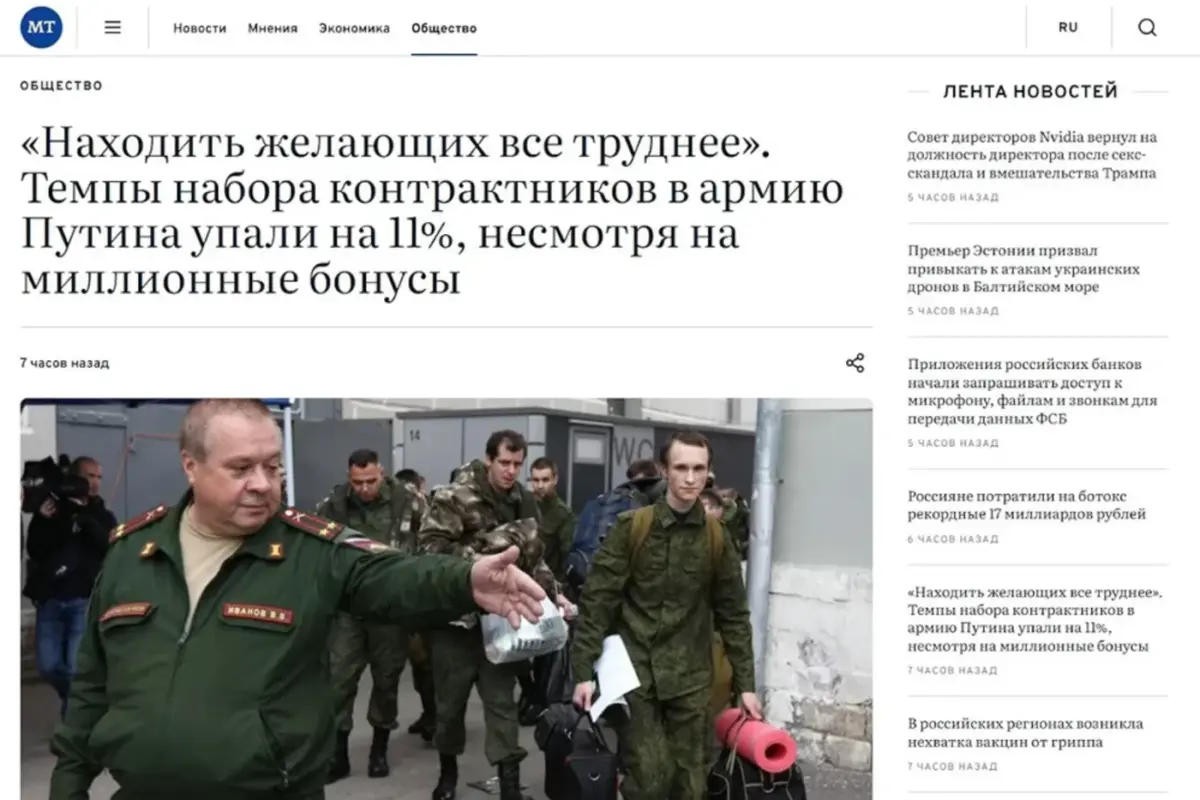
Financial incentives are no longer securing previous rates of army recruitment
The pace of contract soldier recruitment into the Russian army has dropped significantly despite million-ruble bonuses, while occupation force casualties in Ukraine continue to rise. The slowdown in recruitment indicates a systemic crisis in troop staffing amid a protracted war. This was reported by Glavcom citing The Moscow Times, according to the portal PromPolitInform.
Updated data indicate that over ten months, the Russian army fell short by 37,000 personnel compared to the same period last year. The recruitment mechanism of the Russian Ministry of Defence has faced a situation where monthly front-line casualties are estimated by Western intelligence at approximately 50,000 killed and wounded.
Decline in contract soldier recruitment
According to researchers, the average regional bonus for signing a contract has reached 2.4 million rubles. Despite this, 109.5 thousand people signed agreements in July-September, while in October the figure dropped to 34 thousand, which is 11% lower than the previous year’s figures.
Cumulatively, the recruitment campaign brought in 297 thousand new recruits over ten months. At the same time, the total losses of the Russian army since the beginning of the full-scale invasion have approached the mark of 1.5 million people.
Limited financial incentives
Experts note that the Kremlin has turned troop staffing into a market for purchasing human resources through large payouts. However, financial incentives cannot indefinitely compensate for risks to life and the lack of prospects for returning to peaceful existence.
The decrease in recruitment rates does not mean an immediate halt to hostilities, but it makes their continuation significantly more expensive for the Russian state. The Russian leadership tries to avoid a new large-scale mobilization due to political risks for the regime.
Photo: Glavcom