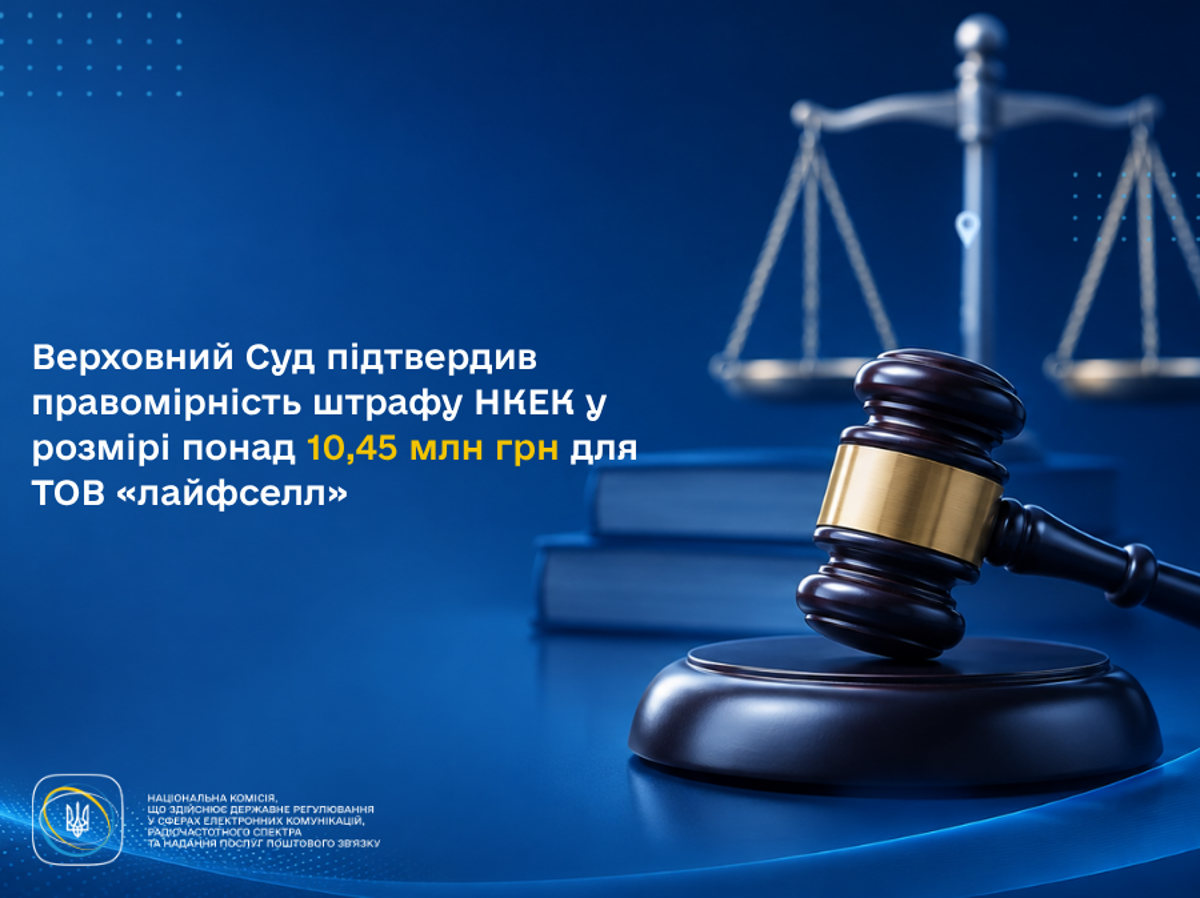
A fine of over 10 million hryvnias for failing to prepare networks for blackouts in a timely manner has been ruled lawful
The Supreme Court has upheld the penalties imposed by the NCEC on lifecell for failing to meet the regulator's requirements regarding the continuity of communications. The mobile operator's appeal was dismissed, leaving previous court rulings unchanged. This is reported by the portal PromPolitInform, citing information from NCEC.
The court issued a ruling in case No. 320/15773/24, confirming the legitimacy of the fine imposed on the operator in the amount of 10,450,511.70 UAH. The electronic communications service provider has already transferred these funds to the state budget of Ukraine following the appellate court’s decision.
The financial sanctions were triggered by the results of unscheduled inspections conducted by the commission. The regulator found that lifecell had failed to timely comply with the instructions of the National Centre for Operational and Technical Control of Electronic Communications Networks of Ukraine regarding the maintenance of network stability during potential prolonged power outages.
Legal conclusions regarding the regulator’s activities
The Supreme Court emphasized that the law does not require the NCEC to define specific engineering solutions to address violations, as the choice of technical methods remains within the powers of the business entity itself. At the same time, the regulator must clearly articulate the nature of the violation and set deadlines for bringing operations into compliance with legislative standards.
The ruling also stated that the subsequent correction of errors does not exempt a company from liability for the late execution of instructions within a specified period. The obligation to rectify a deficiency and the liability for delay are distinct legal consequences.
Statute of limitations
The court further clarified the mechanism for calculating deadlines for imposing fines in such cases. The Supreme Court ruled that the six-month period for applying sanctions must be calculated from the moment the failure to comply with the regulator’s order is discovered, rather than from the date the initial violation of legal requirements was recorded.
This decision took legal effect immediately upon announcement and is not subject to further appeal. The NCEC reminded that sanctions decisions are mandatory, and judicial proceedings do not suspend their implementation unless a court orders otherwise.
Photo: NCEC