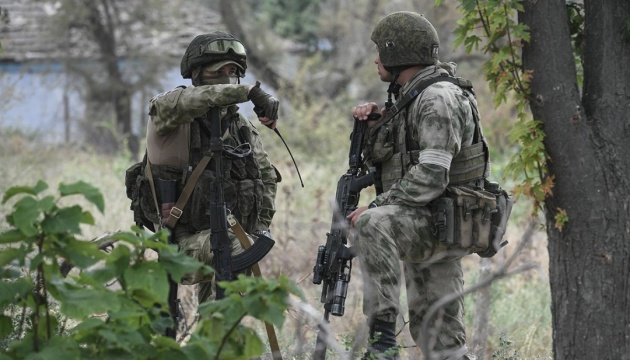
“This is the most f***ed-up brigade, just expendable material” — Ukraine’s military intelligence intercepted two conversations of Russian occupiers from the 5th Separate Guards Motor Rifle Brigade (military unit 41698), one of the units formed back in 2014.
This was reported by Ukraine’s Defense Intelligence (HUR), according to the Prompolitinform portal.
Both intercepts reveal the realities of service in the so-called “penal” brigade through the story of one serviceman — Dzatte Mamitov. In a conversation with his mother, his acquaintance complains about the inhumane conditions in the “fifth”: how wounded soldiers on crutches are sent into assaults, how battalions are replenished twice a month due to massive losses, and how propagandist Vladimir Solovyov helps cover up crimes because of personal connections. Another occupier describes, using Mamitov as an example, how Russian military police torture their own soldiers and appropriate compensation payments for injuries.
From Donetsk basements to “meat assaults” — the bloody lineage of the 5th brigade from Russia
The 5th Separate Guards Motor Rifle Brigade named after Zakharchenko (a war criminal and the first leader of the so-called “DPR”) began its “heroic” history as the “Oplot” combat unit. Back in 2014, from the very first months, it participated in the armed conflict in eastern Ukraine on the side of the Russian contingent under the cover of separatist movements. By the end of 2014, the unit had grown into a brigade and became part of the 1st Army Corps of the “People’s Militia of the DPR.”
Since January 1, 2023, it has officially been part of the 51st Guards Combined Arms Army of the Russian Armed Forces. On December 5, 2024, by Putin’s decree, the brigade was awarded the honorary title “Guards.”
The unit’s war crimes have been documented since 2014: in the Donetsk region, the UN recorded brutal abuse and interrogations of Ukrainian prisoners in a seized SBU building. During the full-scale invasion in 2024, the occupiers tortured to death a mobilized music teacher and killed American volunteer, separatist supporter, and Russia Today correspondent Russell Bentley.
Disposal by design: the case of Dzatte Mamitov
Documents and intercepted conversations obtained by military intelligence concern one individual — Private Dzatte Borisovich Mamitov (born 1997), who became a victim of internal terror in the 5th brigade.
According to the documents, his service followed the worst traditions of the Russian army: suicidal orders from command, torture, and extortion. Mamitov was seriously wounded in combat — losing half of his foot and suffering multiple shrapnel wounds to the torso and head. He went for treatment but did not return to the unit from his home village of Darg-Koh in North Ossetia — the military police declared him wanted.
After complaints and a failed attempt to challenge the actions of the military police in the prosecutor’s office, Ministry of Defense, and Investigative Committee, Mamitov was forced to return to the brigade headquarters in Donetsk. Later, contact with him was lost — instead, his family received notifications about suspicious withdrawals from his bank account. Apparently, militants of the so-called “DPR” military police were extorting a share of his injury compensation.
For refusing to pay, he was held in a basement and systematically tortured. To cover up the abuse and settle the issue of payments, the command of military unit 41698 sent the mutilated soldier on a “combat mission.”
On April 20, 2025, Mamitov was officially declared missing. While the command fabricated circumstances of his “disposal,” Russian law enforcement predictably refused to investigate. Thus, the killing of their own soldier was effectively legalized at all levels — from company commander to military investigator.
Death within an hour — or the “DPR gambit”
“They screwed him over, said he’d hold a position. He got there, stayed for a while, and then they told him to push forward into an assault. He radioed back: what assault, are you crazy, with this leg? And still, he went.”

The first intercept is from an occupier attached to the brigade from another Russian unit. His account provides an insider’s view of life in the brigade.

He describes how Mamitov was misled into believing he would hold a defensive position, but after an hour was ordered into an assault. Despite reporting his injury, the order stood.

Shelf life — two months
“There were thousands of complaints written. Literally thousands about this fifth brigade. It’s the most f***ed-up brigade. Just expendable material. Battalions are renewed twice a month. A regiment — every two months. People don’t remain. It’s a special penal brigade.”
The soldier openly calls the brigade a “penal” unit and “expendable.” According to him, Ukrainian forces inflict massive losses, forcing constant replenishment. Personnel turnover is so high that almost no one remains after two months.
Dissatisfaction is widespread. Soldiers filed complaints in groups of 10–15 people about forced transfers, humiliation, and being sent to the front on crutches. Letters were addressed to Moscow prosecutors, Investigative Committee head Bastrykin, and Putin.
Propaganda cover and silencing dissent

“For example, Solovyov — he often comes there. He’s close friends with someone from the brigade. People wrote complaints en masse… gave them all the evidence. And Solovyov accused them of lying. Said the command was great, and the soldiers were lying.”
A notable detail is the personal involvement of propagandist Vladimir Solovyov. According to the soldier, he is closely connected to the brigade’s leadership. After the complaints, Solovyov arrived at the unit and filmed episodes of his program “Beyond the Frontline.” In the end, soldiers were publicly accused of lying, while commanders were portrayed as exemplary.
“Half goes to the commander”
“In the reserve battalion they beat him. As far as I know, he had to give half the money — to someone, maybe his commander — from the injury compensation.”
The second speaker describes another stage of Mamitov’s ordeal after returning from injury. He faced systematic violence — first in the reserve battalion, then from “DPR military police.” The reason: extortion of part of his compensation.
As noted, the mutilated and robbed soldier was ultimately sent to his death in an assault, allowing others to claim further payments.
Violence, according to the speaker, is routine — and those present either fear intervening or choose not to.
Fear and hatred in the “fifth”
“Bastards… I don’t even know what to call them. They’d sell their own mother just to avoid going to the front.”
The intercept paints a picture of a system driven by fear, deception, and coercion.
The 5th Guards Brigade, awarded by Putin for “mass heroism,” operates through intimidation and exploitation. Soldiers are brought in, thrown into deadly assaults, and robbed. Those who complain are silenced through propaganda. Those who refuse to pay are beaten. The wounded are sent into assaults — or simply executed.
The recorded voices mention callsigns, names, dates, and specific incidents — evidence of war crimes against their own ranks. This is yet another indication that Putin’s “guards” are not an elite force, but a conveyor belt of brutality and a threat to the civilized world.
Previously we wrote that the Main Intelligence Directorate of the Ministry of Defense of Ukraine identified Russian military personnel involved in the missile strike on Sumy on Palm Sunday 2025
Photo: Defense Intelligence of Ukraine and open sources