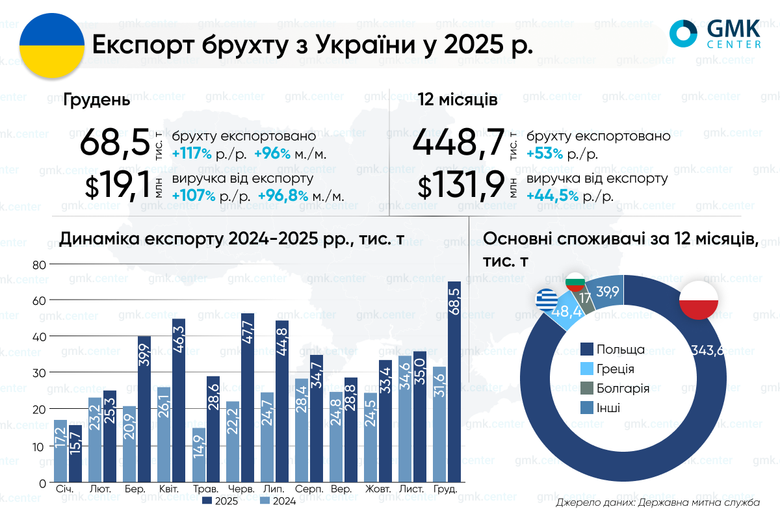
By the end of 2025, Ukrainian scrap metal exporters increased shipments of this strategic raw material by 53% year-on-year, reaching 448.68 thousand tonnes.
This is the highest level in four years, since 2021, according to GMK Center data based on statistics from the State Customs Service, PromPolitInform reports.
Poland remained the main export destination. Over the year, 343.6 thousand tonnes were shipped there, accounting for 76.6% of total exports and representing a 38.2% increase compared to 2024.
Exports to Greece amounted to 48.44 thousand tonnes (+41.7% y/y), to Bulgaria — 16.63 thousand tonnes (+419% y/y), while shipments to Germany totaled 5.29 thousand tonnes (-18.9% y/y).
In particular, in December, Ukrainian scrap collection companies exported 68.52 thousand tonnes, up 117% year-on-year and 96% month-on-month. This was the highest monthly figure since 2021.
Export revenues in December rose to $19.14 million, up 96.8% compared to November and 106.9% year-on-year. For the full year 2025, export revenues increased by 44.5%, reaching $131.93 million.
In the fourth quarter, export volumes totaled 136.84 thousand tonnes (+50.8% y/y), while revenues reached $38.36 million (+44.2% y/y).
As previously noted by Ukrmetalurhprom, exports of Ukrainian scrap metal to the EU have effectively turned into a scheme to avoid paying the €180 per tonne export duty, as the raw material is subsequently re-exported from EU countries to Turkey and India.
At the end of 2025, the government decided to temporarily restrict scrap metal exports until the end of 2026. Prime Minister Yuliia Svyrydenko emphasized that scrap metal is a critically important raw material for Ukraine’s metallurgical and foundry industries.
According to her, despite the export duty, scrap exports continued to grow, mainly due to transit to third countries without creating added value within Ukraine.
Domestic processing, by contrast, creates jobs, generates tax revenues, and supplies metal products needed for defense and reconstruction. In addition, the use of scrap metal in metallurgy significantly reduces CO₂ emissions, in line with EU environmental requirements.
“During wartime, it is important that strategic resources work for the country rather than being exported abroad. Licensing and quotas allow scrap metal to be directed toward the needs of Ukrainian production, defense, and reconstruction. This means jobs, taxes, and finished products within Ukraine. Such an approach helps maintain economic resilience during a difficult period,” said Deputy Minister of Economy Vitalii Kindrativ.
As reported earlier, in 2024, Ukraine exported 293.2 thousand tonnes of scrap metal, 60% more than in 2023. In 2023, exports exceeded 182.5 thousand tonnes (a 3.4-fold increase y/y), while in 2022 exports totaled only 54.1 thousand tonnes. The main buyers in 2024 were Poland (248.6 thousand tonnes), Greece (34.2 thousand tonnes), and Germany (6.5 thousand tonnes).
Photo: open sources