
The National Bank of Ukraine decided on March 2 of this year to withdraw banknotes in denominations of 1, 2, 5 and 10 hryvnia of samples of 2003-2007 from cash circulation, they are replaced with the corresponding circulating coins.
From this date, these banknotes will cease to be means of payment, reported in the press service of the National Bank of Ukraine (NBU), informs thePromPolitInform portal.
“They cannot be used in cash payments, and all retail chains, service enterprises, banks and financial institutions will not accept them for payments for goods, services and payment transactions,” the National Bank said.
At the same time, citizens will be able to exchange banknotes in denominations of 1, 2, 5 and 10 hryvnia and after this date, but only in banks:
️ in all branches of banks of Ukraine – within a year from the date of their withdrawal from circulation, until February 26, 2027 inclusive;
️ in authorized banks (“Oschadbank,” “PrivatBank,” “Raiffeisen Bank,” “FUIB”) – within three years from the date of their withdrawal from circulation, until February 28, 2029 inclusive;
️ at the National Bank – now indefinitely.
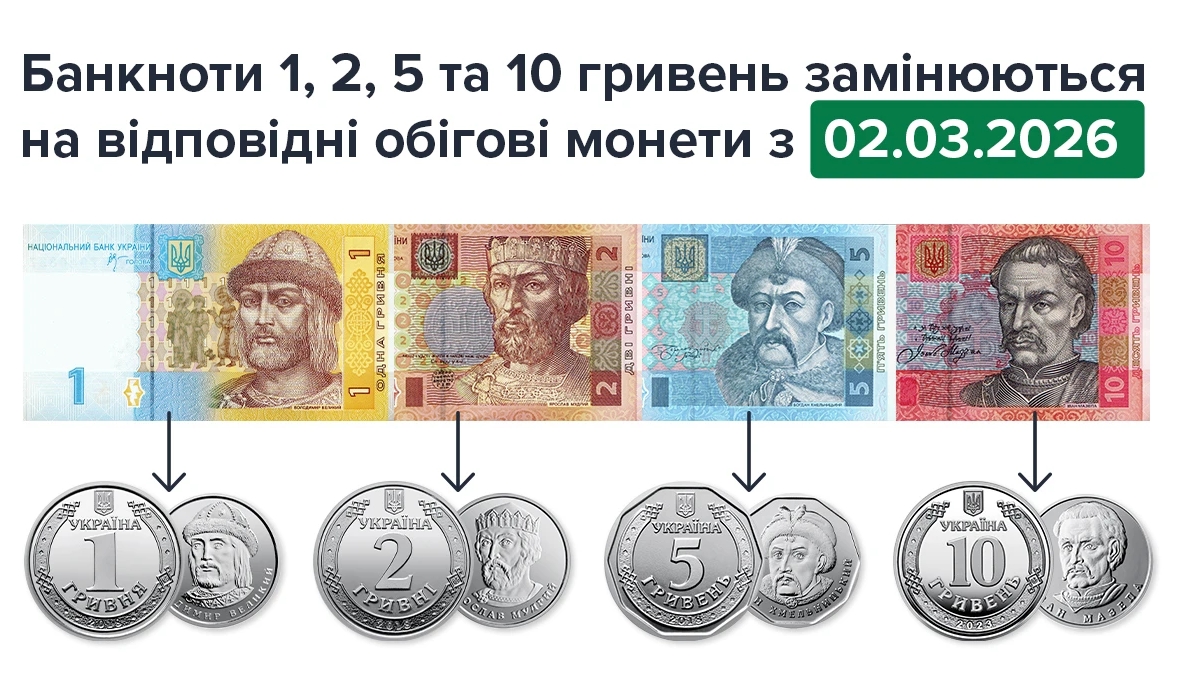
Why are hryvnia banknotes withdrawn from circulation?
The National Bank explains that banknotes in denominations of 1, 2, 5 and 10 hryvnias are now almost never found in the retail trade, citizens are almost not calculated by them.
In addition, the average shelf life is about 2.5 years. That is, in fact, the banknotes of these denominations, which still remained in circulation, are worn out.
At the same time, circulating coins in denominations of 1, 2, 5 and 10 hryvnias have been in circulation for many years. The duration of circulation of coins is 20-25 years.
“The transition to settlements with appropriate circulating coins is already familiar to citizens, it does not create inconvenience for them, at the same time it benefits the state, banks, and retail chains,” the NBU said.
In particular, it contributes to:
reducing the costs of the state and participants in cash circulation for the processing, transportation, storage and circulation of such banknotes;
improving the quality of cash in circulation, taking into account the deterioration of such banknotes, which have been in circulation for almost 23 years, in particular for almost eight recent years, simultaneously with coins of the corresponding denominations;
improved convenience of cash payments for the population and business.
As reported, from October 1 last year, the National Bank began to gradually withdraw coins with a face value of 10 kopecks from cash circulation. Therefore, only a bargaining chip with a face value of 50 kopecks will remain in circulation.
Photo – NBU