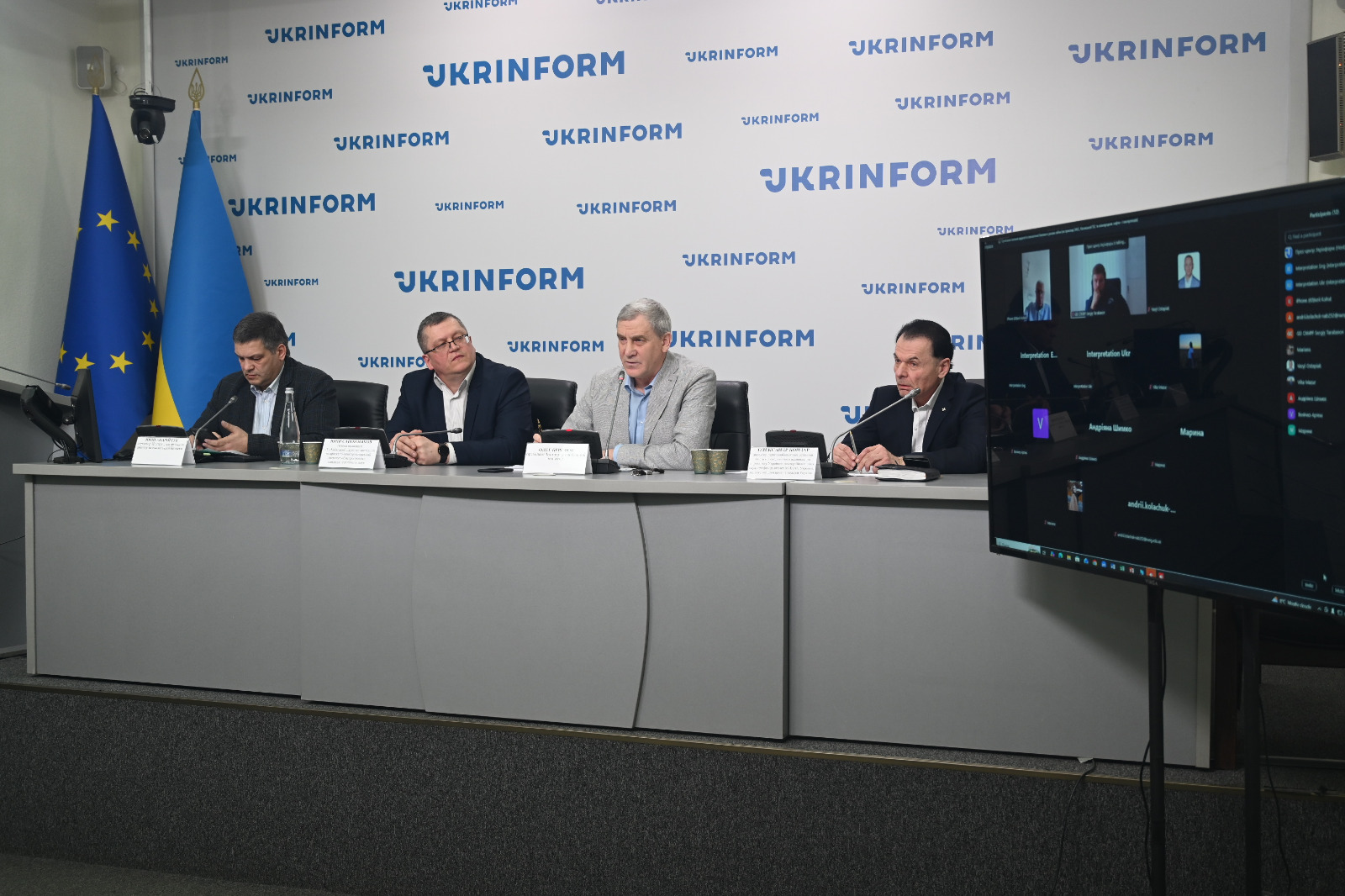
Four years ago, on March 4, 2022, Russian troops seized the Zaporizhzhia Nuclear Power Plant—the largest nuclear power plant in Europe. Since then, it has remained under occupation. During this time, a new type of threat has emerged globally—one for which the international security system proved unprepared. This was the focus of a press conference titled “Problematic Issues of Nuclear and Environmental Safety in Wartime Conditions”, held in Kyiv on March 17, 2026.
This was reported by the NGO Institute of Global Policy, which organized the event, according to the Prompolitinform portal.
A Principle That No Longer Exists
The Director General of the Chernobyl Nuclear Power Plant, Serhii Tarakanov, began his speech by stating facts that set the tone for the entire discussion:
“On February 24, 2022, the Chernobyl Nuclear Power Plant became the first nuclear facility in world history to be seized by military force. That was the moment when a fundamental international principle was broken—that nuclear facilities are inviolable.”
The occupation of the plant lasted 36 days. Staff worked at gunpoint, without proper rotation. The shift that was on duty at the moment of capture lasted 600 hours. According to Tarakanov, this experience served as a testing ground for the aggressor before the seizure of the Zaporizhzhia plant.
“I am convinced that if the world’s response back in February 2022 had been immediate and firm, we would not be facing four years of occupation of the Zaporizhzhia plant today,” he emphasized.
Tanks Near Reactors
The Chairman of the Board of the Research Institute “Energoproekt,” Yurii Sapozhnikov, described the events at Zaporizhzhia NPP in the early days of the invasion as an unprecedented nuclear threat.
The VVER-1000 reactor units were designed to withstand maximum external impact such as the crash of a light aircraft—nothing more. Instead, military equipment fired directly at the reactor units.
Sapozhnikov once commissioned a calculation of the probability of damage to the reactor cores. The result was alarming:
“The probability of core damage is usually calculated as once in a million years. But in the situation at the Zaporizhzhia plant, this probability rose almost to one. That means—it could happen at any moment.”
He attributes the avoidance of catastrophe primarily to the resilience of the plant personnel. However, he insists the aggressor state must be held accountable for creating such risks.
He also noted that the Zaporizhzhia NPP cannot function properly without the Kakhovka Hydroelectric Power Plant, destroyed in June 2023. Still, any ceasefire could affect the situation:
“We must create as many obstacles as possible—both physical and legal—to prevent this plant from operating in the interests of the aggressor state.”
One Drone and €1.5 Billion
The Chernobyl Nuclear Power Plant, often seen as a closed chapter in history, remains an active risk zone.
Tarakanov reported that on February 14, 2025, a Russian Shahed-type drone struck the New Safe Confinement—the protective arch built with international funding totaling at least €1.5 billion. The strike caused a fire that lasted several weeks, and the confinement lost its airtightness. This was confirmed by a mission of the International Atomic Energy Agency in November 2025.
Inside the shelter are hundreds of tons of fuel-containing materials—solidified lava made of melted fuel, concrete, and metal, as well as a full range of transuranic isotopes, including plutonium. Over time, these materials turn into fine dust that cannot be contained by standard filters. If the shelter is destroyed, a radioactive cloud could rise into the atmosphere.
“Every night we observe enemy drones and missiles flying over the exclusion zone. Any one of them could veer off course and hit our facilities. If 1986 taught us anything, it is that radiation recognizes no borders,” Tarakanov said.
IAEA Without Proper Leverage
Another key topic was the role of international institutions. Sapozhnikov described the International Atomic Energy Agency as having effectively become a mediator for information exchange between conflicting parties—largely because Russia can significantly influence the agency’s structure.
Tarakanov disagreed that the IAEA has no tools at all, but noted it is not using them effectively. In his view, nothing prevents the agency from initiating Russia’s removal from the Board of Governors or imposing sanctions on Rosatom for facilitating the occupation of Zaporizhzhia NPP.
Meanwhile, IAEA Director General Rafael Grossi attended ceremonial events at a Hungarian nuclear plant alongside the head of Rosenergoatom and Hungary’s Prime Minister.
Conference participants unanimously concluded that the current international control system is failing in its primary function:
“Without real enforcement mechanisms, the idea of the peaceful atom turns into an instrument of military blackmail,” Tarakanov summarized.
Kakhovka HPP and the Scale of Environmental Disaster
The Director of the “Institute of Environmental Restoration and Development of Ukraine,” academician Oleksandr Bondar, outlined the environmental consequences of the war.
At Zaporizhzhia NPP, 18,000 fuel assemblies are stored—nine times more than were at Chernobyl in 1986. In the event of an accident, the critical contamination zone could reach 30,000 square kilometers.
Due to the destruction of the Kakhovka HPP, 600,000 hectares of agricultural land have lost irrigation. Seawater is displacing underground freshwater sources and salinizing them. Over time, this could lead to desertification in southern Ukraine—the country’s main grain-producing region.
He also mentioned Zhovti Vody, Ukraine’s first uranium mining site, where at least 35 million tons of uranium waste have been stored since 1947. The storage site lies just 700–800 meters from the Dnipro River. A missile strike there could cause massive radioactive contamination of the river.
“Humanity Will Not Forgive Another Chernobyl”
Participants announced preparations for an international scientific and practical conference on nuclear and environmental safety, involving Ukrainian and international experts. The resulting collection of reports will be submitted to government authorities and foreign missions.
“Nuclear safety is not guaranteed once and for all. It is daily work at all levels—from engineering to political. Humanity will not forgive the nuclear community another Chernobyl,” Tarakanov concluded.
Author: Oleh Makhno, NGO Institute of Global Policy
Photo: by the author