The attempt to take Kyiv in three days failed, and now the Kremlin is promising to destroy Poland in the same amount of time. Russian presidential aide Nikolai Patrushev claimed that Russia could wipe out Polish statehood in two to three days in the event of a war with Poland. According to him, Moscow would use its “entire arsenal” of available forces and resources in such a scenario. Patrushev was quoted by Russian media on September 15, 2026.
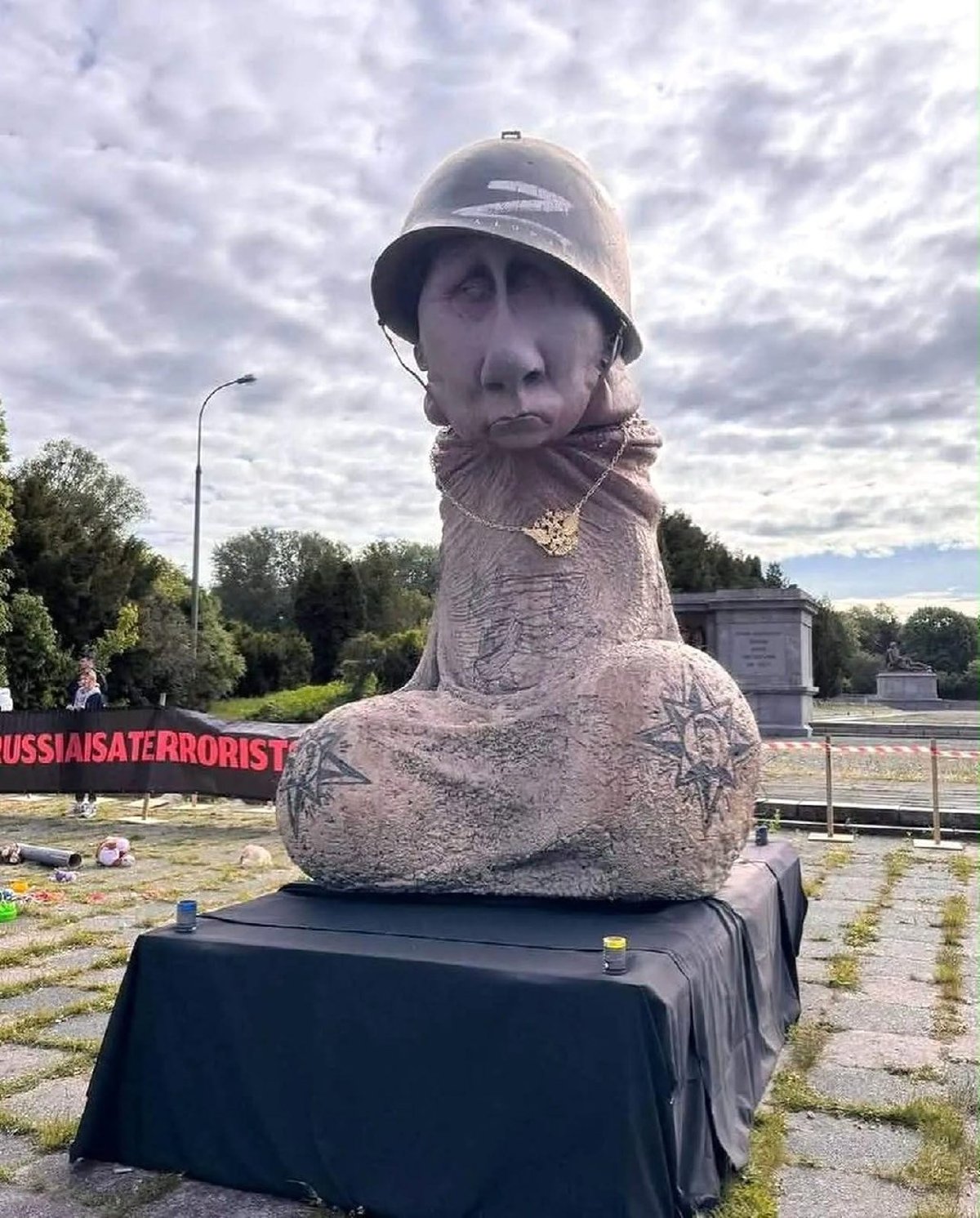
In the meantime, Poland is arming itself, and a parody sculpture of Putin in Warsaw explains the true cost of Russian “greatness” without needing many words.
This was written by Ivan Arefiev specifically for the PromPolitInform portal.
Such a sculpture does indeed exist. On May 9, 2025, near the entrance to the mausoleum cemetery for Soviet soldiers in Warsaw, Lithuanian artist Martinas Gaubas unveiled an anti-Putin installation over two meters tall with the telling title “Chujlo”.
This is not a permanent city monument, but an art project organized in response to the Russian ambassador’s latest attempt to hold a Kremlin-style “pobedobesie” (victory mania) ritual there.
The sculpture is executed in a brutally blunt manner: Putin is depicted as a phallic symbol, wearing a helmet, with disproportionately small eyes and ears and a long nose. The meaning is clear without a tour guide: the dictator refuses to see the truth, does not want to listen to the world, and is constantly sticking his nose where it definitely doesn’t belong.
The artist worked on the sculpture for nearly two years. And it seems he predicted not only Putin, but the entire style of modern Russian diplomacy.
Because now, it would be appropriate to add a plaque to this installation featuring Nikolai Patrushev’s new statement:
If Poland enters the war against Russia, Polish statehood would allegedly cease to exist in two to three days.
It seems the Kremlin has finally completed the modernization of its legendary “Kyiv in three days” plan. They didn’t take Kyiv, they didn’t break Ukraine, but they decided not to cancel the presentation. They simply erased the word “Kyiv” and wrote “Warsaw” instead.
Ukraine has a smaller population, a weaker economy, and does not have the protection of NATO’s Article 5. Yet, it has held out for five years, fighting and methodically destroying Russian command centers, ships, aircraft, oil depots, and military factories.
And Poland is a member of NATO that is actively rearming, purchasing modern tanks, aircraft, artillery, and air defense systems. Behind it stands the entire North Atlantic Alliance, whose combined military and economic capabilities Russia would be better off not testing in practice.
But the Kremlin has long lived not in a world of military mathematics, but in its own theater of threats.
Patrushev claimed that Poland allegedly wants to seize the western regions of Ukraine. Putin called the western Polish lands a “gift from Stalin.” Medvedev has fantasized about redrawing Poland’s borders and has traditionally reached for the nuclear button—though mostly in his own phone.
In the Kremlin’s repertoire, everything is stable: Poland will soon disappear, NATO will collapse, Europe will freeze, Ukraine will capitulate, and Russia will defeat everyone.
The dates are constantly pushed back, but they keep selling tickets to the show.
In reality, Patrushev’s new hysteria has a very specific cause. In Warsaw, there is increasingly serious discussion about protecting the Polish-Ukrainian border, as Russian missiles and drones are coming closer to NATO territory. Poland is strengthening its border crossing defenses and is also considering options to counter aerial threats over Ukrainian border infrastructure.
The Kremlin is not afraid that Poland will “enter the war.” It is afraid that Warsaw will stop silently watching Russian weapons explode a few hundred meters from the Polish border.
That is why Patrushev is dragging out his old nuclear balalaika. When there are no convincing arguments, they threaten the destruction of a state. When there are no real victories, they promise to capture the next capital in three days. When they don’t like reality, they try to intimidate those who see it.
That is precisely why Gaubas’s sculpture turned out to be so accurate. Small eyes to avoid seeing their own defeats. Small ears to avoid hearing the truth. A long nose to stick into Ukraine, Poland, Moldova, Georgia, and generally everywhere Russia was never invited.
Patrushev most likely understands how ridiculous his statement looks. But it is not addressed to Polish generals. Its goal is to frighten Polish society, sow discord between Poles and Ukrainians, and stop decisions that could actually limit Russian aerial terror.
It will not work.
“Kyiv in three days” has already become an international meme. Now we have “Warsaw in three days.” At this rate, next week Patrushev will promise to take London by lunch, Washington by dinner, and dissolve NATO with a single stern look.
There is only one small problem: the “Kyiv in three days” operation has been going on for five years, and the losses of the Russian army in Ukraine have already reached over 1.5 million invaders.
Therefore, Russian threats to Poland are not a demonstration of strength, but a loud masking of fear. Moscow sees that Warsaw is arming itself, strengthening its borders, and reacting less and less to Kremlin blackmail.
And the sculpture should probably stay. It has turned into a universal monument to Russian foreign policy: the form is indecent, the content is repulsive, and on top sits a helmet to create the illusion of military power.
Author: Ivan Arefiev
Photo from open sources
Photo: Памятник-пародія путіну у Варшаві