Geran-4 drones have received American sensors and speeds of up to 500 km/h
The Russian military-industrial complex continues the forced evolution of unmanned systems in an attempt to neutralize the advantage of Ukrainian air defense assets. Recent intelligence data and the registration of new attacks indicate that the aggressor is shifting from the mass use of cheap disposable devices to the creation of high-tech destruction tools. The key directions of this modernization are increased speed characteristics, more complex navigation, and the use of specialized combat units.
An analysis of structural changes shows that the enemy is trying to solve two main tasks: to increase the survivability of drones when countering Ukrainian UAV interceptors and to ensure the accuracy of strikes in conditions of active electronic jamming. To achieve this, the Russians are not only modifying the airframe but also actively involving foreign electronic component bases, finding ways to bypass international sanctions.
American Sensors and the Susanin Optical System
Details about the technical equipment of the updated modification of the Geran-4 jet UAVs were reported by the Main Directorate of Intelligence of the Ministry of Defence of Ukraine on the War & Sanctions portal. The new version of the drone features the “MOK” unit, which is based on a high-precision magneto-inductive sensor PNI5GA manufactured by the American company PNI Sensor. This device operates in tandem with the SADRA inertial navigation module, reducing the drift of its gyroscopes to achieve higher autonomous flight accuracy.
In addition to magnetometers, the enemy has integrated an autonomous navigation system called “Susanin” into the vehicle’s design. As intelligence representatives reported, this optoelectronic correlation unit compares current frames from the optical sensor with a reference map pre-loaded into the computer’s memory. A similar technical solution is also used on the newest Geran-5 drones of the K5 version, which indicates the systemic implementation of the technology.
KRSN Warhead and Alabuga Import Substitution
The developers paid special attention to the destructive capability of the weapons. The Main Directorate of Intelligence of the Ministry of Defence of Ukraine noted that for guaranteed destruction of bridge crossings and overhead power line supports, the drones were equipped with the KRSN warhead. This cumulative-cutting special payload is designed to cut through corresponding metal and concrete structures with a cumulative jet during impact.
Changes also affected the power plants: instead of the Chinese Telefly turbojet engine, the updated devices are equipped with a Russian-made analog assembled at facilities in Alabuga. At the same time, the electronic control system and the rest of the components remained identical to previous generations of drones produced by Alabuga. The first test launches of Geran-4 were carried out until January 2026 from the Primorsk dronoport in the Oryol region and from the territory of the former Donetsk airport, and starting in May 2026, they began to be used for strikes against Ukraine.
Speed of 500 km/h Against Ukrainian Interceptors
The appearance of Geran-4 was a direct response by the enemy to the high efficiency of Ukrainian UAV interceptors. The intelligence report notes that previous jet versions — Geran-3 — were created on the basis of the airframe of the gasoline-powered Geran-2, but such a design could not withstand high speeds and overloads. The new vehicle received a separate reinforced airframe with improved aerodynamics, integrated wings, and a reduced number of technological hatches.
According to intelligence data, the new UAV is capable of carrying a warhead weighing up to 90 kilograms over a distance of up to 450 kilometers, climbing to an altitude of up to 5,000 meters, and accelerating to 500 km/h (300–400 km/h during maneuvering). In basic modifications, Chinese Telefly LX-WP-160 and Telefly TF-TJ2000A turbojet engines are used for this purpose.
Artificial Intelligence in the Geography of Coastal Attacks
Parallel to the improvement of the hardware part, the enemy is changing approaches to tactical planning. The use of artificial intelligence elements by the opponent for target recognition and strike planning was announced by the Deputy Commander of the Air Force of the Armed Forces of Ukraine. According to him, using special software, the aggressor calculates complex wave routes, which was confirmed during prolonged attacks on Odesa with minimal intervals.
Conducting air defense over the sea has significant specific features due to storms, dense fogs, and the enemy’s ability to maneuver freely. As the Air Force representative noted, Ukrainian units are also integrating artificial intelligence into automated turrets and using special platforms for transporting drones, which makes it possible to maintain drone duty and cover the coastal strip.
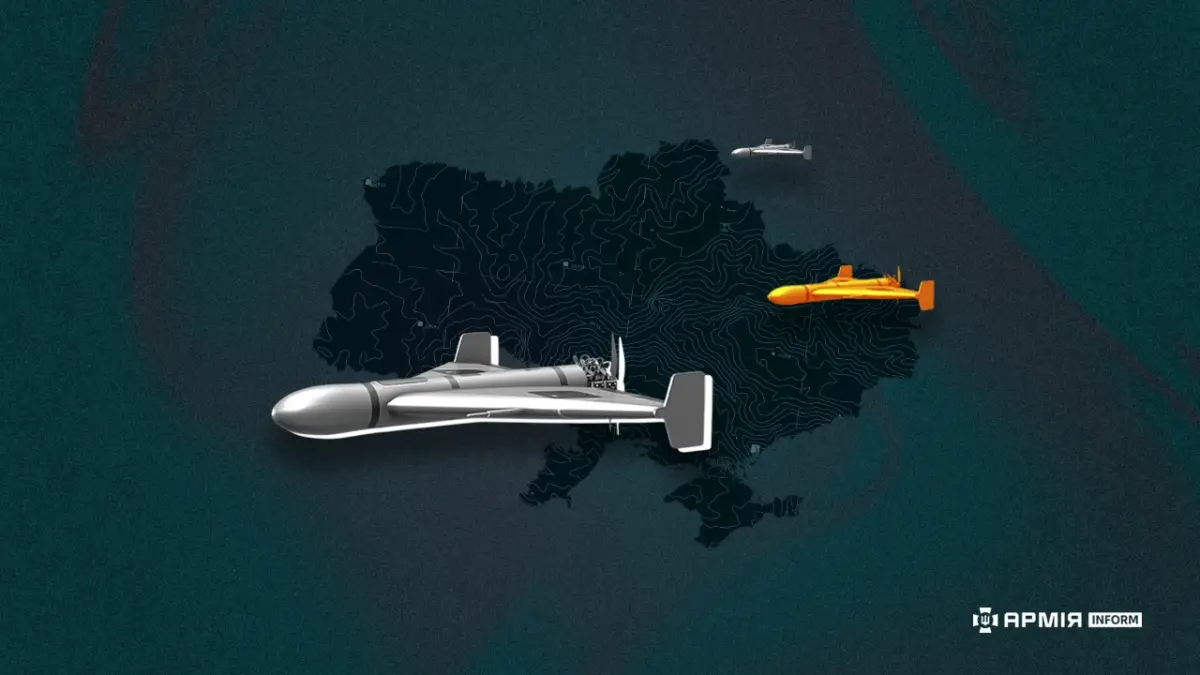
Illustrative photo: ArmyInform / CC BY 4.0
Read also: