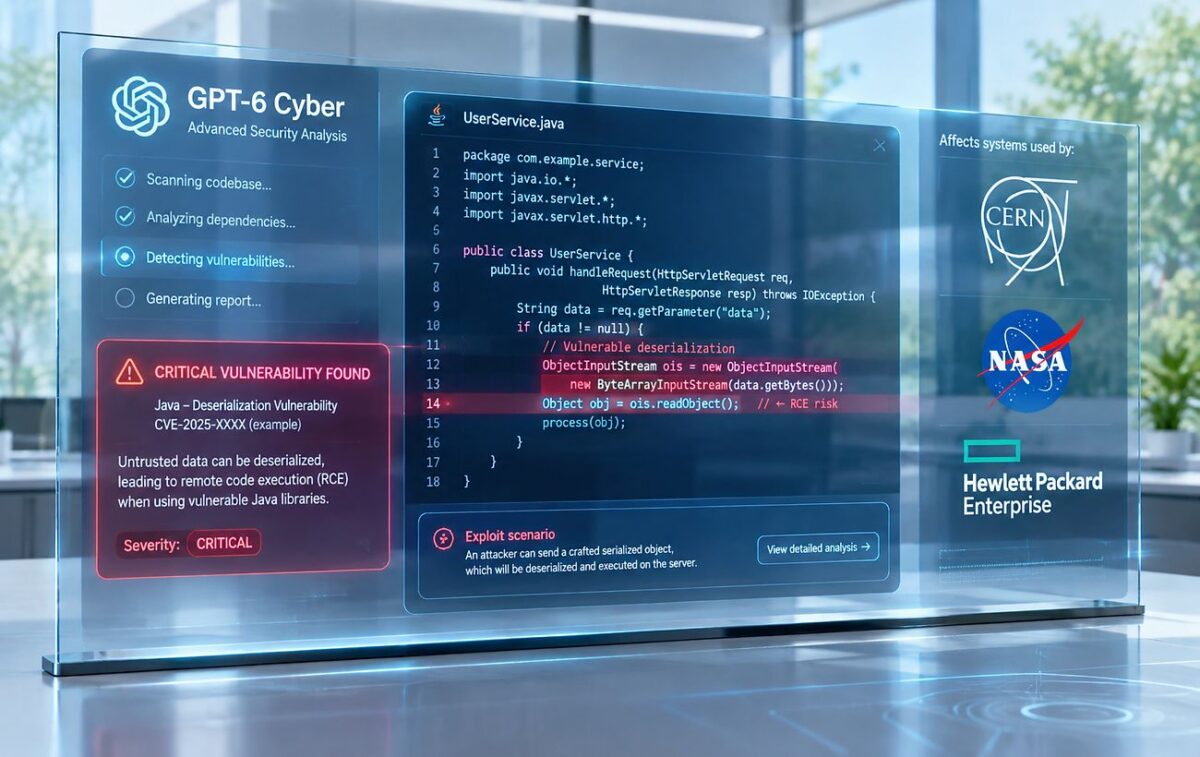
The Java4Shell flaw allows hackers to compromise systems and damage data
A critical vulnerability has been discovered in the Java programming language, identified with the help of OpenAI’s GPT-6 Cyber model. The issue affects the base64 decoder and potentially exposes systems used by NASA, CERN, and Hewlett Packard. This was reported by RBC-Ukraine (Ольга Завада) citing The York Times, according to the portal PromPolitInform.
Security researcher Kwang Luong discovered the flaw while analyzing the base64 decoding algorithm. Under certain conditions, the system incorrectly processes a specific combination of 64 ‘A’ characters and an equals sign at the end.
How the Vulnerability Works
The Calif team used AI to exploit this bug, causing memory corruption and gaining control over the system.
A test attack was successfully conducted on Keycloak, a system used for managing access to services. It is used by thousands of organizations, including CERN, NASA, and Hewlett Packard.
Response Time and Limitations
Journalists verified the attack demonstration and found it takes less than an hour to execute. Oracle has already released a patch, and CISA urged organizations to apply the update promptly.
While a large-scale attack is difficult to organize, the risk remains for legacy systems that do not receive updates for another 5–10 years.
Calif’s Second Major Discovery
The Java4Shell case marks Calif’s second high-profile finding using OpenAI tools in recent weeks. Previously, researchers discovered serious vulnerabilities in PHP, which powers about 70 percent of all websites.
Calif CEO Taing Zuong emphasized that generative models are radically transforming the workflow of both cybersecurity professionals and attackers. Tasks that once took months can now be solved by small teams in hours.
‘I don’t know how much time we have left—maybe three months, maybe three years. But right now, the best hacker is a centaur hacker,’ Zuong concluded.
Photo: RBC-Ukraine
Read also: Donald Trump justified Russian strikes on Ukraine’s civilian infrastructure