How can Kyiv maintain cross-river traffic after Russian strikes, and what could a tunnel under the Dnipro provide
The first railway bridge across the Kerch Strait was opened in November 1944. Trains were already running, although work to protect the crossing from ice was still ongoing. Three months later, on February 18, 1945, ice floes from the Sea of Azov destroyed the structure. In a single day, 24 piers and 26 spans collapsed. It was decided not to rebuild the bridge.
Ivan Arefiev writes about the history of the Kerch crossing, the design of Kyiv’s bridges, and the people who engineered them, exclusively for the Prompolitinform portal.
In May 2018, Putin opened the new Crimean Bridge for the second time in the crossing’s history, driving a KAMAZ truck. He called it a «miracle» and recalled that such a bridge had been a dream since the time of the tsars. Then-President of Ukraine Petro Poroshenko replied that the crossing would be useful to the occupiers when they eventually leave Crimea. However, it turned out that the Russian army initially used it in the opposite direction. At the start of the full-scale invasion, Russian troops crossed the bridge into Crimea and moved from there to the south of mainland Ukraine. In July 2023, Volodymyr Zelenskyy said bluntly in Aspen: «It is being used to deliver ammunition and to militarize the Crimean Peninsula».
Since October 2022, the history of the bridge has also been measured by how long it takes Russia to restore traffic. After the first major explosion, its capacity remained limited for several months. In July 2023, the road section was damaged again. Then-head of the SBU Vasyl Maliuk reported that Russia had employed ferries to transport weaponry. There were fatalities during the 2022 and 2023 attacks. In June 2025, the SBU announced a third strike. Maliuk described the bridge as a «logistical artery for supplying their troops». At the time, traffic was halted for several hours before being restored, Reuters reported, citing Russian sources.
In November 2026, the consequences were more severe. The SBU confirmed the collapse of an arch and a road span, and Reuters reported the destruction of the central section of the road bridge. After the November 17 strike, footage of a train on the bridge appeared. Following a new strike on the 19th, train traffic was stopped again. That same day, Putin claimed the railway section had been restored, calling the bridge an «exclusively peaceful object» and threatening Ukraine with a «much more painful» response. As of now, open reports confirm the collapse of a road span and disruptions to the railway. It remains unclear from these reports how many trains the crossing can handle following the latest strike.
Here, Ihor Kolomoisky entered the conversation from the courtroom. On November 18, he brought up Kyiv’s North and South bridges. He claimed ours were «built under the Bolsheviks», while the Crimean one was built by the Rotenbergs. «Ours were opened by the evening, while the Crimean one is unlikely to open again», he said. He added that if the second arch falls, «the Sea of Azov will become a lake». This is where the 1944 bridge comes to mind: it was also built under the Bolsheviks, and it did not survive its first winter. In Kyiv, the North Bridge was partially opened on November 8 after an inspection of the structures. At the same time, the city was preparing for reversible traffic on the Paton Bridge. This is the substantive conversation: how much traffic can be restored and how can other trips be maintained.
Kolomoisky recalled the era, but I would recall the names. The Paton Bridge is a beam bridge: its spans rest on piers, and the steel elements are connected by welding. Yevhen Paton was born in Nice, studied in Dresden, and in Kyiv, nearly at the age of sixty, he created the Electric Welding Laboratory. He passed away a few months before the bridge opened in 1953. Among the engineers was Oleh Shumytskyi. In 1942, he volunteered for the front, was wounded, and after the war worked on restoring destroyed crossings. Later, he also contributed to the design of the Chernobyl «Sarcophagus».
The North and South bridges are cable-stayed: the main spans are held by steel cables stretched from pylons. Both projects were led by Kyiv engineer Heorhiy Fuchs. He started in production and later received four state prizes for four bridges. Kyiv residents know three of them without a hint: the North, South, and Metro bridges. The fourth one crosses the Daugava River in Riga.
The main span of the Podilsko-Voskresenskyi crossing is arched: the deck is suspended from a steel arch. The Kerch Bridge has a combined design. Most spans rest on piers, while separate steel arches for the road and railway were erected over the shipping channel. When Kolomoisky speaks of the Rotenbergs, he refers to the contract: the general contractor was Arkady Rotenberg’s company Stroygazmontazh. That is why, after news of an arch collapse, one should immediately specify which part of the crossing is meant: the road or the railway.
Two days after Kolomoisky’s remarks, on November 20, Vitali Klitschko reported damage to the Darnytskyi and South bridges and the Podilsko-Voskresenskyi crossing. The mayor asked Kyiv residents not to use private cars unless absolutely necessary. Among the hit objects, Zelenskyy named bridges across the Dnipro, the railway, and the energy infrastructure. Whether the November 20 attack was a «retaliation» for the Kerch Bridge is not confirmed by open sources. Russia’s capacity to damage several Kyiv crossings in one attack has already been confirmed.
And this, to me, is the main question for Kyiv. Imagine a typical morning after an attack. On one bank, a person is waiting for an ambulance; on the other, a nurse is trying to reach her shift. The dispatcher must already know how to change bus routes. To create such problems for the city, it is enough for the Russians to restrict traffic on several crossings for a period. Therefore, the state needs air defense systems capable of intercepting ballistics, and the city needs pre-planned reserve routes, priority for emergency services, and ready teams for inspection and repair. The plan must work from the very first morning after a strike.
This leads to the talk about the «Stalinist metro». In 1938, Kyiv began building a military railway under the Dnipro. In 1941, the war halted the work. Some concrete structures and unfinished sections remained. Nearly nine decades have passed, and on November 17, the Ministry of Infrastructure announced the start of a new project for a tunnel under the Dnipro. Minister Mykola Kalashnyk discussed it with the American company Robbins and stated: «Preparation for such a project must begin now». First, they must define the route, study the geology, and calculate the cost.
I would begin the preparation now. And before making a decision on construction, I would ask the designers a simple question: how many people will the tunnel carry per hour if several bridges are operating with restrictions simultaneously? This leads to the conversation about who should be given priority, how much maintenance will cost, and how the tunnel will operate during power outages. The old structures under the Dnipro are interesting as history. A new crossing makes sense only if it is capable of moving people daily and taking on part of the traffic during the most difficult days.
In 1944, a train was already running across the Kerch Strait while the work that determined the bridge’s fate remained ahead. Kyiv has much to learn from this history. While engineers calculate the future tunnel, the city must already know how it will transport people from one bank to the other tomorrow morning.
Author: Ivan Arefiev
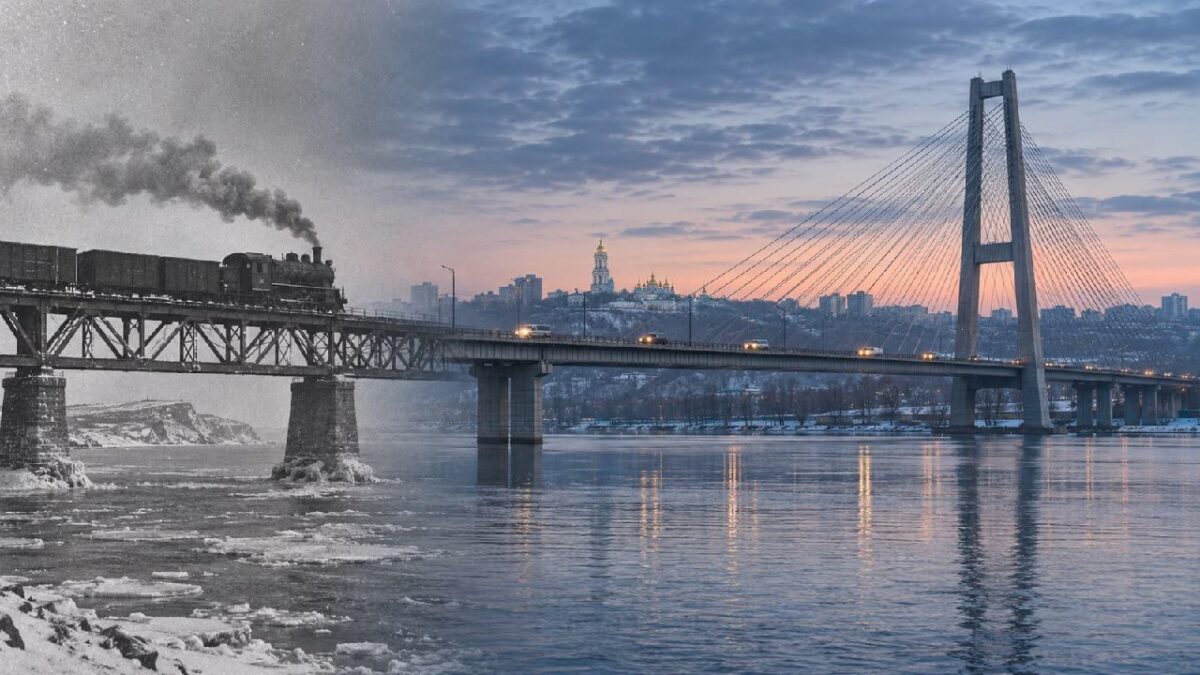
Photo: On the left — an artistic reconstruction of the Kerch crossing in 1944; on the right — a bridge in Kyiv at dawn.
Read also: Up to 300,000 Russian troops could face operational encirclement in Crimea