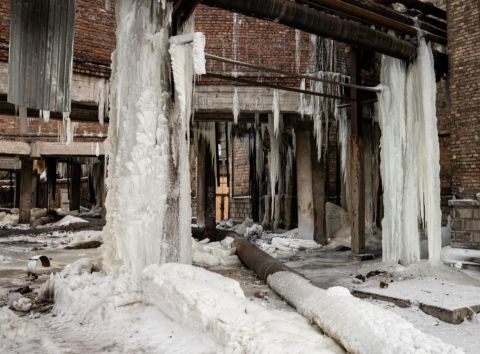
Following the Russian strike on February 3, one of the capital’s key heat-generating plants, the Darnytsia Thermal Power Plant (TPP), suffered critical damage. According to preliminary estimates, full restoration will take at least two months, assuming no further attacks. As reported by life.kyiv.ua, Kyiv Mayor Vitali Klitschko announced the timeframe and consequences. The portal PromPolitInform reports.
What happened and why is it critical for the city
The Darnytsia Thermal Power Plant (TPP) provided heat to more than 1,100 multi-story buildings in the Darnytskyi and Dniprovskyi districts. After the strike on the morning of February 3, water was urgently drained from the heating systems in these buildings to prevent the networks from freezing in the freezing temperatures.
This means that some housing will remain without centralized heat until the CHP is repaired, and in some buildings, until the end of winter.
How long will the restoration of the Darnytsia TPP take?
According to the mayor, the minimum duration of the work is two months. This isn’t just a cosmetic repair, but rather the restoration of critically damaged equipment operating under heavy loads.
The key risk is repeated shelling, which could delay the launch.
Which districts were hit the hardest?
Darnitsky and Dniprovskyi districts
Most of the homes connected to the Darnitsa Thermal Power Plant are concentrated here. In a number of neighborhoods, heat cannot be restored until restoration work is completed.
City authorities have published a list of homes where heat will not be restored until the plant is repaired.
How Kyiv is supporting people without heat
Warming stations in schools
Additional warming stations have been deployed in educational institutions in the neighborhoods left without heat:
5 stations in the Darnitskyi district;
4 stations in the Dniprovskyi district
(in addition to those previously operating).
These locations are connected to mobile boiler houses and operate 24/7.
SES stations
The SES is separately deploying:
36 warming stations in Darnitsa;
27 locations are in the Dniprovskyi district.
Current addresses are available on the websites of district administrations, city authorities, and the State Emergency Service.
Electricity as Partial Compensation
To alleviate the heat shortage, DTEK is introducing flexible power supply schedules for homes in the Darnytskyi and Dniprovskyi districts. This allows for:
use of electric heaters;
charging devices;
maintaining basic household needs.
What does this mean for Kyiv as a whole?
The damage to the Darnytskyi CHPP is not a localized accident, but a blow to the heating system of a large metropolis. The situation demonstrated:
the vulnerability of large heating facilities;
the limited availability of alternative heat sources;
the critical role of heating points and mobile boiler houses.
For the city, this is yet another argument in favor of decentralizing heating and developing backup solutions.
The Darnytskyi CHPP will not be restored quickly—Kyiv residents in two districts will have to live without centralized heat until at least spring. The city is deploying warming stations, schools and the State Emergency Service are working in an enhanced mode, and energy companies are adjusting their power schedules. But this winter once again reminds us: for Kyiv, warmth is not a matter of comfort, but a matter of the city’s security and sustainability.