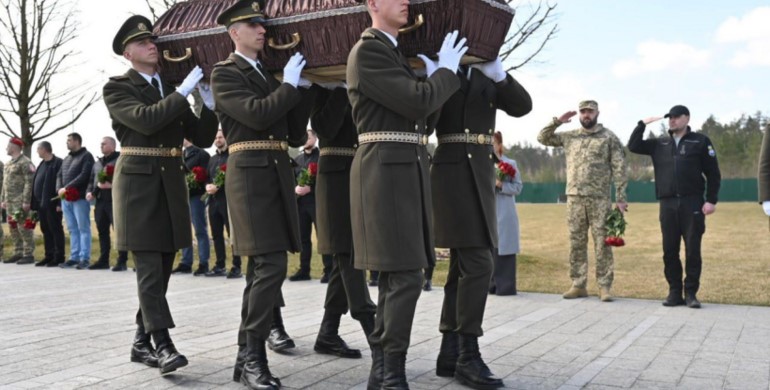
The new law was developed for the families of the military, who were declared dead by the court due to the lack of a body.
On May 13, 2026, the Parliament adopted the Law on the introduction of a military farewell ritual (No. 15029), 273 people’s deputies voted for, the Parliament’s press service said, the PromPolitInform portal informs.
The law, initiated by Prime Minister Yulia Sviridenko, concerns the memory of the military who defended the sovereignty of Ukraine and were declared dead by the court, despite the lack of a body.
“Since the current statute provides for the giving of honors only during burial or reburial, the new document introduces a separate military farewell ritual,” the parliament noted.
The text states that the military farewell ritual is a procedure for the solemn giving of military honors at the site of the symbolic grave – the cenotaph – to the military, who defended the independence, sovereignty and territorial integrity of Ukraine, and declared dead by the court.
The decision to hold or refuse to hold a military farewell ritual is made by relatives or relatives of the military who have pledged to build a cenotaph.
As during the funeral ritual, the farewell provides for the participation of the post (honor guard), which includes:
→ head of the post office;
→ trumpeter and drummer (military band);
→ farewell team (six servicemen);
→ salute team (three servicemen);
→ flag-bearing group with a state flag with a mourning ribbon.
During the ritual, the salute team makes three volleys with blank rounds. The head of the post should hand the folded flag to a relative or other close person of the military.
If necessary, the clergyman can perform a religious ceremony.
Reference: Cenotaph (from the Greek. kenos – empty and taphos – grave) is a symbolic grave, monument or tombstone that is installed in a place where the body of the deceased (deceased) is absent.
Thus, warriors whose remains are not found or identified (for example, missing persons who died at sea, in fires or on battlefields), as well as persons whose bodies were lost in disasters or natural disasters are honored.
Unlike an ordinary grave, there is no burial place under the cenotaph – it is a symbol of memory, sorrow and eternal respect for those whose body did not return home.
Photo – from open sources