For decades, russia has called artillery the “god of war.” It was massive artillery fire that was supposed to ensure the advance of the occupation army and destroy Ukrainian cities. But in the fifth year of full-scale war, this “god of war” is falling silent more and more often.
Ivan Arefyev writes about this for the Prompolitinform portal.
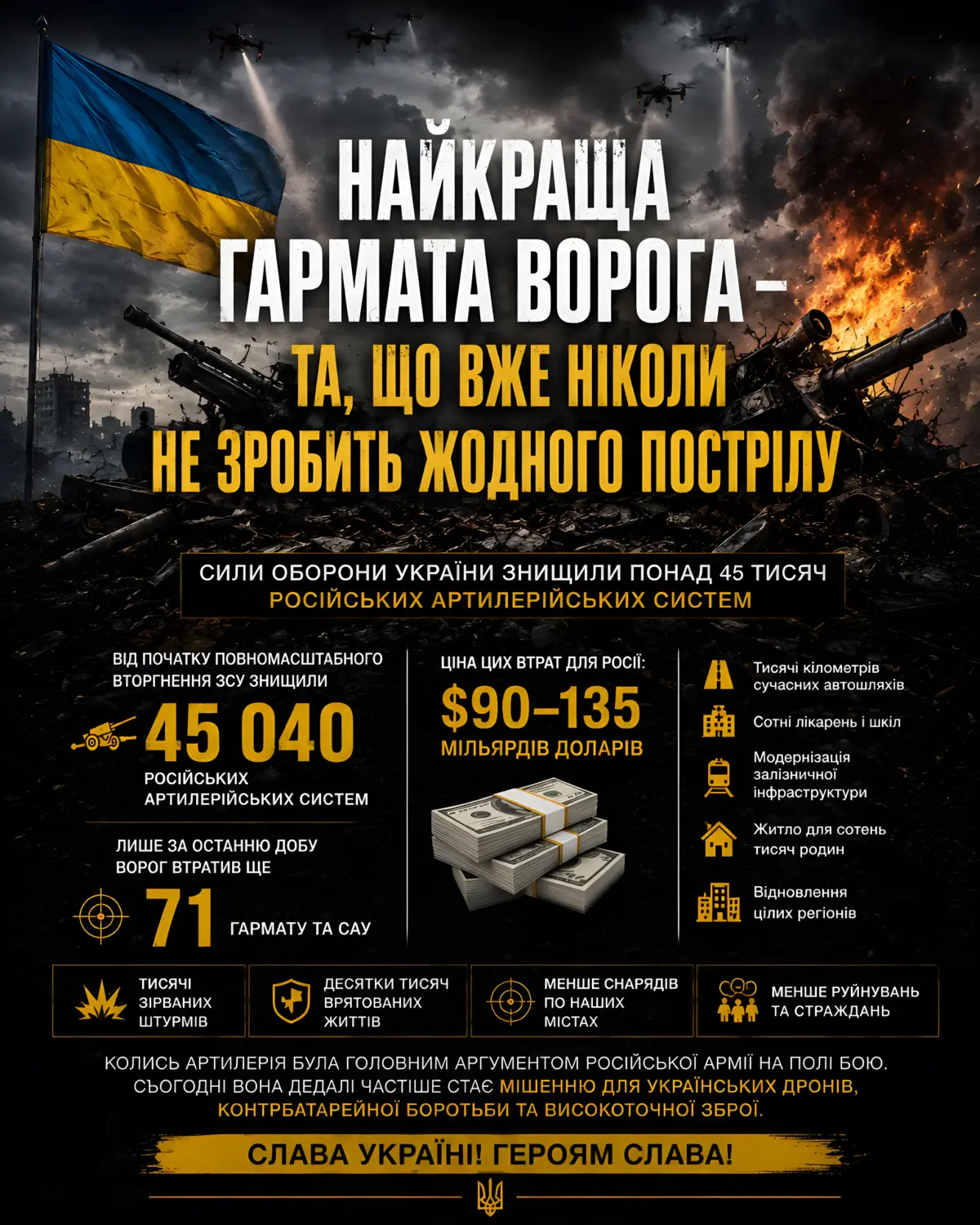
As of June 30, 2026 – the 1,588th day of war since the beginning of russia’s full-scale invasion of Ukraine – the Defense Forces of Ukraine, according to the Ukrainian General Staff, have destroyed 45,040 artillery systems of the russian army. In the last 24 hours alone, the enemy lost 71 guns.
Over 45,000 destroyed russian guns are not just a number in a daily report. These are thousands of thwarted enemy assaults, failed artillery preparations for attacks, tens of thousands of lives of Ukrainian military personnel and civilians saved. And yet another proof that technology, professionalism, and resilience of the Defense Forces of Ukraine can significantly reduce the capabilities of the russian occupation army and change the course of the war.
The cost of these losses for russia is also staggering. Even by conservative estimates, if the average cost of one artillery system is calculated within the range of $2–3 million**, the destruction of **45,040 guns and self-propelled artillery units** has cost the russian military budget at least **$90–135 billion US dollars. And that is only the cost of the systems themselves – excluding ammunition, repairs, logistics, transportation, crew training, and production restoration.
Statistics of losses of artillery systems of the russian army in 2022-2026
| War Year | Number of russian artillery systems destroyed per year |
|---|---|
| 2022 | 2,021 units |
| 2023 | 6,461 units |
| 2024 | 13,050 units |
| 2025 | 14,110 units |
| 2026 (as of June 30) | 9,398 units |
The absolute daily record for destroying russian artillery systems was set on March 27, 2025 – when the Defense Forces of Ukraine eliminated 122 units of enemy artillery. This happened during the most extensive month of counter-battery warfare, when in March 2025, 1,644 guns were destroyed.
Based on official reports from the Ukrainian General Staff, a top-5 days ranking has been compiled for the highest number of enemy artillery systems destroyed per day:
-
1st place: March 27, 2025 – 122 artillery systems destroyed.
-
2nd place: April 17, 2025 – 88 artillery systems destroyed.
-
3rd place: June 7, 2026 – 85 artillery systems destroyed.
-
4-5th place: June 30, 2026 – 71 artillery systems destroyed.
-
4-5th place: June 14, 2026 – 72 artillery systems destroyed.
Statistics on the losses of the russian army indicate that the russian occupation army lost the most artillery systems in 2025 – 14,110 units. However, data for the 6 months of 2026 give reason to hope that this year, enemy artillery system losses could be at the level of 18,000–20,000 units (with an average daily loss of about 50–60 units).
Hypothetically, one could project that these tens of billions of US dollars could have been working for the development of russia itself. With such funds, thousands of kilometers of modern highways, hundreds of hospitals and schools could have been built, railway infrastructure modernized, hundreds of thousands of families provided with housing, or entire regions restored. Instead, the kremlin chose a different path – turning its own resources into scrap metal on Ukrainian soil. This is the price of the war that russia imposed on Ukraine and which its own society is forced to pay.
Once upon a time, artillery was the main argument of the russian army on the battlefield. Today, it is increasingly becoming a target for Ukrainian drones, counter-battery warfare, precision weapons, and the professional work of the Defense Forces of Ukraine.
The russian military-industrial complex is trying to compensate for losses by removing outdated guns from storage and restoring Soviet-era equipment. But even such rates of production and repair cannot keep up with the pace of their destruction by Ukrainian defenders. Because for the Defense Forces of Ukraine, the best enemy gun is the one that will never fire another shot.
Author: Ivan Arefiev
Collage: Andrii Atlantov