Russian Special Services Turn the Trust of Ukrainian Soldiers into a Weapon Against Them
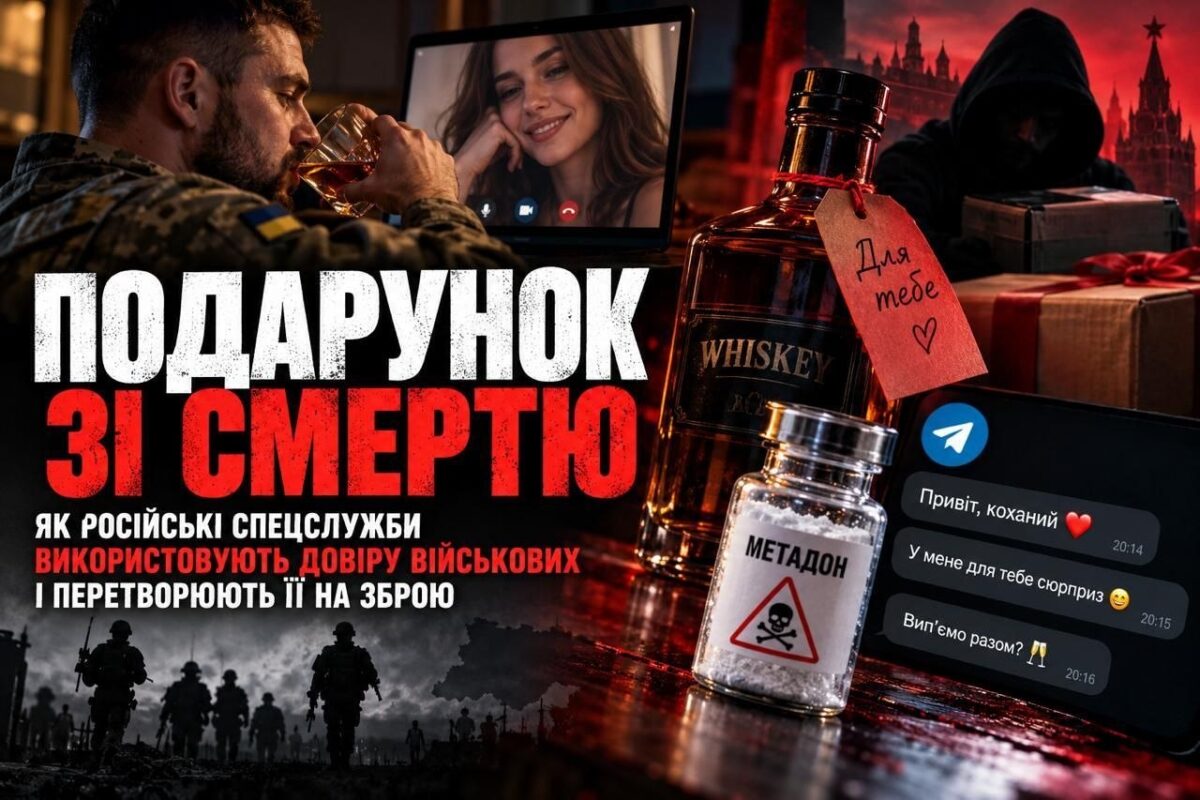
On October 30, 2026, Head of the National Police of Ukraine Maksym Tsutskiridze spoke about the death of a serviceman after consuming whiskey with methadone, sent under the guise of a gift from a girl. At the same time, similar schemes had been recorded earlier.
The war has long moved beyond trenches, dugouts, and combat positions. Today, the enemy can strike not only in the form of a missile, an attack drone, or a sabotage group. Sometimes the enemy comes through a Telegram message, a pleasant female voice, a smile on a phone screen, or an ordinary parcel.
According to Maksym Tsutskiridze, the serviceman communicated with a girl via Telegram. They regularly made video calls, although they had never met in person. Eventually, she offered a gift—a bottle of whiskey, which the man was supposed to drink during their next video chat. The drink contained methadone. It was prepared and sent by another perpetrator. The serviceman died.
The weapon was not just methadone. The weapon was trust, weaponized.
These Are No Longer Isolated Incidents
On October 23, the National Police announced the detention of a 17-year-old girl suspected of aiding in the poisoning of two servicemen in Zhytomyr Oblast. According to the investigation, she received instructions from a Russian handler, prepared capsules with narcotic substances, and sent them by mail. She was promised money for completing the tasks.
Back in August, the SBU warned about so-called “honey traps”—attempts to use personal connections to lure military personnel into dangerous situations. Thus, this is a recurring method of influence rather than a single isolated case.
What the Analysis Shows
The first factor is psychological vulnerability. A soldier may be experienced at the front, but still remain a human being who needs communication, attention, and human warmth. This is precisely what the organizers of these crimes can exploit.
The second is remote management. One participant maintains the communication, another prepares the package, and a third coordinates the actions. In a number of proceedings, law enforcement officers are checking the involvement of Russian special services.
The third is target selection. It is not necessarily about a commander or a soldier with access to classified information. The target can become anyone simply due to the fact of serving in the Armed Forces of Ukraine.
What Servicemen Need to Consider
Explanatory work within units should be strengthened. Special attention must be paid to new acquaintances in social networks, gifts of unknown origin, and offers of free substances, food, or alcohol. A separate red flag is a request to consume something during a video call or to hide the communication from others.
Caution should not turn into general distrust of people. Specific risks must be evaluated. Suspicious substances should not be tasted or checked independently; correspondence should be saved and law enforcement notified. If poisoning is suspected, 103 must be called immediately.
Conclusion
Russia continues the war not only on the battlefield. Alongside missile strikes and drone attacks, covert methods of physically eliminating servicemen are being employed. The story of the poisoned whiskey demonstrates how dangerous a prepared manipulation of human trust can be.
At the front, a soldier knows where incoming fire might come from. In a peaceful city, they do not always expect danger to arrive disguised as a gift.
Behind every such story lies not just statistics, but a dead person, their family, brothers-in-arms, and an unfinished life. A serviceman must be able to trust people. But trust must never compromise safety.
It should be noted that the circumstances of the criminal proceedings are presented according to law enforcement reports. The guilt of specific individuals is established by the court.
Author: Ivan Arefiev
Collage: Andrii Atlantov
Photo: Колаж Андрій Атлантов
Read also: Mass checks of VLK conclusions: police cancelled 6.5 thousand decisions