Relations between states and leaders of the United States and Europe at this historical juncture can be classified as traditional political disputes. However, a closer look reveals something different: not only politics is changing — the geostrategic condition of the space in which it exists is changing as well.
This was reported by ArmyUA, according to the portal Prompolitinform.
In the past, international conflicts arose around the interests of states: economy, security, resources, territories, and so on. Interpretations of events appeared only after the events themselves and explained them to society, often as political contradictions.
Today, the situation is fundamentally different. Communication-content interpretations instantly become “glocal” and themselves begin to generate event-driven conflicts and amplify processes that often exceed the scale of the original events.
Political statements on glocal digital platforms, powerful information campaigns, and public communication-cognitive reactions no longer describe reality — they shape it and often do so in a generatively aggressive manner. As a result, even existential allies experience significant tensions that previously seemed unlikely.
It is within this context that contemporary diplomatic disputes between European countries and the United States should be considered, as well as debates around digital space regulation and political reactions to internal tragedies or the radicalization of societies. Individual events become symbols of broader processes that go far beyond their immediate content.
For the first time in a long period, interpretations cease to be neutral and turn into instruments of dominant, generative influence on interstate relations. This creates a new geostrategic public reality in which political competition gradually loses its traditional boundaries — and, most importantly, its safeguards for neutralization.
Under such conditions, the key question is no longer who is right in political debates between allies. Rather, it is whether states’ actions remain within civilizational principles: respect for institutions, judicial independence, accountability for statements and positions, and limitation of power by national legislation.
When these boundaries begin to blur through the digital platforms of allies, conflicts spread faster than economic or religious confrontations. Tensions arise not from state power itself, but from a shift in the style of political behavior — when hyper-personalization, emotional pressure, and generative public campaigns replace institutional dialogue among allies.
That is why modern international public crises increasingly resemble something other than traditional national politics. They become manifestations of a broader struggle between a civilizational model based on rules and the functioning of legitimate institutions, and models that substitute them with authoritarian personal will and antagonistic mobilization of societies.
In this new geostrategic reality, politics is no longer a competition of programs or interests. From a permanent struggle between parties, as in times of political stasis, it transforms into a “last battle” over the very character of the human environment — over whether the public space will remain a space of responsibility, respect, and gratitude toward partners and allies, or become a space of exponential and permanent escalation without the possibility of return.
Within the hyper-dynamics of glocal aggression, such a public style becomes a constant state of modernity. An example can be found in the public accusations and conflicts surrounding the death of far-right activist and student Quentin Deranc, who was beaten by several masked individuals during a conference at the Institute of Political Studies in Lyon in mid-February.
As a result of public assessments of this event by leaders and institutions of the United States and Italy, France’s Ministry of Foreign Affairs summoned U.S. Ambassador Charles Kushner (a phone conversation took place during which the ambassador promised not to interfere in France’s internal affairs). French President Emmanuel Macron and Italian Prime Minister Giorgia Meloni postponed a major Franco-Italian summit scheduled for early April in Toulouse.
Therefore, the events within the France–Italy–United States triangle regarding the tragic incident in France should not be understood as isolated diplomatic incidents, but as signs of a historical transformation in which the decisive factor is not state power, but the ability of institutions to restrain power even when it is politically inconvenient or personally uncomfortable.
Conclusion
The modern geostrategic existential confrontation is increasingly defined not by the speed or completeness of political reactions. The problem lies not in delayed responses by states or leaders, but in the changing nature of the public environment itself. Collective Putinism creates communication-content traps in which interpretations of events emerge before the events themselves and compel states to react within a pre-scripted scenario shaped by extra-civilizational forces.
In such a reality, even allies may find themselves in mutual tension not because of diverging interests, but due to simultaneous reactions to artificially constructed informational impulses. Political leaders no longer set the agenda first; they are forced to act within a space where conflict is generated externally as an instrument of geostrategic dominance.
Thus, modern international disputes increasingly represent not traditional political competition, but a deeper transformation — a struggle for control over the very reality of public life. In these conditions, the decisive factor is neither state power nor the speed of reaction, but the capacity of institutions to preserve agency and maintain their own order of action within an environment of imposed reactions.
Authors: Valerii Skrypniuk, Viktor Velbyk
NGO “Center for Communication-Content Security”
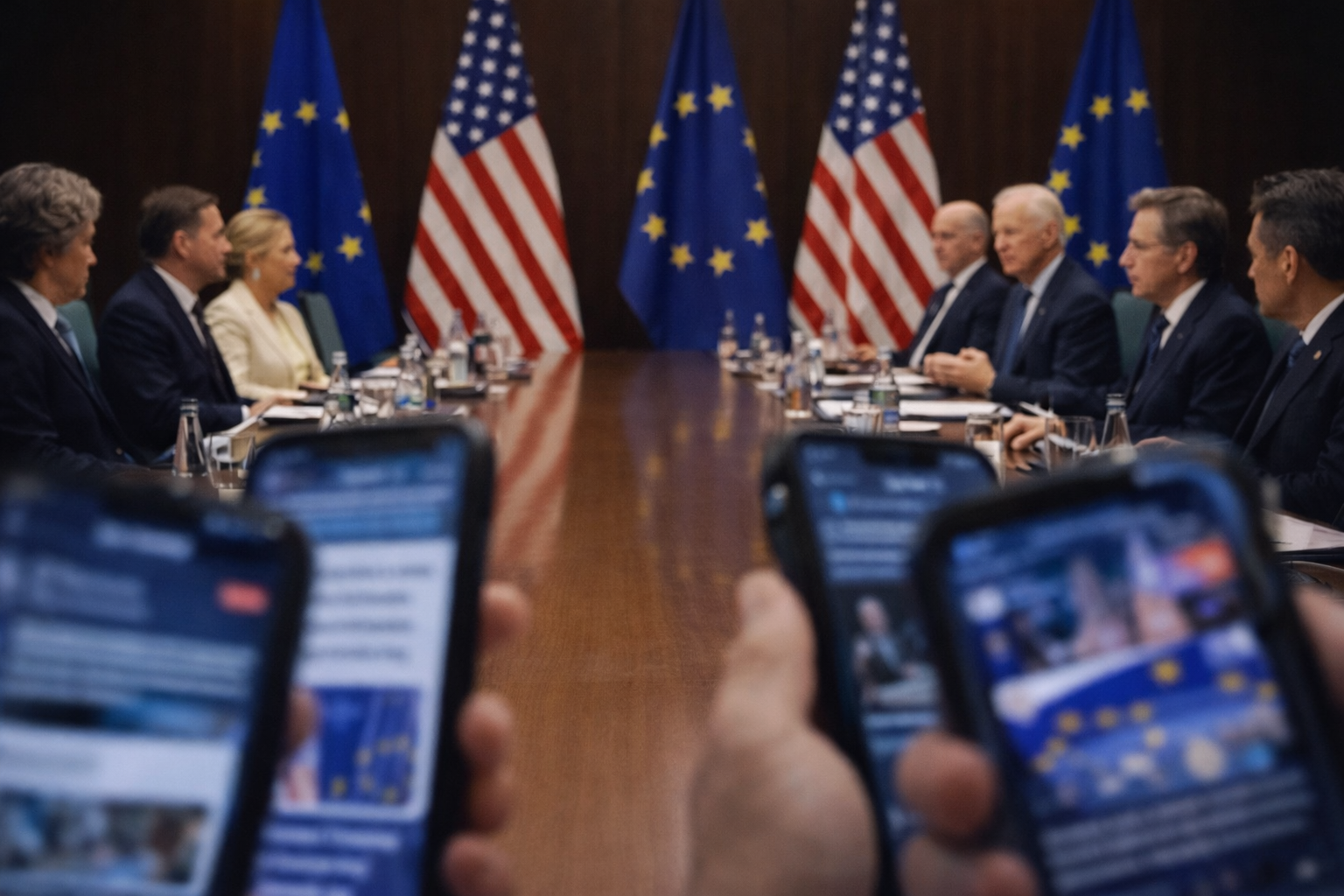
photo generated by AI