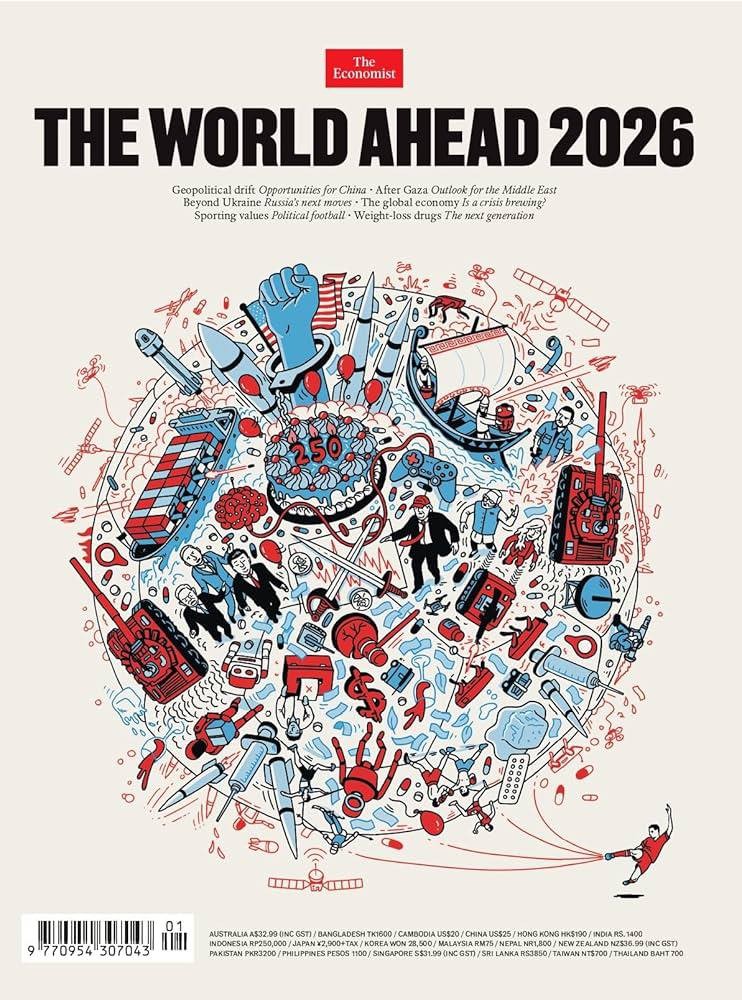
The British magazine The Economist has released its annual outlook, The World Ahead 2026, outlining key trends for the coming year, PromPolitInform reports.
According to the publication’s forecast, there will be no peace deal in the near term, the war in Ukraine will continue until at least 2027, U.S. President Donald Trump will shift responsibility for supporting Ukraine onto Europe — which may struggle to bear the burden — Taiwan could become a bargaining chip in U.S.-China relations, and the weight-loss drug market is set for renewed growth.
Analysts highlight geopolitical challenges, economic risks, and technological shifts that will shape the global agenda in 2026.
War in Ukraine
Experts estimate that Russia’s war against Ukraine will continue at least until 2027. A majority of surveyed analysts (74%) believe that no peace agreement between Kyiv and Moscow will be reached before January 1, 2027.
The magazine notes that Trump plans to transfer primary responsibility for supporting Ukraine to European allies. However, Europe may lack sufficient resources to sustain this burden. The situation is further complicated by austerity policies that could boost public support for far-right parties, particularly in France and Germany.
Middle East
The Economist suggests that a new large-scale war in Gaza may be avoided if the parties maintain a fragile balance. However, the region remains one of the most volatile in the world, and any escalation could rapidly change the situation.
Asia and Taiwan
The forecast devotes special attention to U.S.-China relations. Analysts do not rule out the possibility that Trump could sacrifice Taiwan in pursuit of a broad agreement with Beijing. Such a scenario would represent a dramatic shift in the regional balance of power and carry serious consequences for Washington’s Asian allies.
United States
No major political shifts are expected from the midterm Congressional elections. Even if Democrats gain control of the House of Representatives, Trump is expected to continue steering the country through tariff policies and political pressure.
Most “superforecasters” — analysts who rely on statistical modeling for predictions — believe that after the midterms Democrats will control the House, while Republicans will retain the Senate.
Much will depend on who replaces Jerome Powell as Chair of the Federal Reserve in May. The choice will signal whether Trump intends to preserve the central bank’s independence. Politicization of the Fed could trigger market turbulence.
According to the forecast, 98% of respondents believe Trump will not receive the Nobel Peace Prize.
Economy and Finance
The Economist warns that wealthy nations are “living beyond their means,” and the risk of a bond market crisis is rising. This could pose a serious challenge to the global financial system.
Technology and Investment
The magazine also highlights a potential “bubble” in artificial intelligence investments. If it bursts, it could cause significant shock to the global economy, as the IT sector currently remains one of the key drivers of growth.
Pharmaceuticals and Medicine
In 2026, new, more effective and affordable GLP-1–based weight-loss drugs are expected to enter the market. Unlike the popular drug Ozempic, the new treatments are anticipated to be available in pill form, significantly expanding their use.