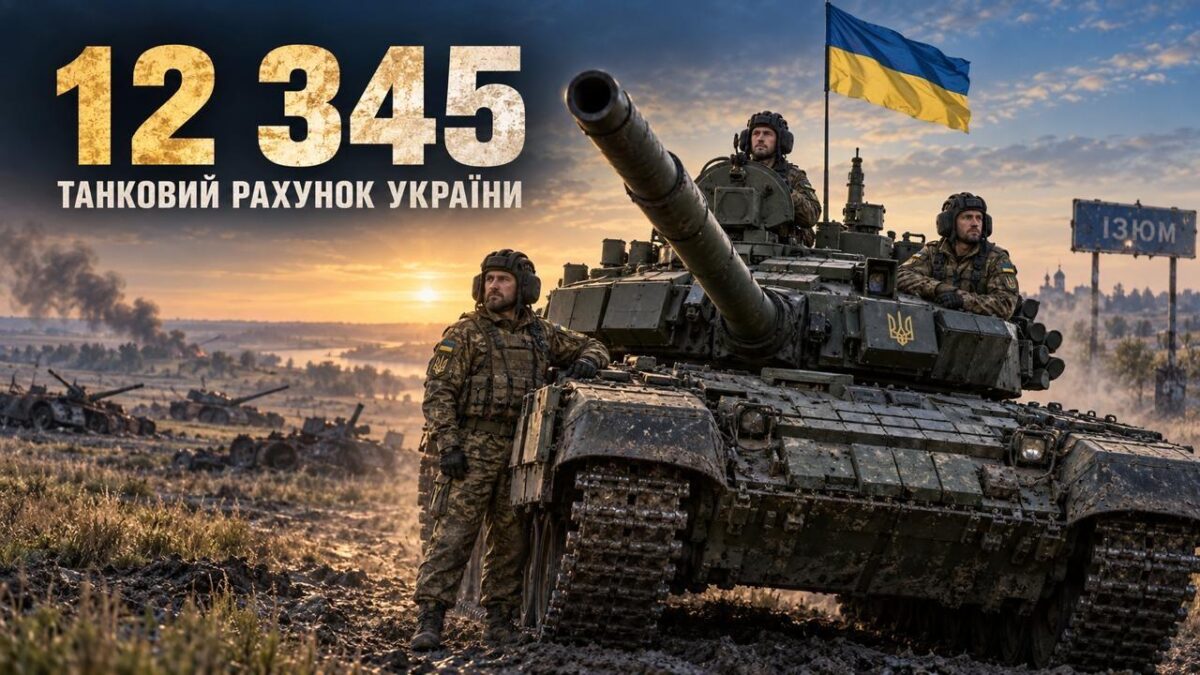
Even the numbers lined up symbolically today: 1–2–3–4–5. It looks like a brief manual for the Russian armor that entered Ukraine: arrived, got spotted, got hit — and ceased to exist.
But behind this beautiful sequence lies a reality that is far from beautiful for the enemy.
Since the beginning of the full-scale invasion, Russia has been losing an average of more than seven tanks daily. This is not just metal. These are thwarted offensives, burnt columns, smashed battalion sets, lost crews, and years of labor by the Russian military-industrial complex.
At the same time, we must be precise: the official statistics of combat losses include not only guaranteed destroyed vehicles but also tanks that were damaged, abandoned, or captured by the Defense Forces. But for the Russian command, the result does not become any more pleasant: these machines are no longer performing their assigned tasks in the ranks of the occupying army.
Why September 14
Tank Forces Day of Ukraine has been celebrated on September 14 since 2023. The new date was established by Decree of the President of Ukraine No. 574/2023.
This was a fundamental change. Ukraine abandoned the Soviet-rooted tradition of celebrating Tankman Day on the second Sunday of September. Our military holiday gained its own Ukrainian meaning, linked not to foreign myths but to the real victory of the Ukrainian army.
On September 14, 2022, the State Flag of Ukraine was raised over liberated Izyum. This became one of the main symbols of the Kharkiv counteroffensive — a rapid operation during which the Russian defense crumbled faster than Russian propagandists could redraw maps.
Ukrainian tank units played a key role in that breakthrough. They provided the pace of the advance, firepower, and development of success. During the operation, the Defense Forces captured, in particular, 77 Russian tanks.
Yesterday they were the weapon of the occupiers, and tomorrow they could work against their former masters.
That is what real military recycling, Ukrainian style, is all about.
The Tank Budget of the War
Let’s try to convert the 12,345 lost tanks from military statistics into monetary terms.
An absolutely accurate calculation is impossible. Russian losses include old T-62s, various modifications of T-72s and T-80s, more modern T-90s, refurbished vehicles from storage depots, as well as damaged and captured equipment. Their residual, production, and export values differ significantly.
Therefore, we will take three hypothetical scenarios:
-at a minimum estimate of $1.2 million per tank — approximately $14.8 billion;
-at an average hypothetical value of $2.5 million — about $30.9 billion;
-if all losses had to be replaced with modern vehicles worth about $4.5 million, the bill would reach $55.6 billion.
Thus, the estimated value of Russian tank losses can range from $15 to $56 billion.
This is not an audit report or the exact book value of the lost equipment. It is a scale calculation made based on open estimates of the cost of various Russian tanks — from old T-72s to more modern T-90s.
And this is only the cost of the machines themselves. It does not include:
-ammunition and fuel;
-repair and evacuation;
-transportation and storage;
-crew training;
-work of repair enterprises;
-failed combat missions and lost time.
The 77 Russian tanks captured during the Kharkiv counteroffensive alone can be hypothetically valued at $92–347 million, depending on modifications, technical condition, and the chosen methodology of calculation.
This means Ukraine did not just liberate territories back then. It also forced Russia to leave us a portion of its own tank budget.
Such is the arithmetic of the “second army of the world”: they spent decades stockpiling armor and billions funding tank armies, and now all of this is gradually turning into scrap metal, museum exhibits, and spare part donors.
The Tank Has Not Disappeared — The Battlefield Has Changed
After the appearance of thousands of strike drones, some rushed to declare the tank obsolete. But the tank is not dead. What died was the old notion that it could move forward with impunity on its own, hiding behind nothing but the thickness of the armor and a general’s arrow on a map.
A modern tank requires reconnaissance, electronic warfare capabilities, anti-drone protection, engineering support, infantry cover, a repair system, and constant interaction with unmanned aerial systems.
Without this, even the heaviest machine turns into an expensive metal exhibit in the middle of a field.
The Russians tried to respond with “barbecues,” nets, chains, and so-called turtle tanks. What resulted was a mobile shed with a cannon.
Such protection sometimes complicates hits, but it does not cure the main disease of the Russian army — template thinking and the habit of compensating for technological backwardness with the quantity of metal and human lives.
12,345 — A Verdict on Old Russian Doctrine
Russia entered the war with a myth about endless tank reserves. We were shown parades, “analog-free” developments, and the promised “Armata.”
But T-72s, T-80s, and T-90s traveled en masse to Ukraine, and subsequently, equipment that began to be pulled from old storage bases.
The “Armata” remained primarily for television. On the battlefield, Soviet stocks, repair plants, and increasingly bizarre structures for protection against Ukrainian drones are at work.
The loss of 12,345 tanks testifies not only to the scale of the war. It is an indicator of the crisis of the Russian military model.
The enemy must not be underestimated. Russia has resources, restores old equipment, and continues the production of new machines. But warehouse stocks are not unlimited, and returning an old hull to service does not make it a modern tank.
12,345 lost machines are not just a military defeat. These are tens of billions of dollars burned along with the Russian illusion of a quick victory.
Our Holiday is About People, Not Metal
On Tank Forces Day, we must first and foremost talk not about machines, but about Ukrainian tankers.
About the crews that go into battle under the constant observation of enemy drones. About drivers and mechanics who lead multi-ton machines through minefields. About gunners, commanders, repairmen, and evacuation groups. About everyone who returns damaged equipment to service.
A tank remains a formidable weapon only when there is a trained crew inside.
Armor has no character. People have character.
September 14 is not just a professional holiday. It is Izyum, the Kharkiv counteroffensive, and 77 captured Russian tanks. And today, it is also the number 12,345 in the column of enemy losses.
Russia came to us in tank columns, hoping to intimidate us with the quantity of metal. Ukraine responded with skill, character, technology, and crews who know the price of every shot.
So, we salute the Ukrainian tankers!
May our armor protect our own, and may the Russian armor continue to diligently top up the General Staff statistics. Because the winner is not the one with more old iron in warehouses. The winner is the one with better training, faster adaptation, more modern technologies, and a stronger character.
Author: Ivan Arefiev
Collage: Andriy Atlantov
Photo: Танковий рахунок України