This is reported by Ivan Arefiev specially for the Prompolitinform portal.
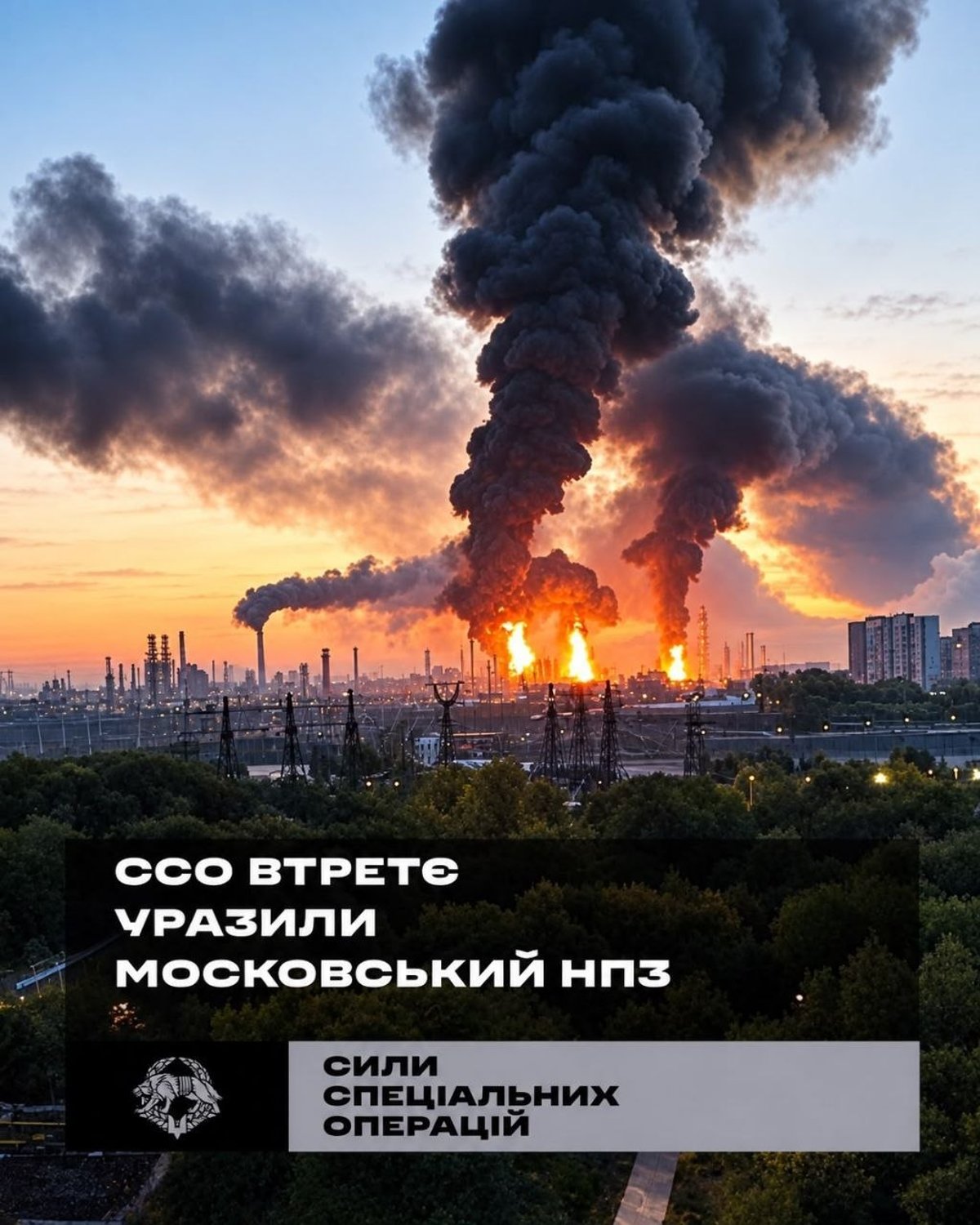
The hitting of the Moscow Oil Refinery in Kapotnya has been confirmed, alongside reports of explosions, fires, and damage to residential buildings in the Moscow region. In the Ramensky district, about 400 residents of an apartment block were evacuated. There are reports of deaths and injuries. Temporary restrictions were imposed at Moscow airports.
Information has also emerged regarding potential strikes on the TETs-22 in Lyubertsy and a logistics complex in Sofyino. However, the scale of the damage to these facilities still requires independent verification.
The Ukrainian side has not officially reported which specific forces and assets may have been involved in this operation. And this is correct. The names, specifications, flight paths, and technologies of Ukrainian weapons should remain not in social media, but behind the closed doors of military offices.
However, the general trend is already obvious: the war that the Kremlin has spent years selling to Russians as a television series about distant “new territories” is increasingly arriving directly at the Russian capital.
And these events should be viewed in the context of the latest statements by the President of Ukraine.
Following reports from the Minister of Defence of Ukraine Yevhen Khmara and the Commander-in-Chief of the ZSU Mykhailo Drapatyi, Volodymyr Zelenskyy announced that he had approved new long-range operations in response to Russian strikes. The President also stated that preparations are underway to expand Ukraine’s long-range capabilities.
This is a fundamentally important signal.
Ukraine is moving from individual pinpoint strikes to the formation of a holistic system: domestic production, new technological solutions, increased range, scaling of combat deployment, and the planned destruction of objects that sustain the Russian war machine.
Oil refineries, energy infrastructure, warehouses, airfields, and logistics hubs are not abstract structures. They are fuel for tanks and aircraft, electricity for defense enterprises, ammunition supply routes, and money to continue the war.
Previously, the Kremlin believed its strategic infrastructure was located in a deep and safe rear. Now, the very concept of a “safe Russian rear” is gradually disappearing. Distance is no longer a reliable armor.
At the same time, Ukraine is developing not only offensive but also defensive technologies. The President reported on the testing of a new Ukrainian weapon against drones. One of the domestic developments has already successfully destroyed a Russian Shahed, although individual technical solutions are still being perfected.
Thus, work is continuing in two directions simultaneously: Ukraine is expanding its ability to reach Russia’s military and fuel-energy infrastructure while creating more effective and cheaper means of protecting its own cities.
This is the correct formula for war: a long-range hand for the enemy and a reliable shield for Ukraine.
But good news from Moscow should not dull our vigilance.
Russia is not attacking Ukraine “in response” to our actions. It has been systematically killing Ukrainians since the beginning of the full-scale invasion. However, after such a strike, the Kremlin may attempt to conduct a demonstrative combined attack to hide the failure of its own air defense, calm the Russian audience, and supposedly project strength.
Energy and gas infrastructure, railways, logistics hubs, defense enterprises, airfields, communication facilities, and large Ukrainian cities traditionally remain under threat.
The Kremlin has repeatedly responded to its own military failures with strikes on residential neighborhoods. Not because it makes military sense, but because terrorizing the civilian population remains one of the few tools with which Russia still tries to demonstrate “strength”.
Therefore, civilians need to be prepared — without panic, but responsibly.
Check your nearest shelter and the route to it. Charge your phones, power banks, and flashlights. Prepare documents, water, medicine, a first-aid kit, warm clothing, and a minimal supply of food. Agree with your loved ones on where you will meet in case of communication loss.
If you hear an alarm, head to a shelter. If this is physically impossible, stay away from windows, balconies, and outer walls; use the two-wall rule. Do not use the elevator.
Do not go out on the balcony to film drones and missiles. Do not publish air defense activity, flight paths, impact sites, or the geolocation of important objects. Do not touch debris — it may be explosive. If you find any, call 101 or 112.
Take care of children, the elderly, neighbors with disabilities, and pets. They may need help during a quick move to a shelter.
Ukraine is becoming longer-range and more technological. But the more palpable our capabilities become, the more insidious the enemy may behave.
Therefore, the formula for the coming days is simple: the ZSU do their job, Ukrainian engineers create new weapons, and civilians do not ignore air raid alerts.
Moscow has finally heard the war it brought to Ukraine. However, we cannot lose our vigilance.
Bravery is not standing by a window waiting for an explosion. Bravery is protecting yourself, your family, and the people around you.
Because good news from Moscow does not cancel the air raid alert in Ukraine.
Author: Ivan Arefiev
Photo from open sources