Providing Russian troops in the south will become more difficult and expensive
On the night of June 11, Ukrainian forces struck four bridges at once, connecting the occupied part of the Kherson region with Crimea. As Mind informs, the so-called “governor” of the Kherson region appointed by Russia, Volodymyr Saldo, reported about the damage to the crossings. The PromPolitInform portal reports.
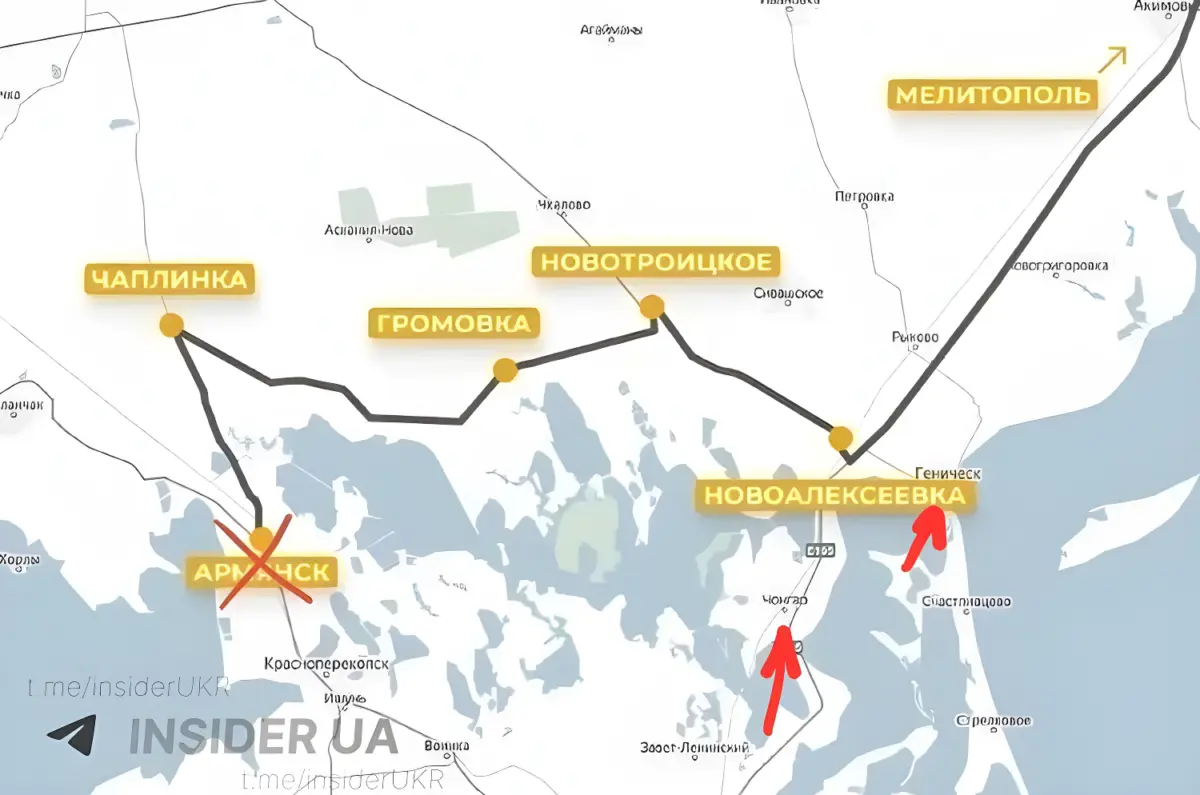
According to him, the bridges over the North Crimean Canal near Preobrazhenka and Mirne, the automobile crossing in the direction of Perekop – Armyansk, as well as the bridge near the village of Stavky were hit. The Russian side stated that experts are conducting an inspection of the structures and assessing the extent of the damage.
The attack was a continuation of a series of strikes on the transport infrastructure that provides communication between the occupied Crimea and the captured territories of southern Ukraine.
The day before, the Russian authorities reported an attack on the bridge between Genichesk and Arabatskaya Strela, one of the reserve supply routes to the peninsula.
A few days earlier, the Chongarsky Bridge was damaged, one of the most important crossings on the land corridor to Crimea, writes United24 Media.
The Chongarsky Bridge is part of the R-280 “Novorossiya” highway, which runs from the Rostov region through the occupied Mariupol and Melitopol to Crimea. It is through this highway that the Russian army transfers a significant part of its personnel, equipment, ammunition and fuel to the south.
In recent months, Ukraine has significantly intensified its campaign to destroy the occupiers’ logistical infrastructure.
In May, Ukrainian drones established fire control over the R-280 highway. According to OSINT analysts, about 125 trucks were hit on this highway in just one month.
Defense Minister Mikhail Fedorov previously reported on the implementation of the “Logistics Lockdown” program, the goal of which is to systematically destroy Russian supply routes by striking bridges, fuel depots, ammunition depots, and transport hubs.
In parallel with the attacks on transport infrastructure, fuel supply problems are worsening in occupied Crimea.
After a series of strikes on logistics routes, the occupation authorities were forced to restrict the sale of gasoline. Limits were introduced at some gas stations, and later in some areas, the free sale of fuel for cash was stopped.
On June 11, the Russian-appointed head of Sevastopol, Mikhail Razvozhaev, admitted that fuel tankers were unable to reach the city on time. Because of this, priority in fuel supply is given to public transport, municipal services, and emergency services.
Local residents were urged not to create queues at gas stations.
As the publication notes, unlike strikes on individual warehouses or equipment, the destruction of bridges has a long-term effect. Restoring crossings requires time, engineering resources and additional security measures, and each damaged bridge forces the Russian army to look for longer and less efficient routes.
A series of strikes on Chongar, Genichesk, Arabatskaya Strela and new attacks on bridges across the North Crimean Canal indicate that Ukraine is gradually isolating Crimea from the land corridor that Russia created after the start of a full-scale invasion.