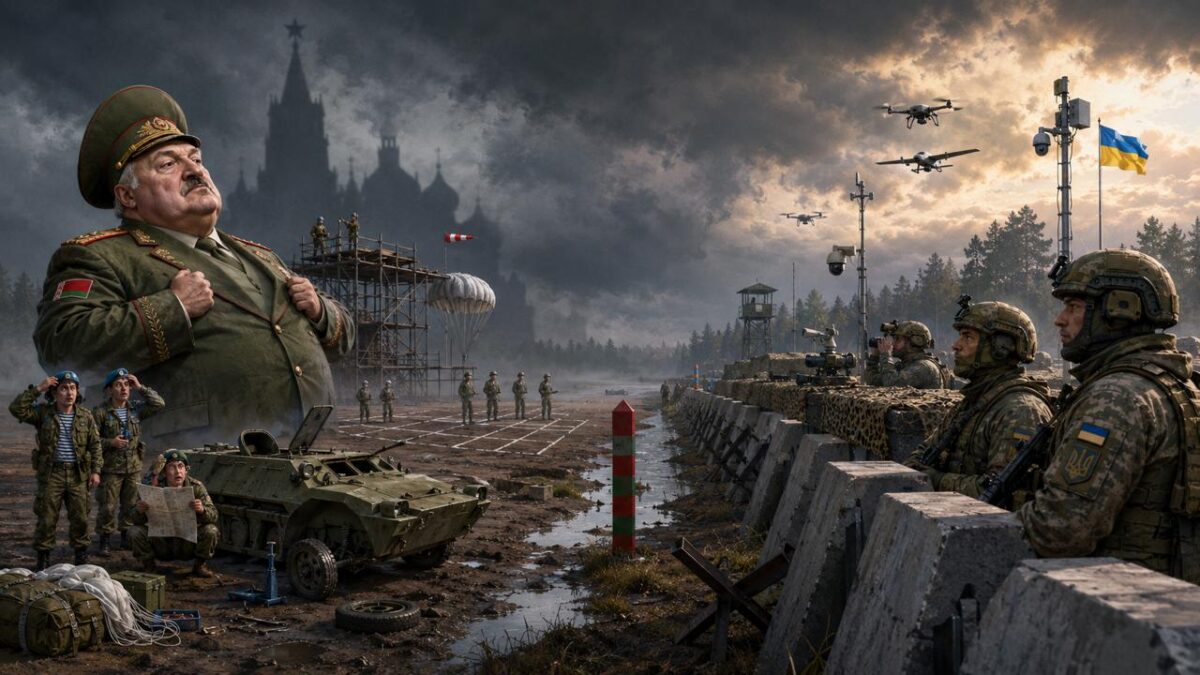
Near Homiel, approximately 40 kilometres from the Ukrainian border, a new air assault brigade is being formed. There is no strike force yet, but the Kremlin continues to use Belarus as a military balcony.
This is written by Ivan Arefiev exclusively for the Prompolitinform portal.
True, for now, only one battalion has been formed for this formidable brigade. The rest exists mainly in plans, orders, and on Belarusian television. In other words, Lukashenko has already ceremoniously puffed out his cheeks, adjusted his moustache, and showed Ukraine a fearsome military fist. But if one looks closer, the fist is still missing several fingers.
The Belarusian command promises to form another battalion, as well as artillery, anti-aircraft, and reconnaissance units. Everything is serious: they are building training grounds, mapping out routes, and setting up locations for equipment. In a word, they are preparing as if they are going to Kyiv tomorrow. And they are living as if they will have to explain the day after tomorrow why they started it at all.
The State Border Guard Service of Ukraine reassures: there is currently no strike force near the border capable of launching an offensive. There is NO necessary concentration of troops, equipment, artillery, ammunition, or logistics!
There is Lukashenko. There is a television. There is one battalion. And there is a lot of military-political huffing and puffing towards Ukraine.
However, one should not laugh too casually. The Belarusian leadership has long turned the country into the Kremlin’s military balcony. It was from its territory in 2022 that Russian troops entered, planes took off, and missiles flew. Today, the Russians are using Belarusian airspace for strike drone routes.
Therefore, the issue is not so much the capabilities of the Belarusian army, but the readiness of the Lukashenko regime to once again give Russia the keys to the northern entrance to Ukraine.
The new brigade near Homiel can perform several tasks at once. First, to scare Ukrainians. Second, to force Ukraine to keep forces on the northern border. Third, to create military infrastructure where, if necessary, Russian “tourists” can be quickly brought in with tanks, missiles, and the traditional Russian habit of calling an invasion an exercise.
Lukashenko understands perfectly well that an independent march of the Belarusian army into Ukraine could become the shortest military campaign in its history. The air assault brigade risks very quickly turning into a pedestrian-retreating one. Because the Ukrainian border today is no longer the border that Russian columns crossed in February 2022. It is fortified with minefields, reconnaissance, drones, and soldiers who remember well where the trouble came from back then.
Therefore, our response must be calm and cold. You build training grounds — we build fortifications. You form battalions — we define the coordinates. You lay out military routes — we carefully study where they lead. And if someone in Minsk wants to test the strength of the Ukrainian border again, one should not mistake our restraint for weakness.
The Belarusian people are not our enemy. But the regime that voluntarily works as a Kremlin military vestibule must clearly understand: the doors to Ukraine are locked. And if Lukashenko decides to knock with his new brigade, the answer might be such that his moustache will be returning to Minsk long before he does.
Author Ivan Arefiev
Collage: Andriy Atlantov