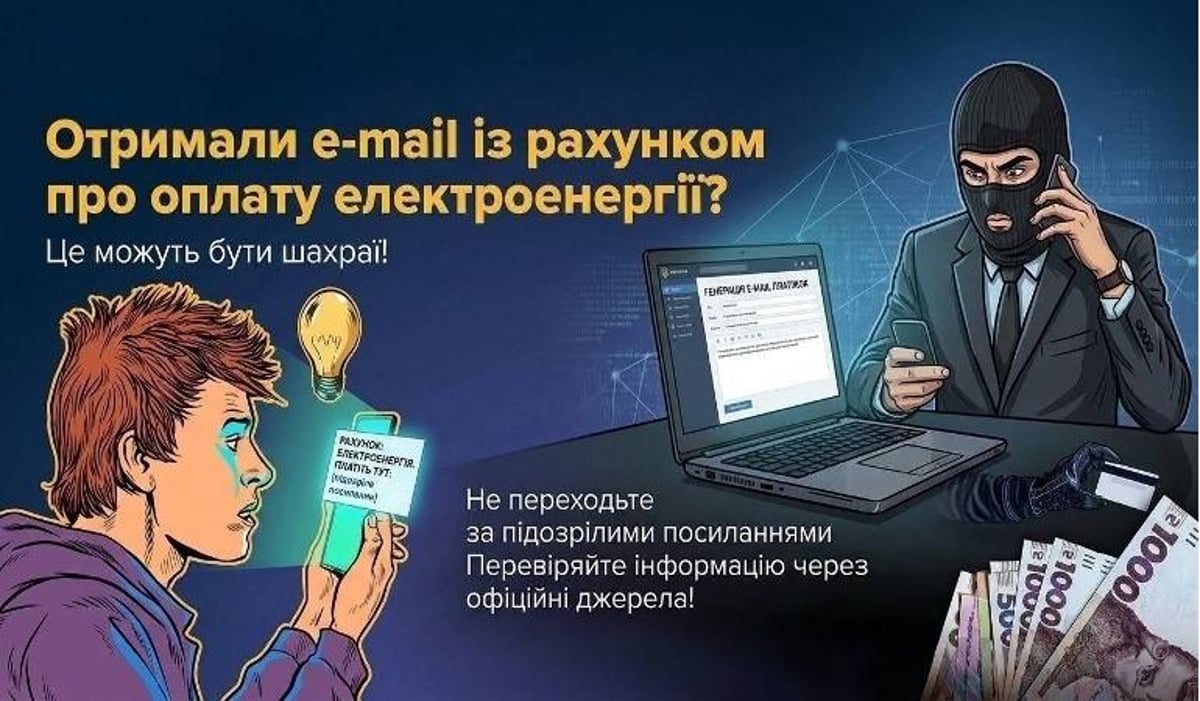
The Cyberpolice urges citizens to be cautious of emails and messenger messages containing electricity bills. Fraudsters may disguise these messages as official letters from the Ministry of Energy of Ukraine.
This is reported by the Department of Cyberpolice of the National Police of Ukraine, informs the portal PromPolitInform.
The message may contain information about a supposed debt, a payment invoice, or a request to make an urgent payment. For persuasiveness, the perpetrators use official logos, the names of state institutions, and familiar message formatting.
The main goal of such a scheme is to trick a person into clicking a link. It can lead to a phishing site where the user is asked to enter bank card details, a login, a password, or other personal information. Also, under the guise of an invoice or a document, malware can be distributed.
As a result, the attackers can gain access to bank accounts, email, social networks, and other accounts.
Important: The Ministry of Energy of Ukraine does not send consumers electricity bills and does not collect utility payments. Invoices are issued by electricity suppliers with whom the consumer has concluded a relevant agreement.
Treat letters and messages with caution if:
· they contain a link for “urgent” bill payment;
· you are notified of a non-existent debt and demanded to pay it off immediately;
· the sender uses an email address that does not belong to an official institution;
· you are asked to enter bank card details, a password, or an SMS code;
· an unknown file is attached to the message, which you are offered to download or open;
· the text contains errors, unusual wording, or creates a sense of urgency.
How to protect yourself?
Do not follow links from suspicious emails and messages. If you need to check information about electricity payment, independently open the official website or application of your supplier and check the account status.
Do not enter personal, banking data, passwords, or confirmation codes on websites whose links you received in an email or messenger.
If the message raises doubts, do not rush to pay the bill. Check the information through the official channels of the electricity supplier.
Remember: the presence of a state institution logo or the name of a well-known enterprise does not mean the message is genuine. Fraudsters can copy the appearance of official letters to build trust.
If you have already followed a suspicious link, entered banking data, or lost funds, you must contact the bank as soon as possible and block your payment instruments. Also, save the correspondence, email, link, phone number, and other evidence.
You can report fraud by contacting the Cyberpolice via the electronic form.
More information about current fraud schemes and protection methods can be found on the Cyber Brama portal — stopfraud.gov.ua.
Do not rush to follow links and pay bills received from unknown sources. Check information through official channels and use only trusted services.
Photo: Cyberpolice of Ukraine
Photo: Фотоколаж Кіберполіції України
Read also: Ukraine introduces up to 10 years of imprisonment for working in fraudulent call centers