Plans are in place to begin constructing several backup crossings in Kyiv starting next week, with the future possibility of building a tunnel under the Dnipro River also under consideration. Mykola Kalashnyk, Ukraine’s Minister for Restoration, Infrastructure, and Transport, discussed this in an interview with Suspilne, as reported by NV and the PromPolitInform portal.
At the same time, the minister stated that the agency’s top priority is reinforcing existing bridge infrastructure and protecting the bridges from attacks to enhance their structural resilience.
He noted that, in the event of damage to the bridges, options for rapidly connecting Kyiv’s left and right banks—such as building earthen causeways and pontoon crossings—are being considered to maintain traffic flow across the Dnipro.
“Immediate solutions involve causeways and pontoon crossings, which can be built quickly… This work has already begun. A coordination meeting was held with the President, and we received all necessary directives based on the critical nature of the situation. The city had not handled this on its own, so a decision has now been made for the Ministry, the Agency for Restoration, and the military to undertake this task in cooperation with the capital’s authorities,” Kalashnyk explained. According to him, the construction of such crossings could take up to three months, and they are intended to provide at least half the traffic capacity of existing bridges.
“Preparatory work is currently underway, and construction will begin shortly. We will mobilize all necessary infrastructure to maximize traffic throughput. On average, about 600,000 vehicles cross between the left and right banks daily, and our goal is to maintain this capacity. Consequently, specific locations for the construction have already been identified,” the minister explained.
Kalashnyk stated that locations for alternative crossings have been selected; plans include building them not only in Kyiv but also in other regions of Ukraine, and not exclusively across the Dnipro River.
He also noted that the Ministry for Restoration, Infrastructure, and Transport is considering options such as the construction of rapidly assembled concrete structures and, in the long term, a tunnel beneath the Dnipro. The minister explained that these projects could cost tens of billions of hryvnias, making their implementation possible only with partner support.
“We can now begin seeking investments, donors, and international partners to implement projects that ensure connectivity between the left and right banks… Estimates run into the tens of billions of hryvnias—or even hundreds for massive infrastructure projects. We currently lack the financial means to fund this, but the task is to secure the necessary resources,” Kalashnyk said. In addition, he stated that “the maximum amount of equipment has been deployed” to preserve the bridges and prevent their destruction.
“Clearly, every bridge has a certain structural safety margin. Our primary task is to ensure protection from the air—a task we are undertaking in coordination with the military. In other words, the first priority is to prevent them from being hit. The second is to ensure their protection. The third is rapid repair. And the fourth is to make decisions regarding alternative backup crossings—that is, constructing new alternative bridge infrastructure,” the minister declared.
Key details regarding the aftermath of Russian strikes on Kyiv’s bridges
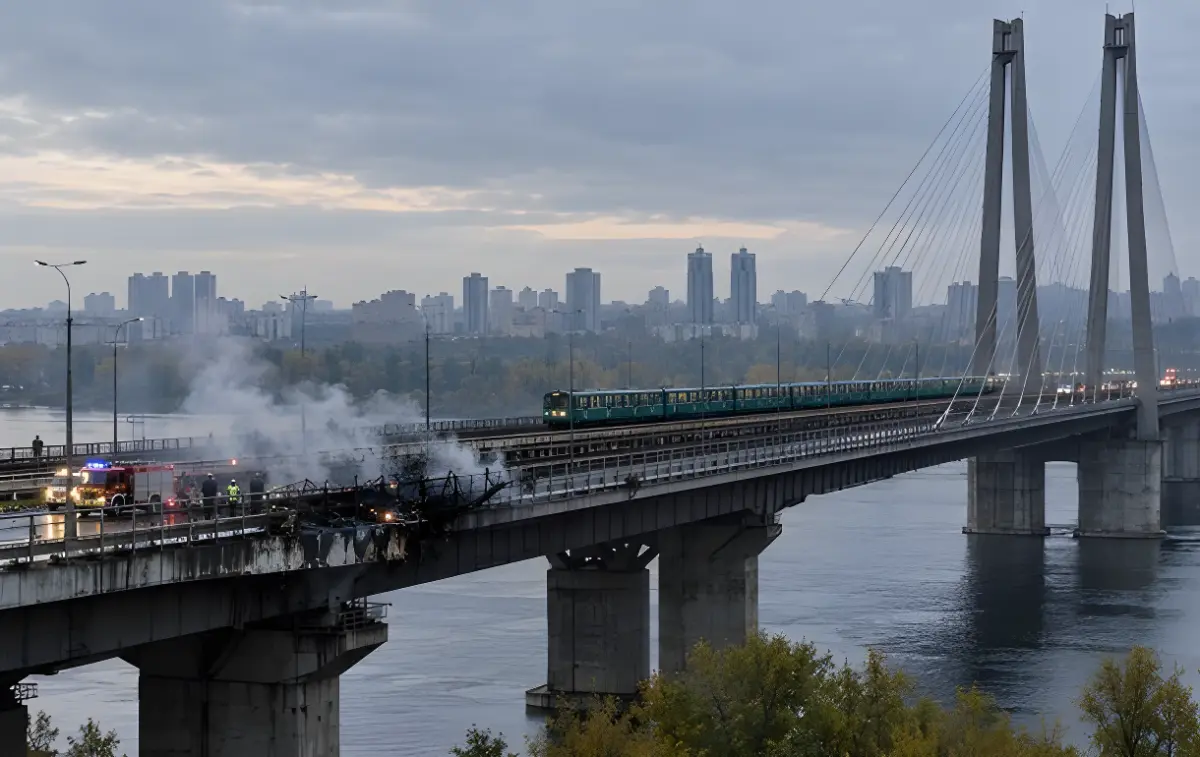
Traffic across Kyiv’s South Bridge has been blocked since October 2 following a series of Russian drone strikes that damaged the bridge’s supports, road surface, and guardrails.
That day, the capital experienced traffic gridlock: all major thoroughfares were paralyzed, and public transport was delayed, forcing people to cross the bridges on foot.
On October 3, Russia launched a drone strike on the North Bridge (formerly the Moscow Bridge) in Kyiv. Mayor Vitaliy Klitschko reported damage to the road surface and the trolleybus overhead lines; two people were injured. Traffic across the bridge has been restricted.
On October 3, rules regarding bridge crossings during air raid alerts were changed in Kyiv. Specifically, the following restrictions were introduced:
Podilskyi Bridge Crossing — traffic will be temporarily blocked (for up to 15 minutes after the start of an air raid alert) in the direction from the Left Bank to the Right Bank.
Pivdennyi Bridge — traffic from the Right Bank to the Left Bank will be temporarily blocked (for up to 15 minutes after the start of an air raid alert).