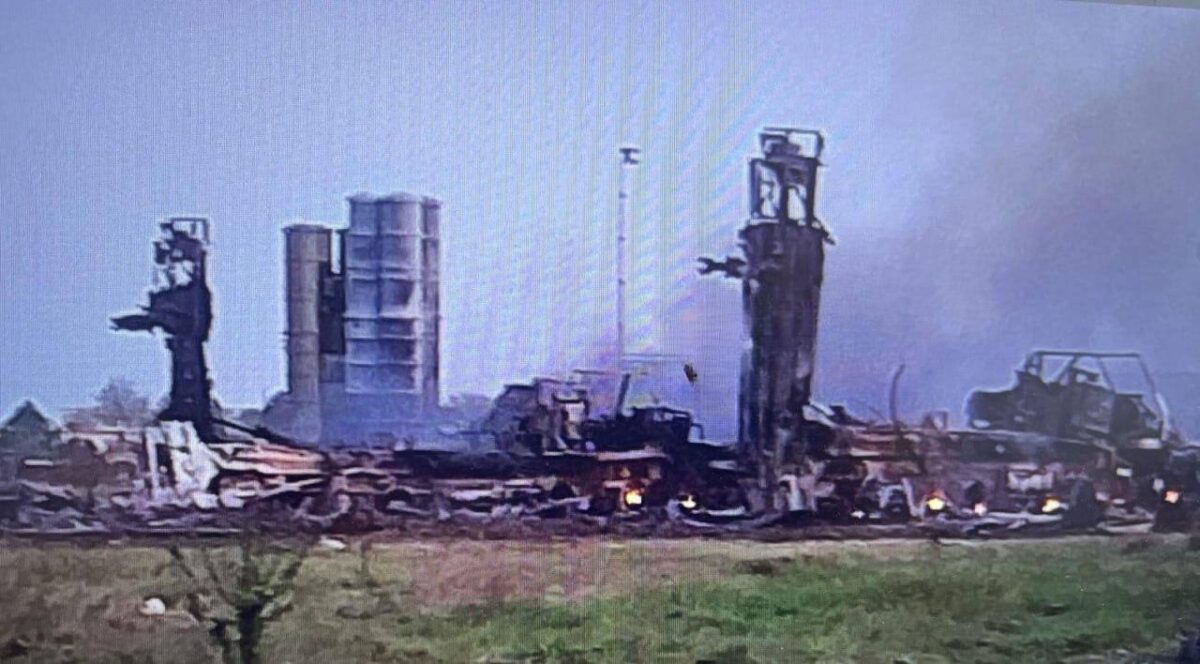
The aircraft repair plant in Staraya Russa services engines for Il-76, Il-78, and L-410 aircraft
Information about the fire and hits on the company premises was reported by the Krymsky Veter Telegram channel, while the Exilenova+ Telegram channel reported a series of explosions.
This enterprise is a critical link in supporting the military transport aviation of the occupation forces. The plant specializes in restoring the technical condition and maintaining engines and power plants for Il-76 aircraft, Il-78 tankers, and L-410 light transport aircraft. Neutralizing such facilities creates direct obstacles to the operational redeployment of reserves and the supply of enemy troop groups.
Systemic destruction of aviation infrastructure
The recent attack on the 123rd Aviation Repair Plant in Novgorod Oblast is a continuation of consistent actions to disable enemy special equipment. This facility was previously under fire on March 17 of this year, when damage to the hangar complex resulted in the neutralization of an A-50 airborne early warning and control aircraft. The estimated cost of the “flying radar” hit at the time is about 330 million US dollars.
Other key enterprises of the russian aviation industry are suffering similar strikes. As reported by the General Staff of the Armed Forces of Ukraine in its update, during the night attack on November 29 in Taganrog, Rostov Oblast, the TANTK G.M. Beriev aircraft repair plant was hit. At this facility, which carries out repairs and modernization of Tu-95 strategic bombers and A-50 aircraft, a fire broke out in one of the maintenance workshops after the explosions.
Strikes on fuel and microelectronic bases
In parallel with military aviation plants, oil refining infrastructure that feeds occupation troop groups has come under fire. According to the General Staff of the Armed Forces of Ukraine, on the night of November 29, the Afipsky oil refinery in Krasnodar Krai was hit, causing a fire. Attacks on the same facility were also mentioned in reports by the Glavkom publication on November 6.
The geography of strikes also covers other fuel hubs and specialized production facilities. The report of the General Staff of the Armed Forces of Ukraine confirmed the destruction of an RV-5000 vertical reservoir at the Tuapse port marine oil terminal on November 25. Furthermore, on the night of November 5, explosions occurred at the Ryazan oil refinery, and on November 4, a fire engulfed the Ozon logistics hub in the city of Adygeysk, as reported by company representatives.
High-precision missile strikes and the frontline situation
Not only drones but also domestically produced missile weaponry are used to destroy critical military-industrial complex facilities. According to the General Staff of the Armed Forces of Ukraine, on the night of October 31, a crew of the Neptune coastal missile system of the Naval Forces of the Armed Forces of Ukraine launched a strike on the Kamensky plant in Rostov Oblast, which manufactures special fuel and solid rocket propellant. On the night of November 7, a high-precision strike hit a facility in Orel that produces microelectronics for Iskander-M systems.
Strikes on the enemy’s deep rear are accompanied by high-intensity combat on the front line. According to the General Staff of the Armed Forces of Ukraine, during October alone, operators of unmanned systems from the 20th Separate Brigade and the K-2 unit in the Donetsk region hit 5,654 enemy targets, destroying 2,370 of them completely. Additionally, 1,561 occupiers were neutralized, including 1,084 irreversibly.
Illustrative photo: Unknown authorUnknown author / CC BY 4.0
Read also: