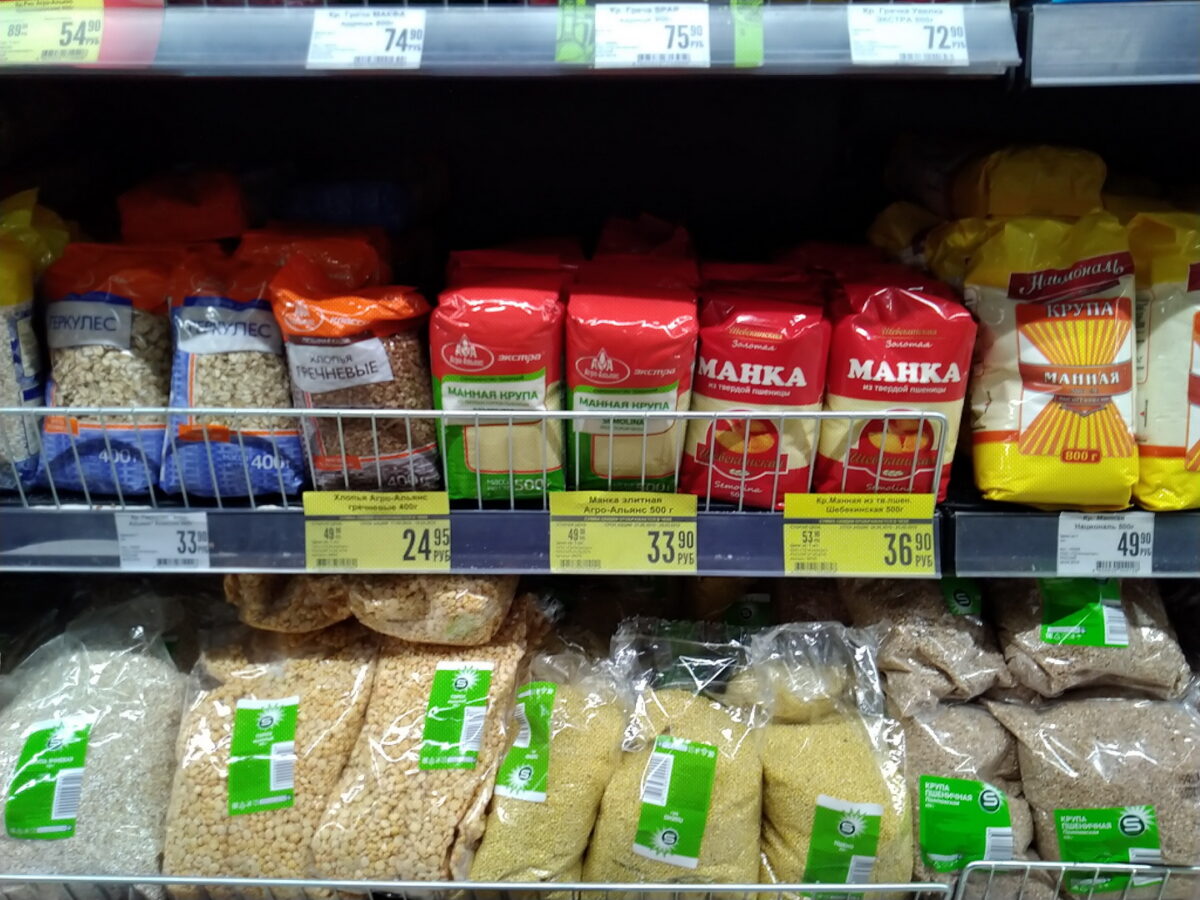
Expansion of the 'Honest Sign' system has led to the closure of small production facilities and retail losses
Russian authorities are expanding mandatory product marking through the 'Honest Sign' system, leading to the closure of small farms and losses for large retail chains. The system, controlled by Putin's circle, creates financial and technical barriers for small businesses. This was reported by The Moscow Times, according to the portal PromPolitInform.
Russian authorities continue to expand the mandatory product marking system ‘Honest Sign,’ causing significant losses to small businesses and farms. According to the company ‘Markznak,’ the system covers 48 product groups, 33 of which are mandatory for all market participants. This means unmarked goods cannot be sold in retail.
Impact on Small Producers
Marking has extended to farm products, pushing small producers toward closure. Even large chains suffer losses: they must remove goods with incorrect or unreadable markings, especially those unsold since October. Marketplaces have also begun blocking sellers’ listings with questionable codes.
The ‘Emelyanov’ network, selling Tambov products, reported that apple puree sales have ceased due to marking requirements. Canning marking became mandatory in 2025, with mandatory sales data reporting starting October 1. This requires special cash registers, scanners, and staff skills often absent in small stores.
The cost of a DataMatrix code is 60 kopecks with VAT, while full marking costs 7–8 rubles. However, for small producers, these expenses are critical. A participant in a Karelian agricultural cooperative noted that marking costs for their products reach 30–40 rubles per unit, destroying margins. Fines range from 50 to 300 thousand rubles, plus confiscation.
Small producers also face technical issues: lack of internet in regions prevents code verification, and system glitches cause product loss. A dairy plant representative mentioned that milk sours due to ‘Honest Sign’ failures before it can be remarked.
Impact on Retail
The range of canned goods in retail is expected to shrink by 10% due to small producers exiting. Retailers complain they cannot sell goods purchased before the new rules. Even large chains must remove items with ‘non-scannable’ codes.
Marketplaces must verify product listings and block violators since October 1. This affects self-employed artisans—confectioners, designers, puppeteers. Minimum connection costs to the system are 40 thousand rubles, inaccessible to many.
Who Controls the System
The ‘Honest Sign’ system is controlled by Putin’s inner circle. The operator, LLC ‘Operator-CRPT,’ was previously owned by structures of Alisher Usmanov’s USM, Rostec, and Alexander Galitsky. In 2024, Usmanov exited, and Galitsky was labeled extremist, with his assets seized. It emerged that his stake was controlled via Gazprombank.
A business ombudsman noted that marking is not for quality improvement but for budget revenue. In 10 months of 2026, the budget deficit reached 5.2 trillion rubles, expected to hit 7.3 trillion by year-end. Marking helps track goods and tax evasion.
While the system is profitable for large companies, it is devastating for small ones. The ombudsman calls ‘Honest Sign’ a ‘hemorrhoid, closure, or exit into the shadows’ for individual entrepreneurs.
Illustrative photo: Alexander Davronov / CC BY-SA 4.0
Read also: Ukrainian defenders force the Russian army to switch to Soviet scrap metal — T-55 tanks