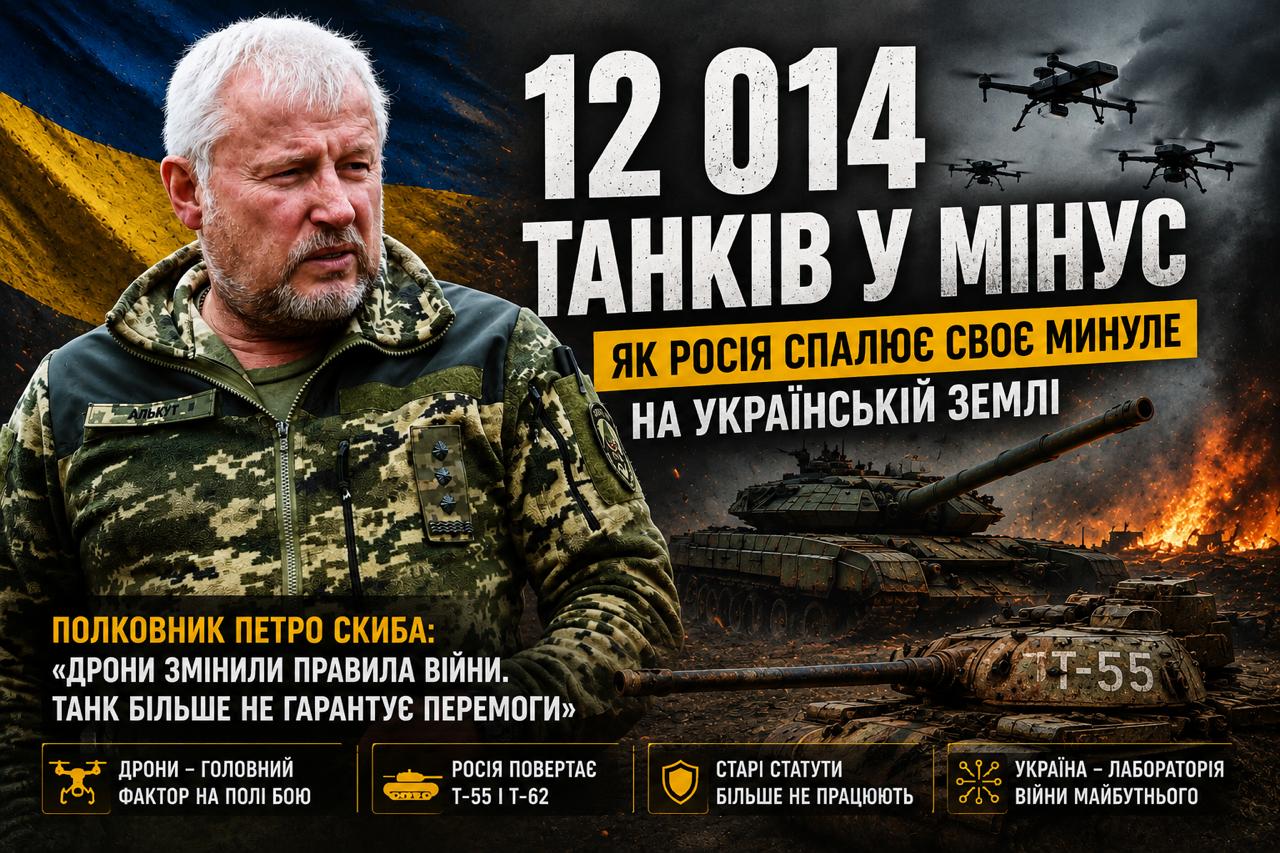
The Russian army, which relied on mass deployment of armored vehicles before the full-scale invasion of Ukraine, has suffered massive losses—minus 12,014 tanks. This forced the enemy to resort to using obsolete Soviet-era equipment on the battlefield.
According to the General Staff of the Armed Forces of Ukraine, as of June 12, 2026, the Russian army has lost 12,014 tanks in Ukraine.
This is not just statistics. It is an indicator of how modern warfare has changed and how high the cost is for Russia in its attempts to seize Ukraine.
To understand what is really happening with Russian tank forces, it is better to listen not to television pundits or propagandists, but to those who have dedicated their entire lives to armored units.
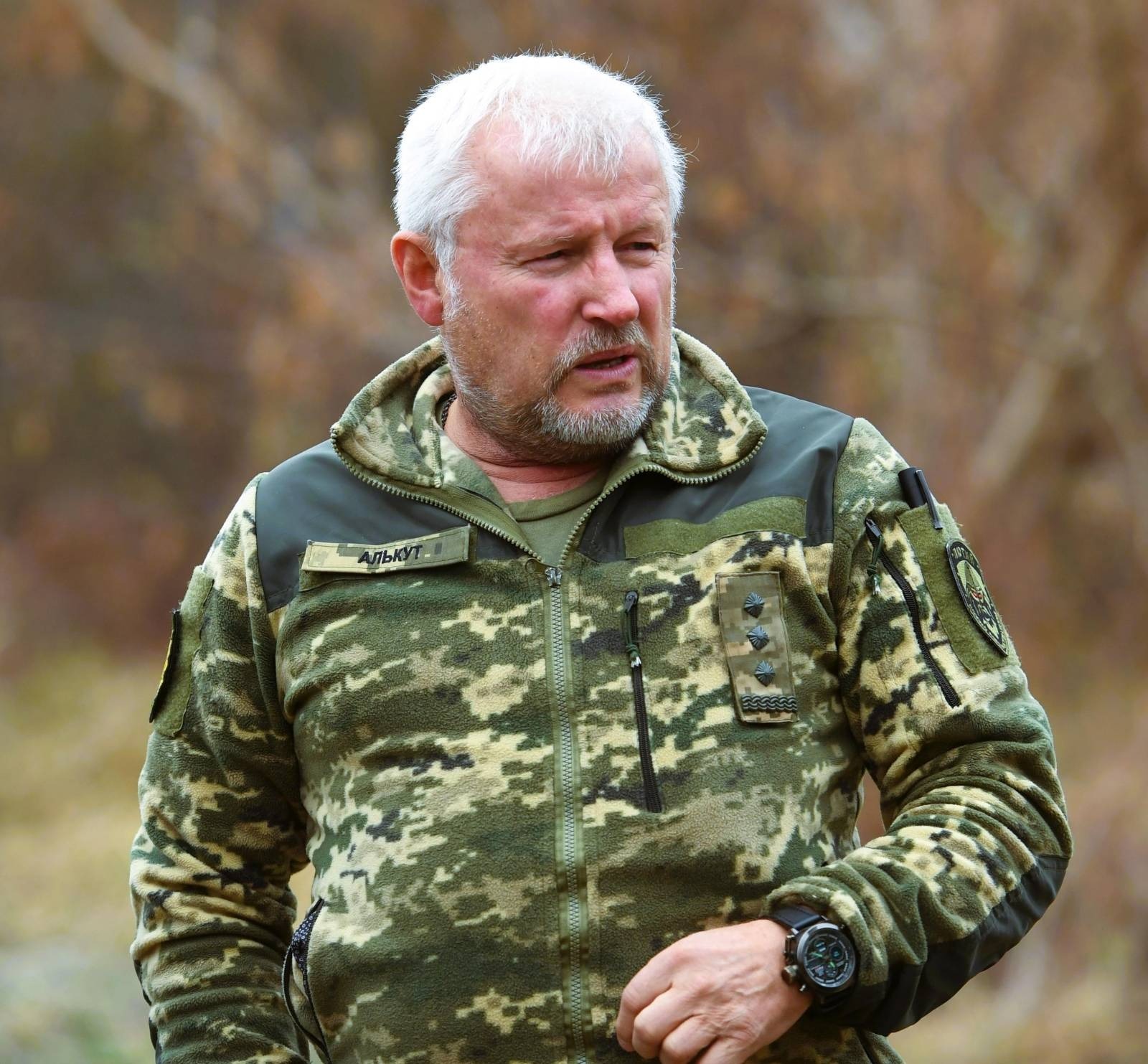
One such officer is Colonel Petro Pavlovych Skyba, a career soldier of the Armed Forces of Ukraine and a tanker who has commanded various tank and mechanized units during the full-scale war.
According to Petro Skyba, the war of 2022-2026 has completely changed the perception of the tank’s role on the battlefield.
“I have been in this war since 2014. But even in 2022, no one could have imagined how drastically the nature of combat would change and how much the role of unmanned aerial systems would grow. Today, it is drones that have become one of the main factors determining success or defeat on the battlefield,” — says Colonel Skyba.
This is precisely why the Russian army, which counted on mass armored warfare before the invasion, has faced enormous losses.
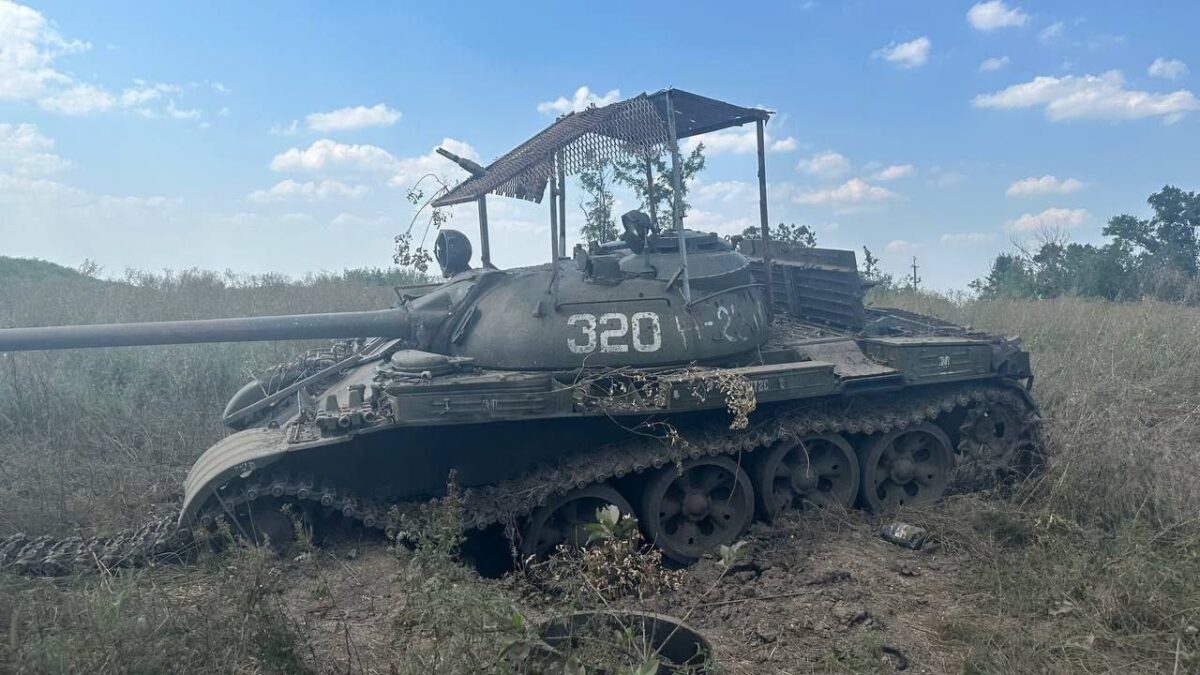
On the front line today, one can see almost the entire lineup of Russian tanks: T-90M Proryv, T-80BVM, T-72B3, as well as T-62, T-55, and even T-54.
While modern machines can be explained by the logic of war, the appearance of equipment created over half a century ago points to something else.
“When T-55s and T-62s return to the front, it is not a sign of military strength, but of the scale of losses. No modern army in the world would return such machines to combat units if things were going well,” — Skyba is convinced.
According to him, Russia is now increasingly forced to use equipment from Soviet storage bases.
“Many of these tanks have been sitting in the open for decades. Some require serious repairs and modernization. But due to the heavy losses of modern machines, the Russians are forced to return everything that can move and shoot back into service.”
The drone war has changed everything
Colonel Skyba is convinced that the greatest revolution of this war has occurred in the sphere of unmanned systems.
“A tank remains a powerful weapon, but it is no longer an independent instrument of victory. Today, victory belongs not to those with more armor, but to those who spot the enemy faster and coordinate better with intelligence, artillery, and unmanned systems. Without this, even the most modern tank becomes a target.”
According to him, the Ukrainian army is also forced to adapt its armor to new realities.
“We also equip our armor with various protective devices. But we must be honest: all these welded iron additions only help partially. At the same time, they negate the tank’s firepower and maneuverability. We are effectively sacrificing some combat characteristics for the survival of the crew.”
This is why, in the officer’s opinion, a much deeper question arises today.
“We need to do more than just reinforce protection. We need to reconsider the very concept of the tank as a strike weapon, taking into account its vulnerability to relatively cheap unmanned systems. The question of the future of tanks, IFVs, and APCs in their current technical form is looming.”
Old manuals no longer work
Skyba is convinced that the war is forcing a rethink not only of equipment but also of military science.
“The very theory of combined arms combat requires deep rethinking. Old and even recently approved combat manuals no longer provide answers to many questions of the modern battlefield.”
According to him, both Ukraine and Russia are constantly adapting to new conditions.
“It is good that we are quickly adapting to the capabilities opened up by unmanned aircraft. But we should not think that the enemy is standing still. The orcs are not lagging behind either. They are also learning, analyzing, and looking for new solutions.”
This is why a technological breakthrough is becoming a key task.
“Fundamentally new solutions are needed to protect armored vehicles. Not cosmetic changes, but a new level of technology. Scaling up electronic warfare, detection systems, and systems to destroy attacking drones is vital. Electronic warfare assets are currently in catastrophic short supply.”
Why Russia is fighting with Soviet scrap
In Skyba’s opinion, the return of old equipment to the front is a direct consequence of Russia’s technological lag.
“Because Russia is unable to quickly resolve technical and technological issues regarding the protection of armor against drones, it is simply flooding the battlefield with old junk, hoping for mass application. They do not care about machines or people. That is why all remnants from Soviet bases and storage depots are being used today.”
And that is why Ukraine is updating the enemy’s loss statistics every day.
“Ukraine is successfully disposing of this USSR legacy on the battlefield.”
As an example of the failures of the Russian military-industrial complex, Skyba cites the story of the Armata tank.
“The negative example of the development and production of the ‘Armata’ clearly demonstrates their technical and scientific bankruptcy. There was a lot of bravado, a lot of boasting, but when it came to real war, it turned out that propaganda cannot replace technology.”
Do we need the tanks of the future?
Despite all this, Colonel Skyba does not believe the era of tanks is over.
“Given the huge amount of armor and ammunition remaining in storage in both Ukraine and NATO countries, as well as the constant need to support, protect, and transport infantry, the role of tanks, IFVs, and APCs will remain important for many years to come.” However, these machines must evolve.
“They will either change technologically or gradually disappear due to physical and moral obsolescence. But in the near future, there is nothing to fully replace them.”
Ukraine — a laboratory for the war of the future
Petro Skyba believes that Ukraine has become a place where the technologies of future warfare are born.
“The Ukrainian battlefield has become an ideal testing ground for new technologies. Here, one can test any solution — from armor protection systems to state-of-the-art drones, electronic warfare, and automated combat control systems.”
This is why, he believes, Ukraine should make the most of this chance.
“We must facilitate the entry of new technologies, new manufacturers, and new solutions. What is being worked out in Ukraine today will determine the appearance of armies worldwide tomorrow. Before our eyes, the war of the future is being born.”
Conclusion: The figure of 12,014 destroyed tanks is not just statistics of Russian losses. It is a symbol of the end of an entire era — an era when the thickness of armor guaranteed superiority. Today, wars are not won by heaps of metal. Today, wars are won by people, technologies, adaptability, and speed of decision-making. And this is exactly what Ukrainian soldiers prove on the battlefield every day.
Author: Ivan Arefyev
Collage: Andrii Atlantov
Photos from the archive of Petro Skyba and open sources