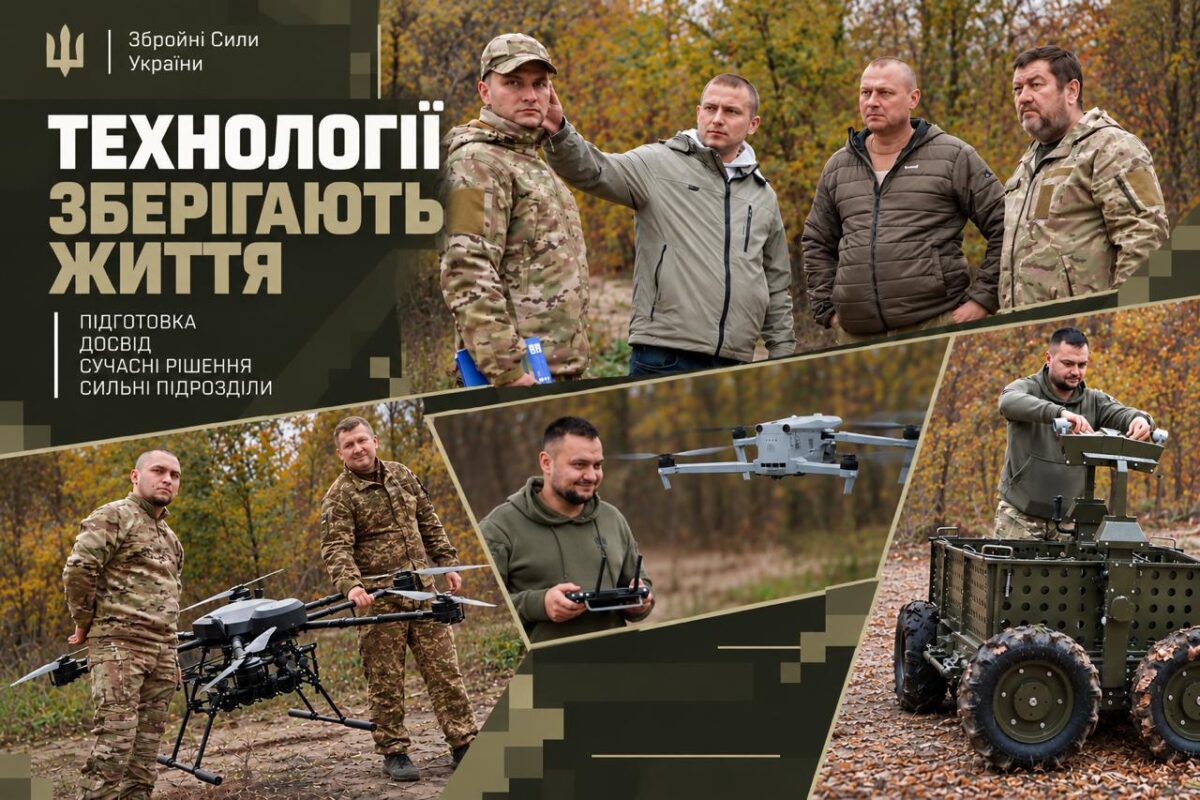
The character of combat operations and the very philosophy of training military personnel are changing in the Kharkiv region. Where rifles, armored vehicles, and physical endurance were the foundation just yesterday, unmanned systems, ground-based robotic complexes, technological literacy, and the ability to make rapid decisions are gaining critical importance today. This is no longer a matter of military fashion. It is a matter of survival on the battlefield.
Commander of the Tactical Group Slobozhanshchyna, Colonel Oleksandr Serhiiev, inspected the organization and conduct of training exercises carried out by instructors of the 5th Slobozhanska Brigade Skif. At first glance, this is an ordinary routine task for a commander: checking drills, evaluating training, and communicating with personnel. However, there is a much more significant process behind it: adapting units to the technological reality of modern warfare.
Robot instead of a soldier: technologies that save lives
One of the key areas of training is the use of ground-based robotic complexes (GRCs). Previously, the delivery of ammunition, food, water, or the evacuation of the wounded from dangerous areas often required the direct presence of military personnel. Today, some of these tasks can be performed by robotic platforms.
This is not just about mechanizing logistics. It is an opportunity to reduce the number of people risking their lives under enemy fire, especially when enemy drones control supply roads and evacuation routes.
At the same time, a GRC is not a magic machine that automatically solves all problems. It requires stable control, maintenance, trained operators, and competent planning. One can purchase hundreds of robots, but without specialists, they will remain an expensive fleet of equipment rather than a combat capability.
Unmanned reconnaissance: those who detect first gain the advantage
The second important area is training operators for reconnaissance UAVs. Today, information about the enemy is virtually as valuable as ammunition. Without timely reconnaissance, it is difficult to deploy firepower, assess changes in the situation, and warn personnel about threats.
However, teaching a soldier to launch a drone into the air does not mean training a full-fledged reconnaissance operator. They must know how to observe, recognize objects, interpret information, and transmit it to decision-makers in a timely manner. And all of this must be done under conditions of enemy countermeasures.
The true value of unmanned reconnaissance is not in a beautiful aerial picture, but in the information that is converted into the commander’s correct decision in time.
Heavy drones: new supply capabilities
Training for the operation of heavy unmanned systems, particularly for cargo delivery and special missions, is of specific interest. Under the threat of strikes on ground logistics, drone delivery can supplement traditional supply methods.
However, such systems have limitations regarding payload capacity, range, weather conditions, and resistance to countermeasures. They should be viewed not as a complete replacement for standard logistics, but as a tool that allows for reduced human risk in certain situations.
A fundamental question arises: are we only training operators, or are we forming an operational system? There is also a need for repairmen, technical specialists, logistics experts, and commanders who understand the capabilities and limitations of the equipment.
Instructor’s combat experience: an advantage you cannot buy
It is especially important that training is conducted by instructors with direct combat experience in the South Slobozhanshchyna direction. War changes faster than individual training programs and methodological guidelines are updated. What was effective six months ago may require revision today.
Therefore, the experience of personnel from combat units must be promptly incorporated into the training system. At the same time, a good soldier does not always automatically become a good instructor. Practical experience must be combined with methodology, objective assessment, and continuous improvement of training programs.
An instructor should not teach what looks good during a demonstration, but what actually works in war.
Commander’s oversight: result, not just volume of training
Colonel Oleksandr Serhiiev’s participation in the inspection of training is an important management signal. However, a modern commander must evaluate not only the fact that training took place but also what exactly has changed in the unit’s combat capabilities after the training.
Is the operator capable of completing the mission independently? Is the GRC crew ready to operate in complex conditions? Is the equipment functional? Have the mistakes from previous combat sorties been accounted for? It is these questions that distinguish real training from the formal execution of a plan.
It is impossible to assess the actual results of the exercises from the released statement, but the training areas themselves demonstrate attention to the current needs of the battlefield.
Acquiring technology is not enough — one must learn how to fight with it
We often talk about the number of drones and robotic platforms. Much less often, we talk about the effectiveness of their use. Even the most modern equipment can be lost due to operational errors, poor training, improper maintenance, or a lack of coordination.
Therefore, the criterion for success should not be training hours or the number of operators in reports, but their actual readiness to carry out combat missions. It is equally important to summarize the experience of using equipment and share it with other units. A mistake that has already been paid for with equipment or human life should not be repeated due to a lack of experience sharing.
Conclusions
The training of 5th Slobozhanska Brigade Skif instructors in the area of responsibility of Tactical Group Slobozhanshchyna demonstrates an important direction for the development of combat training: the systematic mastery of modern technologies. The combination of practical combat experience, work with various types of unmanned systems, and the command’s focus on the training process is a positive development.
At the same time, the main indicator of success should remain not the number of training hours, but the actual effectiveness of the units and the preservation of human lives. Modern warfare is a confrontation of technologies, management systems, speed of adaptation, and quality of training.
A robotic complex can be manufactured. A drone can be purchased. Software can be updated. But a trained soldier who possesses the knowledge, experience, and ability to act under critical conditions cannot be replaced by simply pressing a button.
If, after training, a robot goes where a soldier previously had to be sent under enemy fire, it means the technology is working for the most important goal: preserving human life. If training exists only in reports, then even buying a thousand robots will not improve combat performance. Because the enemy is interested in the results on the battlefield, not in the number of filled-out combat training journals.
Author: Ivan Arefiev
Collage: Andriy Atlantov
Photo: ТГ “Слобода”
Read also: 30 Attacks Repelled on Pokrovsk Front: General Staff Report for October 17