Watching Russian railway tankers burn, I would add a few words to the poem “The Train” by the prominent Ukrainian writer Olena Pchilka — and the Russian iron horses were flying… near Yekaterinburg, off the tracks.
Russia is a land of amazing possibilities. Here, ships sometimes unexpectedly become submarines, oil depots turn into torches, and railway trains suddenly decide that tracks are merely a recommendation, not a mandatory route.
This night, another transport masterpiece was demonstrated near Yekaterinburg.
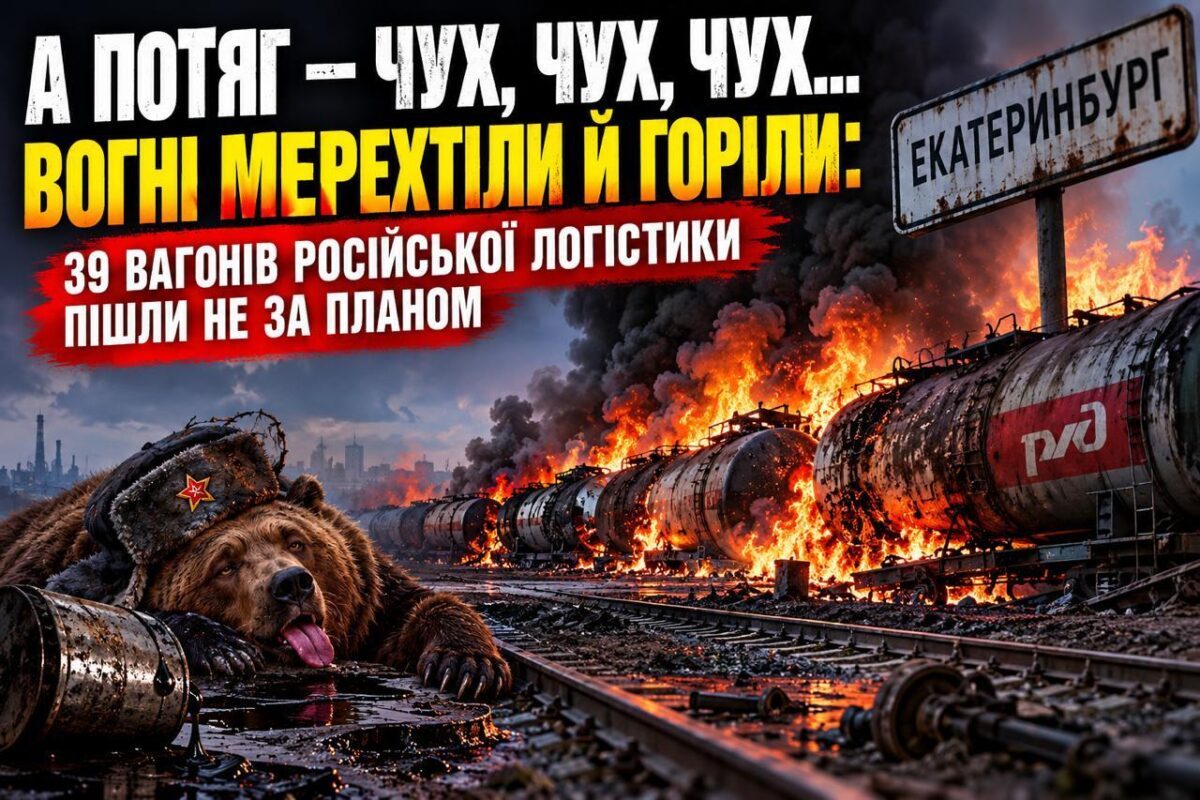
And the train goes choo, choo, choo… Lights were flickering and burning. But instead of the romance of a rail journey, there were seven burning tankers, black smoke, and firefighters who clearly planned to spend the night differently.
On the night of October 26, a freight train derailed on the Reshety-Sedelnikovo stretch in the Sverdlovsk region. According to Ukrainian media, the train consisted of 39 cars, although the Russian Ministry of Emergency Situations officially reported 20. Seven tankers were engulfed in flames.
The fire spread to an area of about 1,500 square meters. Railway traffic had to be stopped. The causes of the accident are currently being determined.
When the railway decided to become a crematorium for logistics
At first glance, it is an ordinary industrial accident. But there is a nuance. The Russian railway is not just transport for passengers visiting relatives. It is one of the main arteries of the economy, industry, and military logistics of the aggressor state.
It is by rail that fuel, metal, industrial raw materials, military equipment, and materials for defense enterprises are transported. And when a large-scale accident occurs on such an artery, the problem is not limited to a few mangled wagons.
Tracks need to be cleared, infrastructure restored, freight flows redirected, and repair crews and special equipment engaged. And this takes time. And time in a war economy is a resource no less important than money or fuel.
At the same time, the real scale of logistical losses from this particular accident remains to be assessed.
Seven tankers — seven reasons to reflect
A particularly interesting detail is the content of the tankers. Russian official reports did not initially specify what exactly was burning. Media report petroleum products. Local residents were advised to close their windows, limit time outdoors, and specialists began checking air quality.
In other words, everything follows the classic Russian pattern. First, something burns. Then officials report that the situation is under control. Then the population is asked not to open windows. And only after that do they start to find out what exactly was burning and why.
Apparently, this is their famous crisis management system: the main thing is that the smoke does not interfere with the television image.
An accident or a symptom of a systemic disease?
One should not rush to conclusions about sabotage or external influence. There is no confirmed evidence of this yet. But there is a much more interesting question: how resilient does the Russian transport infrastructure remain under wartime conditions?
The war requires the railway to constantly transport huge volumes of cargo. At the same time, the importance of technical maintenance, the condition of the tracks, the serviceability of the rolling stock, and the discipline of operation increases.
If at least one of these elements starts to fail, the consequences can be massive.
One accident does not yet prove systemic degradation. However, it demonstrates how vulnerable even a large transport system can be. Because a railway is strong not by the number of kilometers of tracks, but by its ability to ensure continuous and safe movement.
And the train goes choo, choo, choo…
There is a special Russian irony in all this. A state that for years has been telling its own population about its technological greatness, strategic power, and ability to fight against all of NATO is forced to throw significant resources into extinguishing a fire after a freight train derailment.
And while television generals draw arrows on maps, the real infrastructure reminds us that physics, the technical condition of equipment, and the laws of operation cannot be defeated by propaganda. Neither Solovyov nor yet another speech about “analogneet” (no analogues) will help here.
A wheel either holds on the tracks or it doesn’t. A tanker is either airtight or it burns. And propaganda, as is well known, does not extinguish fires.
Conclusion:
One should not turn every Russian accident into a fictional special operation. Sometimes the cause of a catastrophe can be an ordinary technical malfunction, human error, or violation of operating rules.
But there is something that remains unchanged. Any large-scale accident on the transport infrastructure of a state that is waging war is an additional burden on its economy, logistics, and management system.
And here one wants to recall an old railway melody. And the train goes choo, choo, choo… Lights were flickering and burning… It is just that the passengers of the Russian “express of greatness” more and more often see not the light at the end of the tunnel, but the reflections of their own problems.
And the most interesting thing is that the train of Russian imperial policy long ago derailed from the right path. Now the main thing is that its wreckage does not continue to maim other people’s lives.
And to the railway workers of the RF, one would like to wish one thing: that the wheels spin, the tankers do not burn, and the cargo for the war against Ukraine never reaches its destination at all.
Choo-choo, comrades. The final station of imperial ambitions is already somewhere ahead.
Author: Ivan Arefiev
Collage: Andrii Atlantov
Photo: Під укіс летіл залізні коні рф