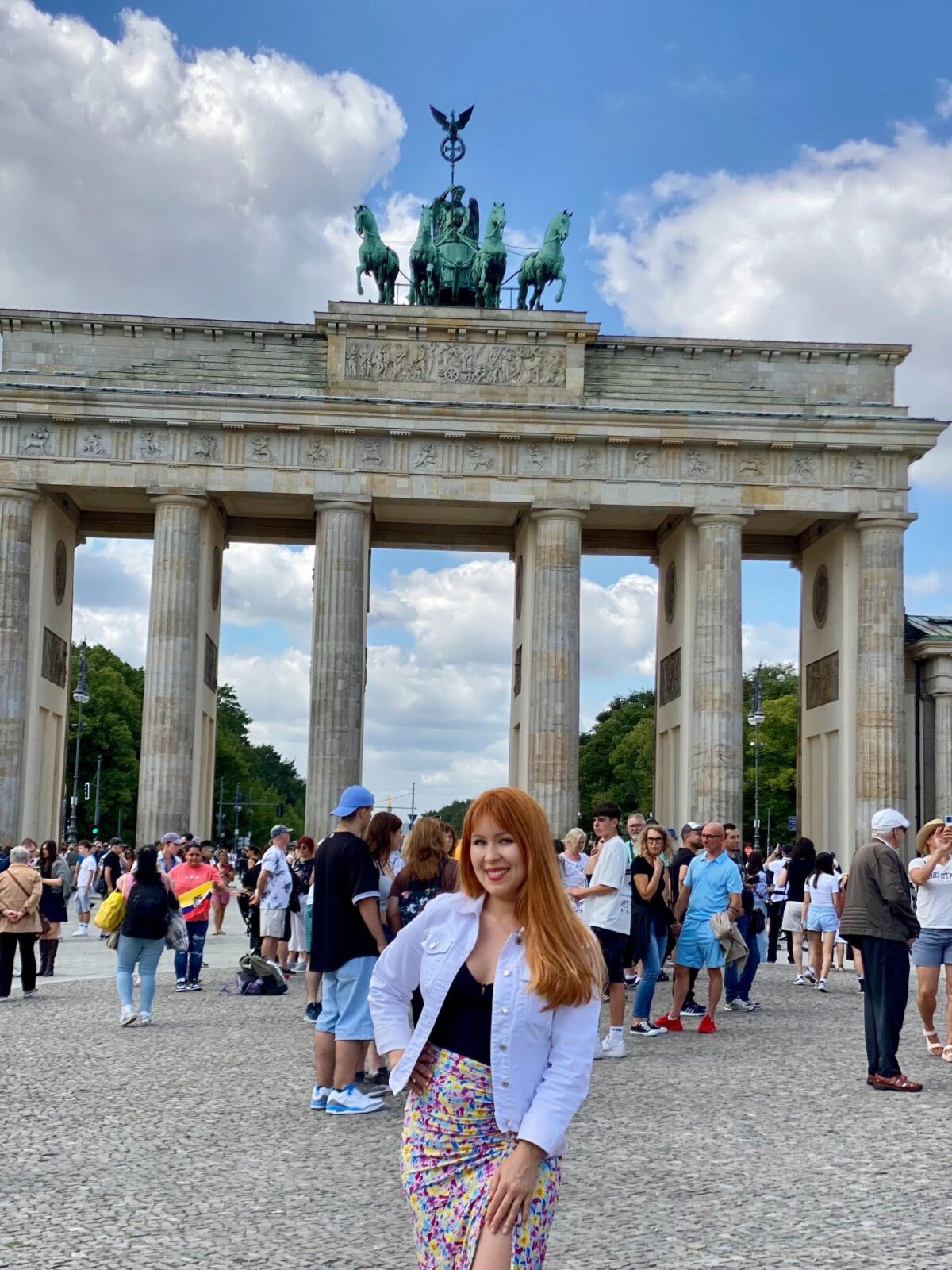
In Berlin, my degree and experience did not disappear, but I had to learn German first
My name is Iryna Lukianets, and I am a Ukrainian journalist and editor with 17 years of experience. Over the years, I have been published in various outlets, written news for the Ministry of Defence of Ukraine, and produced hundreds of educational and entertainment magazines for the international media group Hubert Burda Media. For the six or seven years leading up to the full-scale invasion of Ukraine, I worked in PR for Kyiv-based lawyers. However, none of that matters in the place where I live now, where I am building my life from scratch.
Here, it is simply of no use to anyone.
I turned a new page in my life in Germany, starting with learning a new language. It is a complex one, as logical and structured as its speakers — the Germans. If I were to tell a regular German person or a potential employer at a logistics warehouse that I had lived a vibrant professional life in Kyiv, they would listen, perhaps shrug their shoulders, and ultimately offer me the same contract to pack and unpack various items at the warehouse. This is fine if we talk about the goals of the Germans who saved me from the war, but not about my own goals.
So, I started my journey in Germany with the key to opening various doors in this country — learning the German language. This is exactly what every immigrant should start with, regardless of whether you are here to wait out the war or have arrived to explore the country from within and make a fresh start. Social isolation creeps in very quickly, and along with it comes longing for your home streets, people, and, ultimately, your native environment.
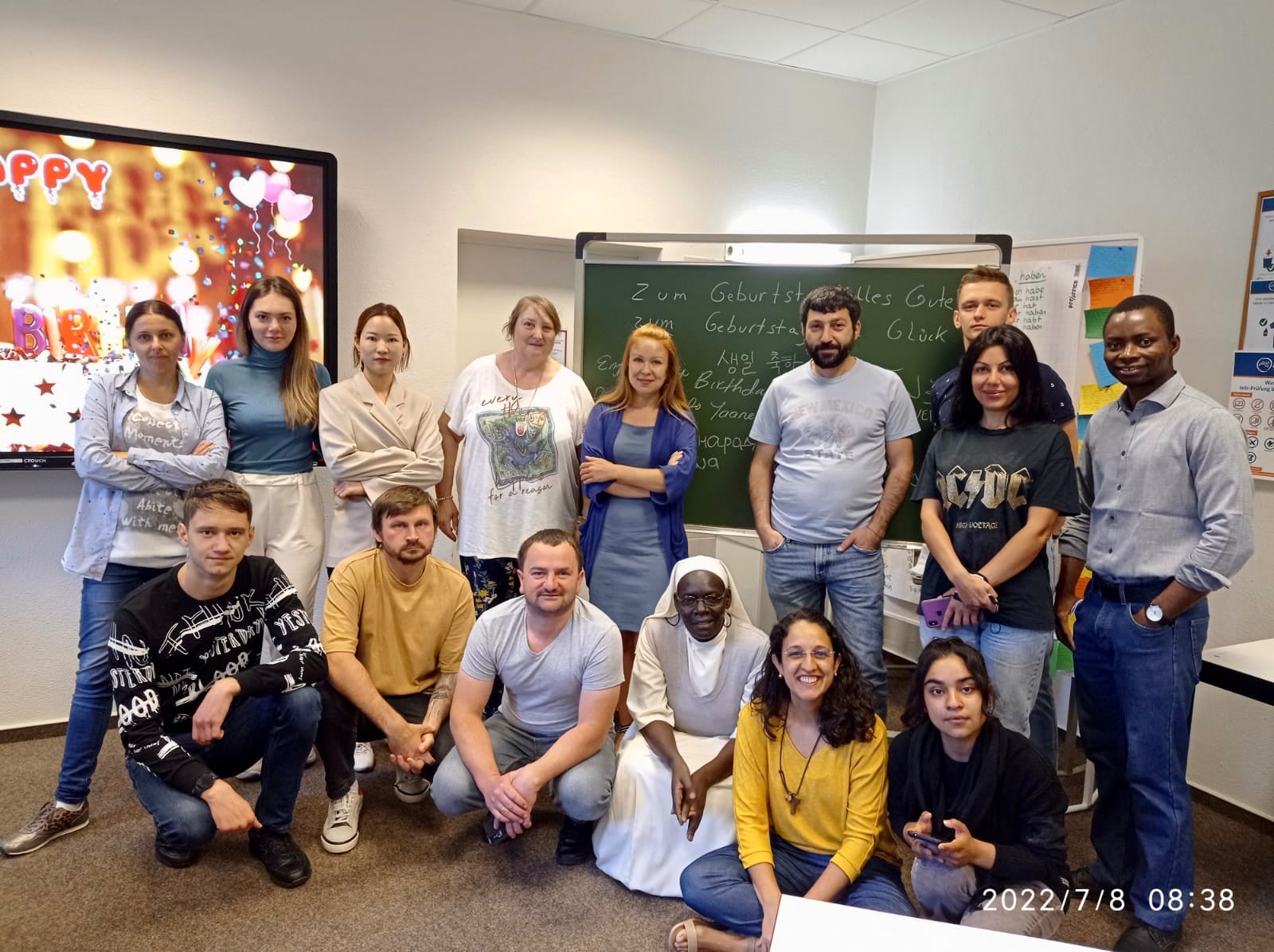 our German language study group
I immediately found lessons on YouTube, and then I was enrolled in courses at a so-called adult education center (Volkshochschule, or VHS), where all adults have the opportunity to acquire various skills—linguistic, culinary, creative—for free or for a symbolic fee. In my opinion, this is the best way to master the language in Germany if you start working right away: VHS offers evening courses. I do not know of any other country that offers as many opportunities to learn a language as Germany. After all, Ukrainian refugees are provided with paid courses up to a sufficient level, connected with clubs, involved in sports and cultural events, and, most importantly, given time to learn the language without being forced to go to work immediately.
It is difficult for me to explain, but I have always been loyal to Germany. Perhaps because the holding company I worked for in Ukraine was German and left me with the best memories. The German language felt right, to use modern slang. I did not feel like an immigrant here. I ran to a church where Ukrainians were gathering to meet us and decide what to do with us at all. Germany really wanted to help, but at first, it did not even know how to manage the whole process. So, like in the Soviet film “The Big Break”: “Who wants to go to construction? – Me. Who wants to sweep the streets? – Me.” I immediately volunteered, met the organizers of our meetings, and communicated in English.
This is not to say that I am so cool: look at me, how easy everything is for me, and be jealous. No. I did not want to be in the position of a victim. It just felt that way, and that was it. I clearly understood that the war would not end quickly and that this was an opportunity to discover something different, which I did not want to lose.
Everywhere and always, one can whine. Either the benefits are not what you expected (and what were the benefits in Ukraine?), or there are a bunch of appointments you do not want to attend, the food is tasteless, or it is unclear where to go at all — and so on indefinitely. With such an attitude, everything will be even harder. So, I asked the Germans myself for more language courses to improve my level for better job prospects. I sat on a bench in a cafe and listened to the language: how it sounds, what words I can already recognize, how they are pronounced differently…
In general, you have to “click” with a country. It is like in a relationship with a partner: it either clicks or it does not, and there is no other way. You cannot always explain why the streets smell like German buns and apple pie with cinnamon to you, why the cobblestones and gloomy brown buildings seem so attractive, or why a passerby’s smile touches your heart.
In our situation, this is, of course, a much more complicated mixture than arriving in a foreign country to enjoy coffee or a walk through a sleepy Sunday city. This is about separated families where children and their mother are here, while the husband defends the Motherland; where a couple was supposed to get married, but the war led them along different paths; where an elderly woman can no longer reconcile herself to the fact that the language, spirit, and customs of the country where she ended up will remain foreign to her for a long time.
But time passes, and whether we want it or not, we integrate where we are. Among my acquaintances, there are many who have validated their degrees, learned the language, and become family doctors, dentists, assistants, and consultants.
And if you have not “clicked” with the country or its language for a long time, you should change the country and try something new. Examples of successful compatriots here forced me to speed up, but at the same time, I had to figure out how to pronounce twenty-letter words where the stress usually falls on the first syllable and numbers are read from left to right.
The hardest thing at first was to break away from English and switch to another language, at least in individual sentences or phrases. My intermediate English was my wheelchair, from which it was so difficult to get up and walk without support.
While learning German, my desk, kitchen furniture, and household items were covered with stickers with words. I would remember the words in the evening, but by morning, I would forget some of them. So it helped me to repeat them over and over again. Memorizing entire phrases or sentences works well in learning a language, so you can later begin to understand why they are built that way and how they can be constructed differently. Language is like a building set, and over time you will learn how to rearrange the blocks.
In my experience, if Germans hear that you are trying to speak, they are eager to help you and will never correct you publicly. If I could address someone in German with at least a few sentences, I received only words of support. For Germans, this matters a lot, as it shows respect for the traditions and people you have come to visit. I was taken into the home of a German family, who still cares about everything that could help me adapt and feel better where I am.
Over time, when my language skills improved, the language school offered an orientation course — a mandatory part of the integration course. There, we were told about the traditions, social, political, and cultural structure of the Federal Republic of Germany. It was there that I learned why all of Germany celebrates October 3rd, and about Gorbachev’s role in the peaceful end of the Cold War and the reunification of Germany, which the Germans highly appreciate. When you are provided with so much interesting information, the journey becomes more and more exciting, and the adaptation more natural and comfortable.
The German language sounds beautiful to me. I admire it and am constantly learning something new, listening to conversations on the street or in the supermarket. Now I can attend the cinema and theater and accurately understand where a beautifully constructed sentence sounds, and where street slang is used. I have already managed to work as an assistant at a translation bureau after applying on my own initiative. I have encountered medicine and health insurance, finding a new apartment and moving, and I am well acquainted with the German autobahn and trains, the celebration of local holidays, food culture, receiving guests, local humor, and the jokes of the local burghers.
But that is a reason for new conversations.
Author: Iryna Lukianets, Ukrainian volunteer and emigrant
Photo by the author
Photo from the web
Read also: Xi Jinping opposes a three-way Ukraine summit involving Russia and the US