The peninsula, turned by the russian federation into a massive military base, has become a legitimate military target for the ZSU. While people in Crimea are being openly urged to stay away from russian military sites, Moscow has started its traditional performance of claiming everything is fine.
While people in Crimea are already being openly urged to stay away from russian military objects, Moscow has begun its traditional genre — “it is not scary,” “it is not important,” “there is no one there.” When russian officials begin to publicly explain why they “will not strike” something, it usually means only one thing: they are very worried that they will be struck themselves.
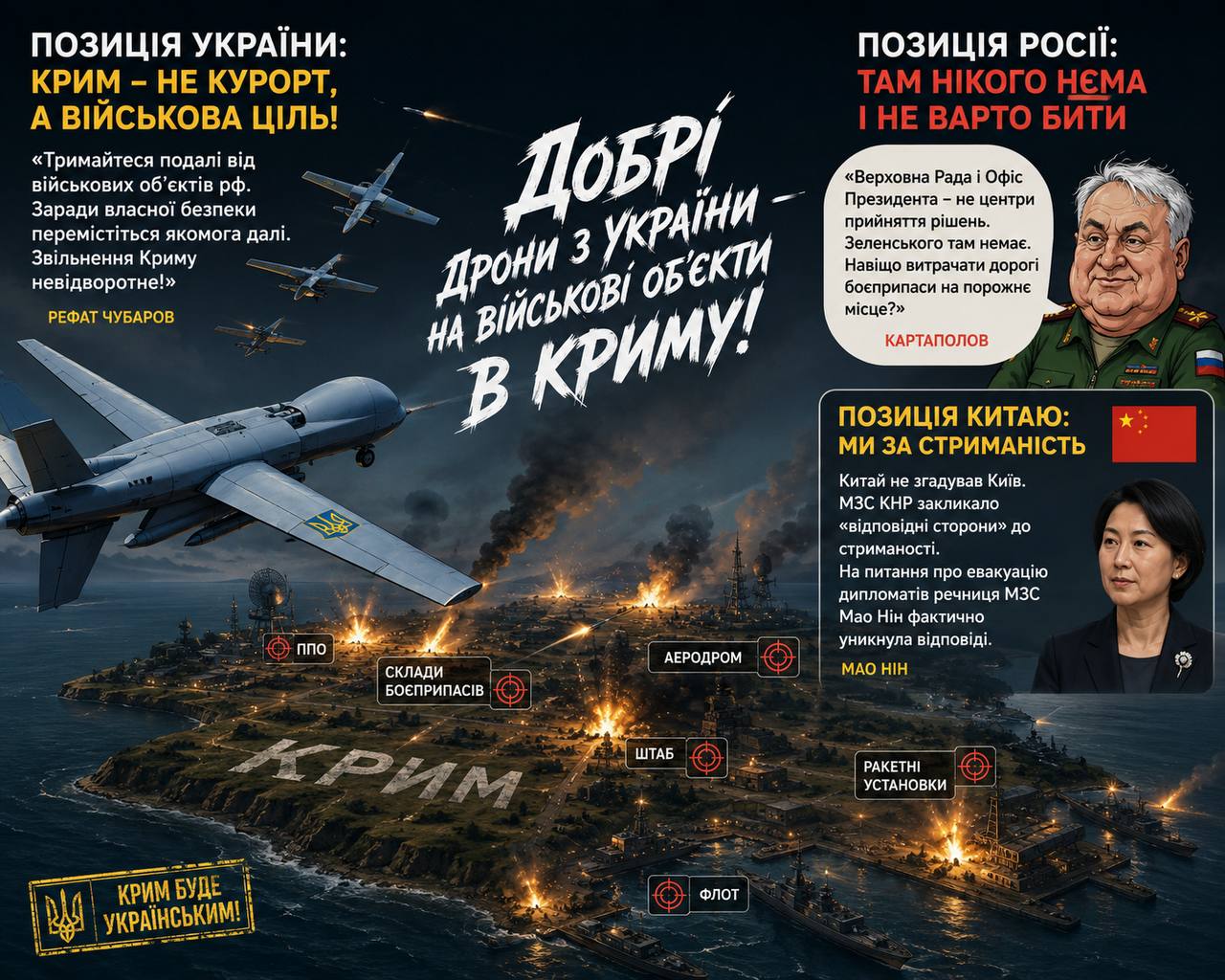
Refat Chubarov speaks directly about what everyone in Crimea has known for a long time without official statements: the peninsula has been turned by the russian federation into a continuous military base. Warehouses, headquarters, air defense systems, airfields, the fleet, launch pads, logistics — for years the occupiers have been dragging everything they use to fight against Ukraine there. And now they have made Crimea one of the most dangerous spots for their own army.
In parallel, the russian deputy Kartapolov began to say that the Verkhovna Rada and the Office of the President “are not decision-making centers.” It sounded particularly ridiculous. Because, in fact, the russian official officially admitted what Ukrainians have been saying for a long time: in the russian federation, even the State Duma decides nothing. They press buttons, raise hands, read papers — an imitation of a parliament in a country where all decisions are made by one bunker television set with an emperor syndrome.
The thesis about the “empty Office of the President” sounds especially comic. This is said by a state that for the fourth year in a row has been spending billions of dollars on missiles to strike residential buildings, playgrounds, hospitals, thermal power plants, water utilities, and shopping centers. But suddenly, they developed a sense of “military expediency.”
And here began another act of the great russian theater. Several channels rushed to spread the story that China is allegedly asking the russian federation “not to strike Kyiv.” But if you read the actual statements rather than the headlines, everything is much more prosaic.
China did not mention Kyiv at all. In response to the russian threats of massive strikes on the capital of Ukraine, the Ministry of Foreign Affairs of the PRC traditionally called on “relevant parties” to exercise restraint. That is, a diplomatic “we are for everything good against everything bad,” without any specifics. And when asked by journalists about the possible evacuation of diplomats, the Ministry of Foreign Affairs spokeswoman Mao Ning effectively avoided a direct answer.
Simply put, a part of the Telegram world saw what it really wanted to see. But the very appearance of such disinformation leaks shows something else well: even Moscow’s allies are beginning to associate the russian federation not with the “second army of the world,” but with a state that threatens strikes on capitals and lives in a mode of constant nuclear-missile blackmail.
It seems that the Kremlin is much more nervous than it tries to show. Because when statements about “we will not strike,” “this is not a target,” and “there is no one there” begin — it means the topic is a sore spot. Especially against the background of increasingly loud explosions in Crimea, problems with the Black Sea Fleet, and the constant hunt for russian military infrastructure.
And the most ironic part of this story is that while russian officials talk about “unimportant objects,” Crimeans are already being asked for a week not to approach russian military bases. Because even the occupation reality is beginning to understand: if the russian federation brought war to Crimea, war will sooner or later come to the russian military objects in Crimea as well.
Author: Ivan Arefiev
Infographics by the author