The Black Sea is no longer a safe zone for Russia: how Ukraine broke the dominance of the Russian Black Sea Fleet.
What the Kremlin presented just a few years ago as an unassailable naval advantage has effectively lost its meaning today. The Black Sea has turned into a zone of constant risk for the Russian fleet, and the Russian Black Sea Fleet itself has become an entity forced to survive rather than dominate.
Thanks to the systematic development of Ukrainian sea drones, special operations by the Defense Forces using them, and technological solutions, Ukraine has changed the rules of naval warfare. The Russian fleet, which for decades was considered the key tool for projecting Kremlin power in the region, has been forced to withdraw a significant portion of its forces to the Novorossiysk area and shift to a defensive model of action.
Key losses that changed the situation at sea
On April 13, 2022, the flagship of the Russian Black Sea Fleet, the missile cruiser Moskva, was hit by two Ukrainian Neptune anti-ship missiles. As a result of the strike, ammunition detonated on board, causing a massive fire, after which the ship lost power, capsized, and sank.
On October 29, 2022, the first successful combined attack in the history of warfare on an enemy military base using exclusively Ukrainian unmanned surface vessels took place, marking the beginning of a new era of naval combat. The target of the attack was the main base of the Russian Black Sea Fleet in Sevastopol Bay (temporarily occupied Crimea).
One of the symbolic strikes was the destruction of the missile corvette Ivanovets, which was tasked with patrolling the area and engaging surface targets. The ship sank in Lake Donuzlav (occupied Crimea). Its destruction sent a signal: even modern warships no longer guarantee safety.
In August 2023, the submarine Rostov-on-Don was hit in Sevastopol Bay. Another Project 636.3 Kilo-class submarine was destroyed by Sub Sea Baby underwater drones of the Security Service of Ukraine in the port of Novorossiysk in December 2025. The explosion caused critical damage to the submarine, effectively putting it out of commission.
On November 4, 2023, during a successful attack by Ukrainian aviation on the Zaliv shipyard in temporarily occupied Kerch, the Russian small missile ship Askold (Project 22800 Karakurt) was hit. Another small missile ship, Tsiklon, was successfully hit and sunk in May 2024 by the Defense Forces of Ukraine.
On February 14, 2024, the large landing ship Caesar Kunikov of the Russian Black Sea Fleet was destroyed. A successful special operation was carried out by the Group 13 special forces of the Main Directorate of Intelligence of the Ministry of Defence of Ukraine in cooperation with other components of the Defense Forces. Such ships are critical for logistics, as they ensure the transfer of equipment, ammunition, and personnel. Their loss directly affects Russia’s ability to support occupation groupings. Also, at various times, the large landing ships Novocherkassk, Minsk, Yamal, Azov, and Olenegorsky Gornyak were destroyed or critically damaged.
On March 5, 2024, as a result of a special operation by the Main Directorate of Intelligence of the Ministry of Defence of Ukraine, the patrol ship of Project 22160 Sergey Kotov of the Russian Black Sea Fleet was destroyed. It is worth noting that the ship, which was monitoring the Kerch Strait area and escorting Russian vessels, was hit. This demonstrated that even the most protected sections of Russian maritime communications and infrastructure are not unreachable.
The losses of Serna-class and Akula-class landing craft, as well as Tunets-class high-speed boats, which were used for logistics, troop transportation, and supplying occupation forces in Crimea, have become systematic. Their destruction is gradually eroding the operational flexibility of Russian forces in the coastal zone.
The frigates Admiral Makarov and Admiral Essen — carriers of Kalibr cruise missiles — have a separate strategic dimension. After the loss of the cruiser Moskva, it was they who played a key role in missile strikes against Ukraine, including Odesa, Mykolaiv, Kyiv, and other cities. Striking such platforms naturally reduces Russia’s ability to carry out missile terror from the sea. The Russian frigate Admiral Makarov was damaged on the night of April 6, 2026, in the port of Novorossiysk as a result of at least two direct hits by Ukrainian drones. In May 2026, the Russian frigate Admiral Essen was damaged. Attack drones of the Unmanned Systems Forces of the ZSU successfully hit the enemy ship in the bay of Novorossiysk during a massive attack on the naval base.
In total, according to the General Staff of the ZSU, as of June 3, 2026, 33 ships and boats and 2 submarines of the Russian Navy have been destroyed or damaged.
The technological factor: a new era of naval warfare
A key element of this transformation has been the Ukrainian MAGURA sea drones. They have formed a new reality of naval combat, where even expensive and modern ships no longer have guaranteed security.
In fact, Ukraine has proven that a country without a powerful traditional fleet is capable of systematically pushing out one of the largest naval powers in the region. The Black Sea has ceased to be a controlled zone for Russia and has turned into a space of constant threat.
Economic dimension of Russian losses
Beyond the operational effect, the losses of the Black Sea Fleet have a colossal financial scale. The total value of the destroyed and damaged ships, according to analytical sources, already exceeds 4 billion US dollars.
Estimated costs:
- missile cruiser Moskva — about 750 million dollars;
- submarine Rostov-on-Don — about 570 million dollars;
- frigates Admiral Makarov and Admiral Essen — over 500 million dollars each;
- large landing ships — 60-70 million dollars per unit;
- small missile and patrol ships — from 50 to 100 million dollars.
These are not only military losses but also a direct depletion of resources that could have been directed toward the internal development of the aggressor state. With these funds, Russia could have modernized civilian infrastructure, funded social programs, or solved accumulated regional problems. Instead, billions of dollars were lost as a result of the war the Kremlin itself started.
War goes far beyond the Black Sea
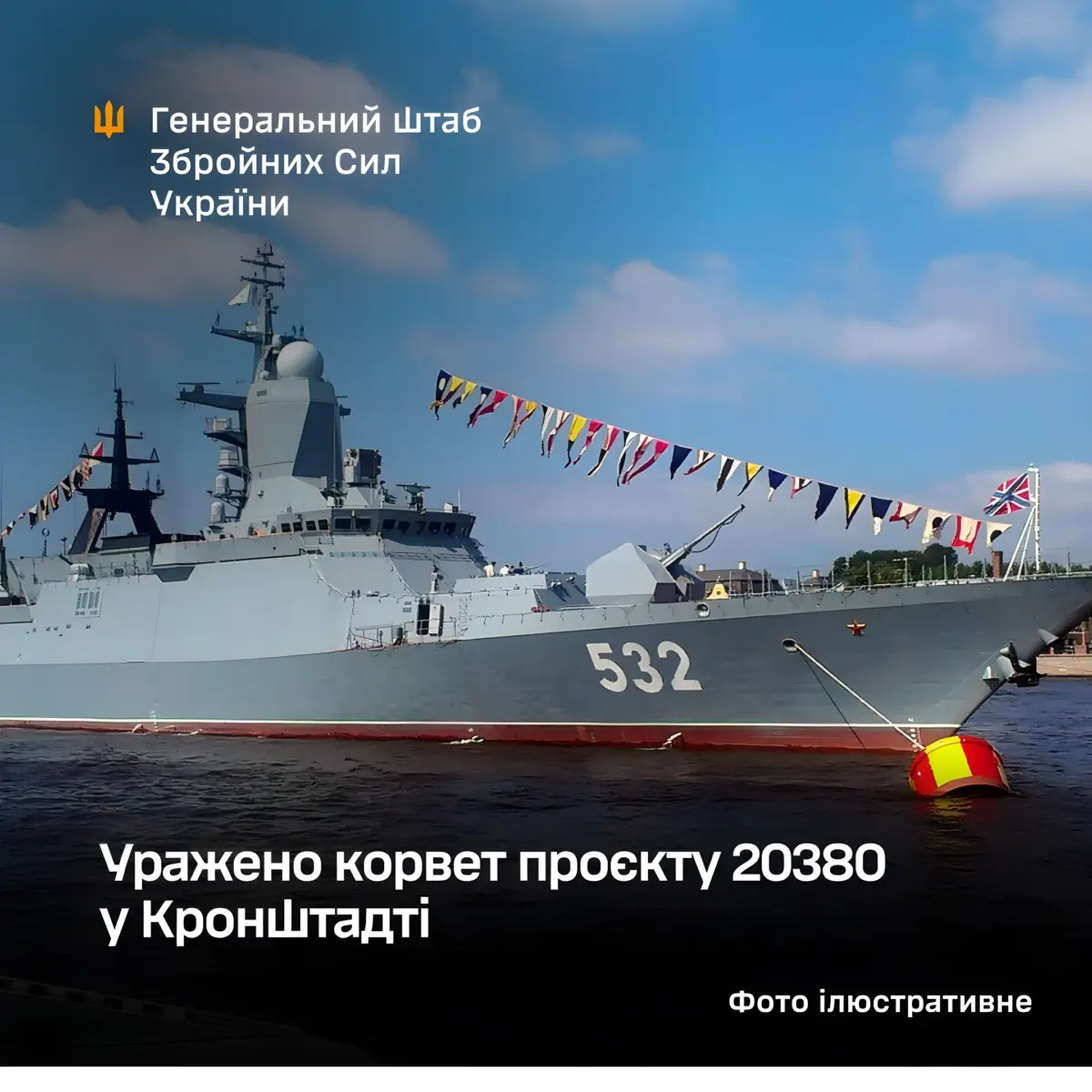
A new confirmation of this trend was the successful operation by the Defense Forces of Ukraine in Kronstadt, one of the key bases of the Russian Baltic Fleet.
On the night of June 3, 2026, units of the Defense Forces of Ukraine hit the corvette Boykiy (Project 20380 Steregushchiy-class). The General Staff of the ZSU reported that a large-scale fire was confirmed on board the ship, and the results and scale of the damage are being clarified.
Commenting on the event, military expert, PhD in History, associate professor Serhii Sokoliuk notes that this is not just about hitting an individual combat unit, but is further proof of the fundamental transformation of modern naval warfare.
According to the expert, Ukraine has effectively forced the Russian fleet to fight by new rules. While just a few years ago, large surface ships were considered the main tool for controlling maritime space, today even well-protected ships in their own bases remain vulnerable to precision-guided drone systems, missile weaponry, and complex combined strikes.
The location of the event adds special significance to this episode. Kronstadt was long viewed by Russian military leadership as a relatively safe base for the Baltic Fleet. Striking a ship in such an area demonstrates that geographical remoteness no longer guarantees protection against modern strike weapons.
During the full-scale war, Russia has already lost or suffered serious damage to a significant number of Black Sea Fleet ships, including flagship and landing vessels. As a result, the Russian fleet has been forced to move ships away from the Ukrainian coast, change its basing system, and spend significant resources on defending its own naval facilities.
Project 20380 Steregushchiy-class corvettes are among the modern multi-purpose ships of the Russian fleet. They are equipped with missile, artillery, and anti-submarine weaponry, and their construction requires a multi-year production cycle. Therefore, even partially putting such a ship out of action has not only a military but also a significant economic effect.
According to open estimates, the cost of one Project 20380 corvette is about 15–20 billion rubles, depending on the configuration and year of construction. At the current exchange rate, this is approximately 180–250 million US dollars. At the same time, the actual cost of restoration may turn out to be significantly higher due to sanctions, shortages of individual components, and the overloading of the Russian shipbuilding industry with military orders.
If the ship has received critical damage to its hull, power plant, or weapon control systems, its repair could take years or prove economically unfeasible. In such a case, Russia will lose not only hundreds of millions of dollars but also a combat unit whose replacement will require significant time.
Strategically, the main result is different: every successful strike on enemy ships forces Russia to spend more and more resources on protecting bases, ports, shipyards, and maritime infrastructure. Thus, Ukraine creates additional costs for the enemy that far exceed the value of the weapons used. This is one of the key principles of modern asymmetric naval warfare.
Today, the Russian Black Sea Fleet is no longer a tool of dominance. It is forced to act cautiously, withdraw ships from risk zones, strengthen the defense of its own bases, and constantly account for the possibility of a strike even in the deep rear. And the strike on the corvette Boykiy in Kronstadt demonstrates that the new reality of naval warfare is already spreading far beyond the Black Sea. The initiative is increasingly shifting to those capable of adapting faster to technological changes and imposing their own rules of the game on the enemy.
Author: Ivan Arefiev
Photo: Facebook GS ZSU
Collage: Andrii Atlantov