In the modern geostrategic environment, there is a shift not only in the priorities of security policy, but in the very understanding of what it means to be aware of challenges and threats.
For a long time, awareness was primarily associated with the ability of specialized intelligence and counterintelligence institutions to obtain information about the intentions, resources, and actions of a potential adversary. This approach remains relevant, but it less and less defines the glocal environment of existential confrontation, in which threats arise simultaneously in different spaces, transition between them, take on new forms, and can remain unnoticed by traditional surveillance mechanisms for a long time.
This is discussed by Hryhorii Liubovets and Valerii Korol, staff members of the NGO “Center for Communication and Content Security,” exclusively for the Prompolitinform portal.
The multiple simultaneity (simultaneity) of glocal challenges changes the subject of awareness itself. It is no longer just about establishing who, where, and by what means is carrying out a certain aggressive action. It is equally important to understand in what environment it becomes possible, what infrastructural, technological, human, economic, and communication links are used, how individual actions relate to each other, and what consequences they may have beyond the immediate place of their occurrence. In this perspective, awareness acquires a landscape dimension, as it must cover not individual objects, but an interconnected set of spaces, routes, networks, infrastructures, and human interactions.
Illustrative in this sense are the decisions of Canada regarding a significant increase in funding for the Canadian Security Intelligence Service. The proposed multi-year funding is not reduced to simply expanding staff or technical equipment of the special service. Among the declared goals are strengthening presence, expanding capabilities, diversifying international security ties, and reducing dependence on foreign partners.
This decision reveals an important shift in priorities, where the state strives to have not only access to information obtained by allies, but also its own capacity to independently form an understanding of the security environment, its changes, and potential threats. Awareness thus becomes a component of the strategic independence of the state.
Another aspect of this transformation is demonstrated by British investments in surveillance systems for the underwater environment of the North Atlantic. The Atlantic Net program, which involves the integration of sensors, autonomous unmanned systems, communication means, and data processing services, is interesting not only for its technological novelty. Its significance lies in the transition to constant surveillance of the space in which critical infrastructure is located, including communication cables and energy networks.
The underwater environment ceases to be perceived as a remote and hard-to-reach space, which becomes a subject of attention only after the detection of damage or suspicious activity. It is transforming into an environment of continuous data acquisition, signal correlation, and early detection of changes.
Of particular note is that this system combines various technological and organizational capabilities into a single complex under the control of the Royal Navy. This opens up a different view on intelligence activity, where its effectiveness depends more and more not on an individual sensor, platform, or departmental structure, but on the ability to combine heterogeneous sources of information into a continuous picture of the environment. What becomes important is not only the availability of data, but also the ability to timely detect changes that individually may seem insignificant, but collectively indicate the formation of a threat.
At the same time, awareness cannot be limited to observing external space. The detention in the UK of an American serviceman on suspicion of providing assistance to a foreign intelligence service raises the question of the vulnerability of the institutions themselves, their personnel, professional ties, and channels of access to protected information. The investigation, which is reportedly being carried out in cooperation between British law enforcement, the FBI, and the American military, shows how important the interaction of counterintelligence and law enforcement structures/capabilities between allies is becoming.
However, suspicion is not yet a proven fact of guilt or established cooperation with foreign intelligence. But the precedent itself draws attention to the fact that modern intelligence confrontation unfolds not only around external objects, but also inside the institutions that ensure security.
In this context, the human dimension of awareness acquires special weight. A person can be not only a source of information or a subject of its analysis, but also a point of vulnerability in a complex system. Access to protected data, professional contacts, trust, carelessness, compromise, or targeted recruitment can create opportunities for penetration where technical means of protection by themselves do not provide proper security. Consequently, building awareness requires simultaneous attention to technological systems, institutional procedures, and the anthropological-cognitive capabilities of a person to recognize threats and assess the situation.
The Ukrainian experience of repelling constant cyberattacks adds another important glocal dimension to this. The cited statistics of 2,000–3,000 attacks annually on the digital systems and tools of Ukraine testify to the regularity and scale of such a confrontation. We are talking not only about state systems, but also about digital systems of the private sector. This means that the object of aggressive actions is not a separate agency, but a distributed digital environment, on which the daily life of people, economic activity, service provision, management, and the functioning of the state depend.
The explanation of the Ministry of Digital Transformation regarding the distributed architecture of digital services is also noteworthy. It demonstrates that security depends not only on the protection of a specific application, but also on how the interactions between registries, information systems, services, and users are built. Distribution can reduce the concentration of risks, but at the same time requires an understanding of numerous interdependencies and possible points of vulnerability.
The human dimension is added to the technical one when a user who does not recognize a dangerous interaction or transmits important information to fraudsters can become part of a mechanism for infiltrating the system. Thus, cyberawareness is not exhausted by the work of digital protection specialists. It implies the ability of people and organizations to understand the nature of threats in their own environment of daily activities.
Comparing these examples allows us to see that awareness is gradually going beyond the traditional departmental understanding of intelligence. Underwater infrastructure, digital systems, the human factor, international ties, logistics routes, and critical objects are becoming parts of a single, albeit organizationally distributed, environment of strategic attention. At the same time, different threats do not necessarily have a single center of coordination or the same nature. However, they can mutually reinforce each other’s consequences, exploit common vulnerabilities, or create favorable conditions for further aggressive actions.
It is here that the glocal-simultaneous nature of modern confrontation is revealed. An event occurring in one place can be linked to the infrastructure of another region, affect the security of several states, and have consequences for global communication or economic networks. An underwater cable, a digital registry, an intelligence penetration, or an information operation do not exist in complete isolation from other processes. They are included in a network of interdependencies through which a local action can acquire a much broader meaning. Therefore, awareness must develop not according to the principle of successive reaction to individual incidents, but in accordance with the multiplicity of spaces, tempos, and scales of the simultaneous flow of threats.
In this regard, it is worth paying attention to the situational correlation between the actions of collective Putinism and the political processes associated with Trumpism. This is not about equating these phenomena, nor about making assumptions about mandatory coordination between them. What is fundamentally important is something else – changes in the policy of great powers, a revision of allied relations, the complication of intelligence data exchange, or the weakening of institutional interaction can create new opportunities for aggressive actors.
Collective Putinism is capable of situationally exploiting such changes, even if they are not the result of its direct influence. Consequently, awareness must take into account not only the actions of the adversary, but also those transformations of the international environment that change the conditions of its activities.
This acquires special significance due to the permanence of unconventional forms of aggression. Cyberattacks, intelligence penetration, sabotage, interference with critical infrastructure, and other forms of covert activity do not always have a clearly defined beginning, end, or a directly visible result. Some of them can create prerequisites for further actions, the consequences of which appear with a time delay.
Delayed kinetic potential means that today’s penetration, damage, accumulation of access, or formation of dependence can become a factor of tomorrow’s physical threat. Therefore, an understanding of security requires attention not only to what has already happened, but also to what opportunities for future aggression are being formed in the present time.
This also changes the perception of the temporality of awareness. If previously its result was often evaluated by the ability to report in a timely manner on the preparation or execution of a specific operation, then in conditions of permanent glocal aggression, the ability to recognize slow, distributed, and non-obvious changes is becoming increasingly important. They can accumulate in different areas and only later manifest themselves as a holistic threat. Awareness in such a case must work simultaneously in several time horizons, where it registers current events, sees trends, reveals the formation of new dependencies, and assesses possible development trajectories.
From here, the question arises about the institutional restructuring of intelligence services and at the same time about the expansion of the very concept of intelligence capability. This is not only about increasing funding or technological equipment of individual agencies. It is necessary to distinguish between an institution as a bearer of authority, responsibility, and specialized functions, and a service as an opportunity to provide analytical, informational, and technological capabilities to various levels of decision-making.
This approach allows for viewing intelligence capabilities not only as an internal resource of specialized structures, but also as part of a broader architecture of awareness that combines the state, military, regional, infrastructural, scientific, and international levels.
At the same time, the expansion of awareness does not mean unlimited data collection or turning the entire society into an object of surveillance. Its development requires a clear demarcation of powers, protection of privacy, verification of information, responsible use of analytical tools, and the preservation of trust. Excessive data concentration, misinterpretation of signals, or the substitution of analysis with automated conclusions can themselves create new vulnerabilities. Therefore, the quality of awareness is determined not by the amount of accumulated information, but by the ability to establish its meaning, check the context, and turn knowledge into informed decisions.
Here opens a fundamental field for communication and content security. Awareness does not end with the receipt of data or their technical processing. It implies the possibility to comprehend what is received, to relate different sources, to distinguish a confirmed fact from an assumption, to see connections between events, and to understand their significance for one’s own environment. If a society receives a large number of messages but has no opportunity to recreate their context and relate them to other processes, the growth of the information flow does not necessarily mean the growth of awareness. On the contrary, fragmentation, overload, and the manipulative use of data can weaken the ability to make independent judgments.
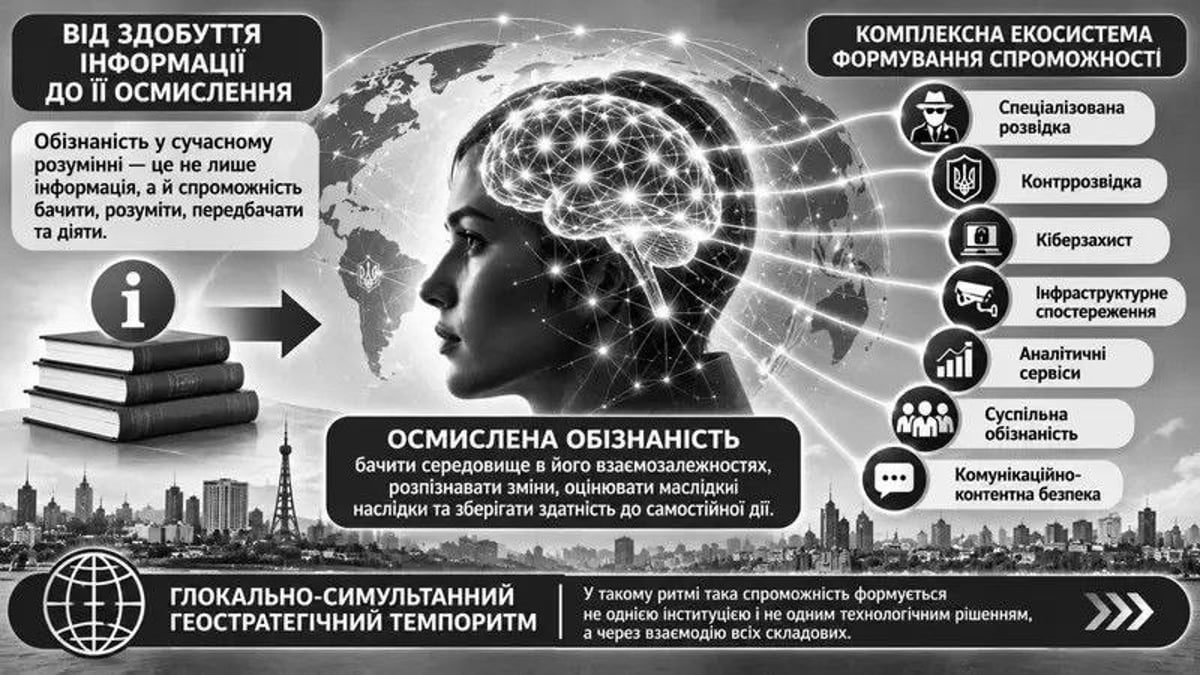
Therefore, the innovation of the modern approach consists in the transition from understanding awareness as a function of obtaining information to understanding it as a constantly reproducible ability to see the environment in its interdependencies, recognize changes, assess possible consequences, and maintain the ability to act independently. In the glocal-simultaneous geostrategic tempo, such capability is formed not by one institution and not by one technological solution. It requires the interaction of specialized intelligence, counterintelligence, cyberdefense, infrastructure surveillance, analytical services, public awareness, and communication and content security.
That is why today it is important not only to increase the capabilities of detecting threats and challenges, but also to open a new culture of civilizational awareness – one that allows societies and states not to remain hostages to the aggressor’s tempo, but to independently form a horizon of vision, understanding, and foresight. This is the transition from awareness as a reaction to already visible events to awareness as an environment of strategic agency.
Awareness becomes an urgent condition for civilizational coherence, because in a glocal-simultaneous world, the human ability to see the interdependencies of realities, understand the contexts of their changes, and maintain one’s own agency can no longer be delegated to specialized institutions. Intelligence services, think tanks, and technological systems provide specialized acquisition and processing of knowledge, but civilizational awareness must be reproduced at the level of every person, becoming a necessary condition for their full participation in social life and ability to act under conditions of permanent aggression.
Authors: Hryhorii Liubovets, Valerii Korol, NGO “Center for KKS”
Photo: Фотоколаж осмислена обізнаність