The Defence Forces of Ukraine are relentlessly depriving russia of its “volley argument”
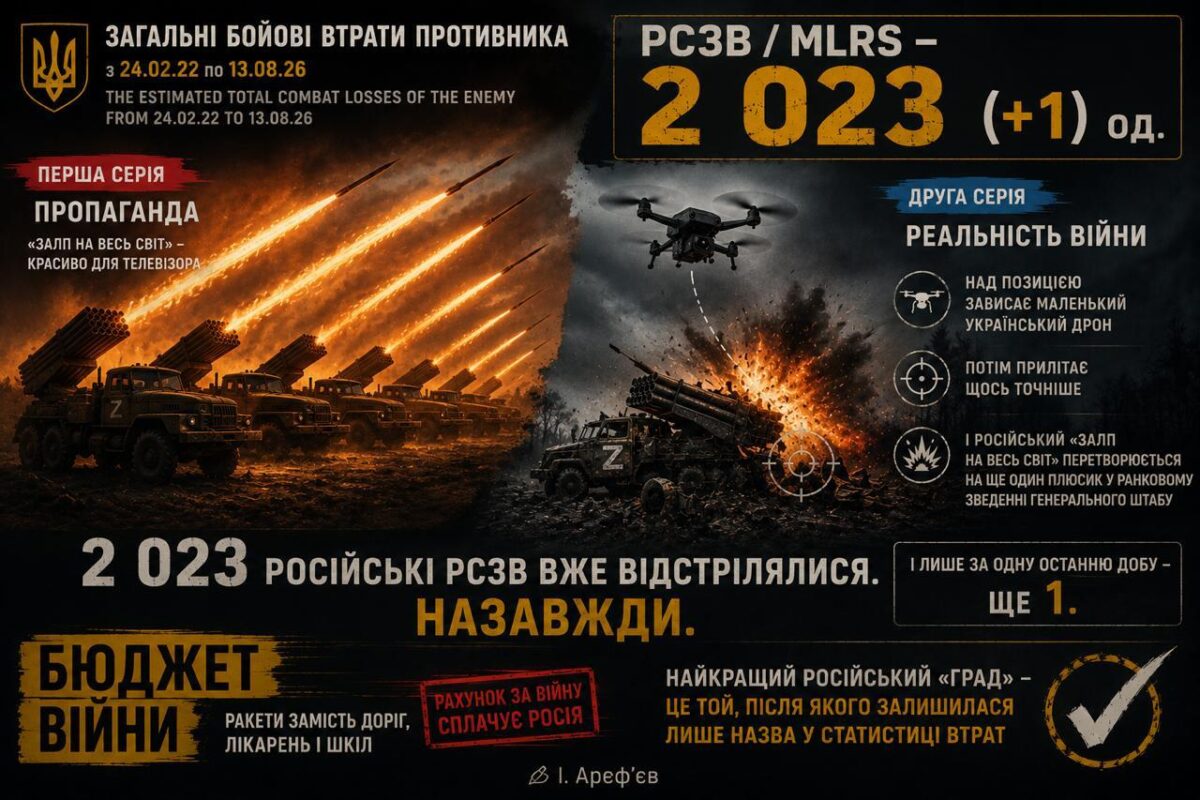
Once, russian propaganda showcased salvos of Grad, Uragan, Smerch and Tornado systems as a symbol of military might. (https://t.me/GeneralStaffZSU/41863) of the General Staff of the Armed Forces of Ukraine – 2,023 MLRS of the russian army have already become combat-loss statistics.
In the new instalment of the “War Budget” series, Ivan Ariefiev, writing for the Prompolitinform portal, analyses how the Defence Forces of Ukraine are methodically depriving the russian army of its “volley argument” and what the economic price of this scrap metal is.
For decades, the russian army built its firepower around a simple formula: more barrels, more rockets, more fire across areas. Grads, Uragans, Smerchs and, later, Tornados were meant to grind down the enemy’s defences before russian infantry moved in.
In the war against Ukraine, this formula collided with a different kind of mathematics — where a multimillion-dollar rocket system, together with its chassis, launch tubes, equipment and trained crew, can turn into scrap metal within minutes of being spotted by Ukrainian reconnaissance.
As of 13 August 2026, according to the General Staff of the Armed Forces of Ukraine, the russian army’s total combat losses in the category of multiple launch rocket systems since the start of the full-scale invasion stand at 2,023 MLRS. In the last reporting day alone, the enemy lost one more multiple launch rocket system.
The psychological mark of two thousand destroyed rocket systems has already been passed. And the count keeps growing. And this is not just another pretty figure in the morning report of the General Staff.
MLRS are weapons of concentrated fire. A single launcher can, within a short time, unleash a full package of rockets at Ukrainian positions, towns and infrastructure. So every destroyed MLRS is one less instrument of massed fire destruction. One less vehicle russia has to build, repair or pull out of storage. One less trained crew, and one more problem for russian military logistics.
And, most importantly, these are rockets that this launcher will never fire at Ukraine again.
From 423 to 2,023: how russia’s “volley argument” shrank
By the beginning of 2023, russian MLRS losses stood at 423 launchers. By the beginning of 2024, the overall figure had approached one thousand — 943 MLRS.
Over the following years, Ukrainian counter-battery warfare grew ever more technological. Reconnaissance UAVs, precision artillery, strike drones and other means of destruction steadily shortened the time between spotting a russian launcher and striking it.
By the beginning of 2026, the russian army’s total losses in this category stood at around 1.6 thousand units. And as of 13 August 2026, the count has already reached 2,023 destroyed MLRS. In other words, since the start of the full-scale war the Defence Forces of Ukraine have removed more than two thousand rocket artillery systems from russia’s combat potential.
To grasp the scale: this is no longer dozens or even hundreds of vehicles. It is a vast fleet of rocket artillery that russia has lost in a war it started itself.
How much do 2,023 destroyed MLRS cost
Here begins the most interesting part of the “War Budget”. According to analytical calculations based on Forbes Ukraine estimates, the total approximate value of the 2,023 MLRS lost by russia is about $1.82 billion.
That said, pricing all 2,023 launchers at a single average cost would be wrong. The MLRS category in the General Staff’s statistics covers systems of different generations and capabilities — from old Soviet BM-21 Grads to the far more sophisticated Uragans, Smerchs and modern systems of the Tornado family.
For instance, there is no precise market price in open sources for the BM-21 Grad launcher itself, as it is old Soviet equipment that is not sold in the usual sense. Modernised counterparts (for example, Ukrainian projects) have been valued at around $1 million. The 9K57 Uragan multiple launch rocket system is valued at roughly the same level – an estimated cost of about $800,000 per combat vehicle.
Meanwhile, the approximate export price of a single combat vehicle of the 9K58 Smerch multiple launch rocket system is about $12.5 million. The Tornado-S MLRS costs even more — over $15 million per launcher. The smaller Tornado-G version costs about $2.7 million (owing to sanctions-driven shortages and the rising cost of electronics).
As can be seen, their prices differ severalfold. But the total comes to billions of dollars’ worth of destroyed and lost russian rocket potential at the very least. And the launcher itself is only the beginning of the bill.
It needs transporter-loader vehicles, ammunition, support trucks, repair facilities, communications and fire-control equipment, fuel, logistics and trained crews. And above all — rockets. Because an MLRS without ammunition is a very expensive truck with tubes.
A full salvo of 40 rockets from a BM-21 Grad costs between $180,000 and $240,000 at current ammunition prices. A full salvo from a 9K57 Uragan is estimated at roughly $200,000.
Rocket prices for the next generations of MLRS are a different matter entirely. A full salvo of 12 rockets from a 9K58 Smerch is estimated at about $1.5 million. And a full salvo from a Tornado-S of 6 guided 300-mm rockets (such as the 9M542, 9M544 or 9M549) starts at approximately $1.2 million, since a single precision rocket is valued at $200,000 and up.
Ukraine has changed the rules of counter-battery warfare
In the early days of the big war, the russian army could mass artillery and rocket systems near the front line far more freely. Today the situation is different. The battlefield has become more transparent.
Reconnaissance UAVs, FPV drones, long-range strike systems, precision artillery and various kinds of intelligence have created an environment in which hiding a large rocket system is much harder.
For MLRS this is critical. A launcher must arrive at its position, set up, fire its salvo and leave the area as quickly as possible. Every extra minute increases the odds that the russian crew hears the sound of a Ukrainian drone before it hears the order to pack up.
The Ukrainian military is steadily narrowing the gap between two words:
“Spotted.”
And:
“Destroyed.”
This is exactly where the technological edge of modern warfare starts to beat russia’s traditional advantage in mass.
The Grads are running out too
Russia inherited vast stocks of rocket artillery from the USSR. It was this reserve that allowed it for years to offset combat losses with vehicles from depots and long-term storage bases.
But a depot is not a magic wardrobe. Equipment that has stood idle for decades needs repair. It needs engines, chassis, electrics, sighting devices, communications equipment and spare parts. Some vehicles can be restored. Some become spare-part donors. And some will never move again.
That is why every modern MLRS destroyed by the Ukrainian military has a double effect: russia loses a specific combat unit and at the same time is forced to spend money, production capacity and time searching for a replacement. And the longer the war lasts, the more expensive that replacement becomes.
“War Budget”: rockets instead of roads, hospitals and schools
More than two thousand destroyed MLRS are only part of the war’s economic price for russia. The Kremlin was spending money on more than just the launchers themselves.
For decades it financed rocket production, system upgrades, the upkeep of depots and repair plants, crew training and the enormous logistics machine required to keep rocket artillery running.
That money could have worked differently. On roads. On hospitals. On schools. On housing. On modernising the infrastructure of russian regions, much of which still lives as if the 21st century simply never arrived.
The Kremlin made its choice. The money went into Grads, Uragans, Smerchs and Tornados. Then they went to Ukraine. And 2,023 of them have already finished their journey.
Once, russian propaganda loved to show MLRS salvos as a symbol of strength: dozens of rockets leaving the rails at once, the sky ablaze — great for television.
But the war has a second episode. In it, a small Ukrainian drone hovers over the position. Then something more precise arrives. And the russian “salvo for the whole world” turns into one more tick in the morning report of the General Staff of the Armed Forces of Ukraine.
2,023 russian MLRS have already fired their last salvo. Forever. One of them — in the last reporting day alone. Because in the Ukrainian version of the “War Budget”, the best russian Grad is the one that left nothing but a name in the loss statistics.
By Ivan Ariefiev
Collage: Andrii Atlantov
Read also: 13,998 units of enemy motor vehicles destroyed — combat losses of rf in July 2026