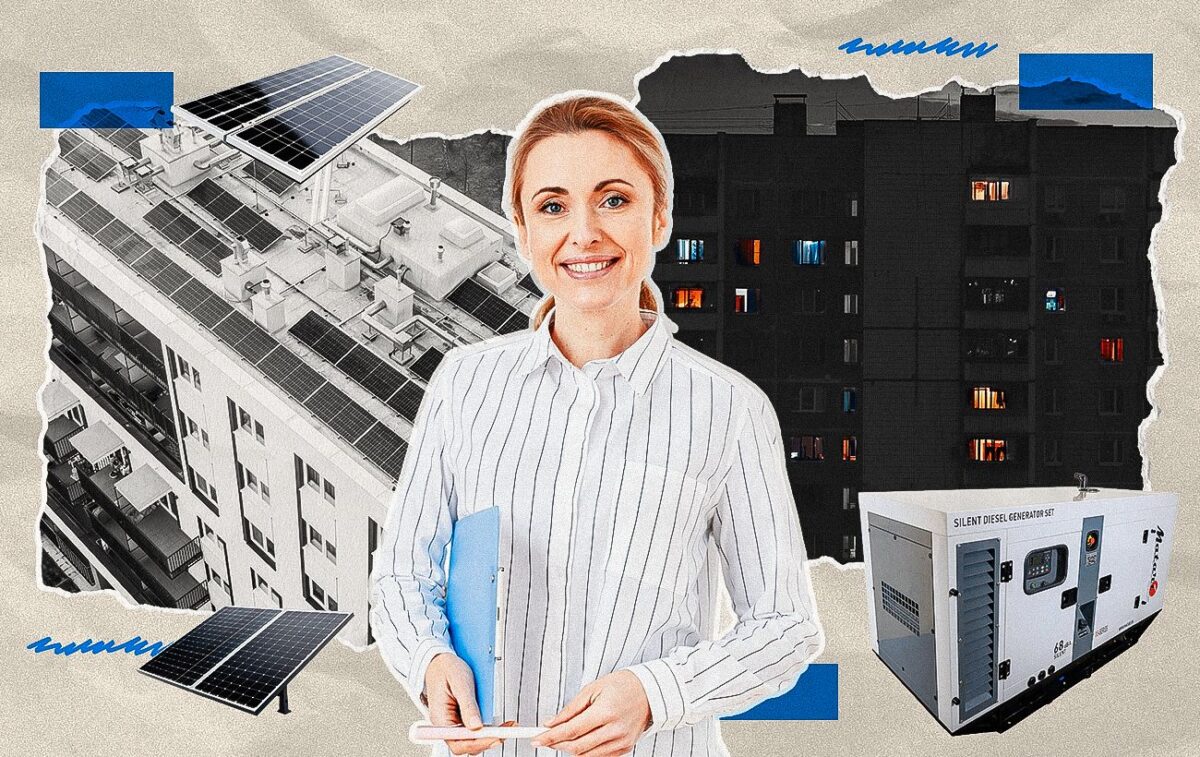
Purchasing a generator for a high-rise building costs about 2.5 million hryvnias
Winter blackouts threaten the livelihoods of high-rise apartment buildings in Kyiv, forcing co-owners to independently invest in backup equipment. HOAs are combining generators, solar power plants, and subsidized programs to keep pumps and heating running. This was reported by RBC-Ukraine (Марія Волощук) citing Gradus Research, according to the portal PromPolitInform.
Prolonged winter power outages can completely paralyze the internal infrastructure of high-rise buildings. Specifically, without a centralized power supply, circulation pumps, boiler rooms, and upper-floor water booster systems grind to a halt.
Allocation of responsibility for utilities
Under current regulations, heat supply companies are responsible for delivering energy exclusively up to the outer wall of a building. All internal networks and equipment are maintained by the residents themselves.
As Oleh Harnyk, an expert on public utilities and infrastructure, explains, municipal services are not obligated to resolve issues with water or heat delivery inside a building during blackouts. Consequently, securing backup power for pump groups becomes a critical task for co-owners.
Financial estimate of energy independence
The practical experience of capital-city co-owner associations demonstrates significant expenses for such projects. Olena Svarychevska, head of the Syretskyi Boiar HOA board, notes that the initial purchase of a 136 kVA generator cost approximately 2.5 million hryvnias.
To cover these costs, residents paid roughly 6,000 hryvnias per apartment. Later, the building utilized the municipal 70/30 co-financing program to install a hybrid solar power plant worth about 6 million hryvnias.
State and municipal support programs
In addition to municipal initiatives, HOAs can utilize government grants and preferential credit tools. For instance, the GreenDIM program from the Energy Efficiency Fund covered up to 70 percent of the cost of solar power plants, though the acceptance of new applications has been suspended due to depleted limits.
At the same time, other mechanisms remain active, including the SvitloDim program with payouts ranging from 100,000 to 300,000 hryvnias and loans under the 5-7-9% program. According to Oleh Harnyk, the main obstacle to such initiatives is often the lack of funds in local budgets.
Legal nuances of decision-making
The procurement process for equipment can be organized either through an HOA or via a management company using an official meeting protocol. Tetiana Boiko, co-founder of the OPORA network, emphasizes the legality of using a qualified electronic signature for voting by owners who are currently abroad.
The legal obligation to maintain common property applies to all co-owners in proportion to their apartment area. Accordingly, owners of ground-floor units have no legal grounds to refuse contributions for elevators or pumps.
Photo: RBC-Ukraine
Read also: «Independence» Rates: Ukrposhta Prices Have Changed—How Much Will We Pay for Parcels and Letters