Prime Minister Serhiy Koretsky spoke about the preparation of educational institutions for the new academic year, security requirements for conducting lines, providing schools with shelters, organizing training in front-line regions and increasing teachers’ salaries from September 1.
Prime Minister Serhiy Koretsky spoke about the preparation of educational institutions for the new academic year, the situation with shelters, training in front-line territories, providing textbooks and food, as well as increasing teachers’ salaries from September 1. This is reported by “Sudovo-Yurydychna Gazeta“, the PromPolitInform portal reports.
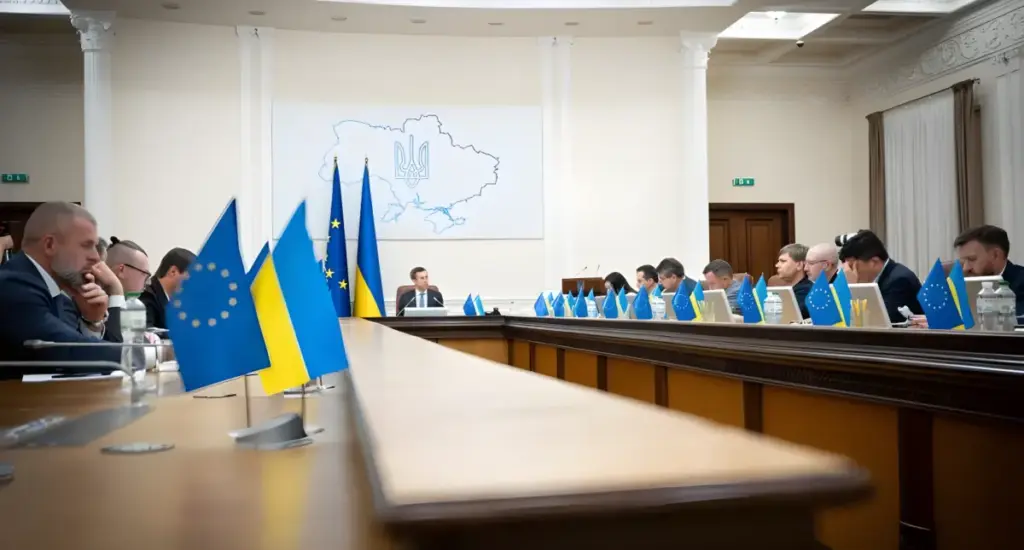
On the eve of the start of the new school year, Koretsky heard a detailed report from the Minister of Education and Science on the readiness of the education system.
According to the Head of Government, the topic was the safety of the educational process, the condition of shelters, the organization of nutrition, providing schoolchildren with textbooks, and increasing the salaries of teachers.
“Our task is to provide children with the opportunity to study qualitatively and safely, despite the war,” Koretsky emphasized.
There should be no mass events in communities with increased risk
25 thousand educational institutions will start working from September 1. At the same time, mass events should not be held in communities where there is an increased risk of Russian strikes.
According to the Prime Minister, school lines and other celebrations can be held only taking into account the security situation, the capacity of shelters, and the ability to quickly move to them in the event of an air raid.
Decisions on holding such events should be made by specific communities on the ground.
“The safety of children and teachers is more important than any celebrations,” Koretsky emphasized.
How many schools and kindergartens have shelters
Currently, over 82% of children attending preschool institutions have access to shelters. Among schoolchildren, this figure is 83%.
This includes over 9,000 preschool institutions and 11,000 secondary education institutions.
The construction of another 131 shelters continues with funds from the state budget, including 18 underground kindergartens.
After the completion of this work, 87% of kindergarten students and students will have access to shelters. By the end of 2027, this figure is planned to be increased to 92%.
For comparison, in 2025, 77% of children had access to shelters, and in 2022, only 10%.
The situation is worse in universities, vocational and professional education institutions. Shelters are available in 965 out of 1,420 universities and colleges, or about 68%.
Higher education institutions and colleges will independently determine the format and schedule of their studies within their autonomy. They can combine full-time, blended and distance learning depending on the security situation, the capacity of the shelters and the specifics of educational programs.
Kyiv and Kyiv region: over 90% of children have access to shelters
According to local authorities, in Kyiv, shelters are equipped in 528 kindergartens and 435 schools. They allow 91% of the capital’s pupils and students to be protected.
At the same time, 23 kindergartens and 20 schools do not have their own shelters. For them, the educational process will be organized in safe spaces that are rented.
In Kyiv region, shelters are equipped in 507 kindergartens and 658 schools. This allows them to provide more than 90% of the pupils and students of the region with them.
How children will study in frontline regions
The Government pays special attention to the organization of safe education in frontline territories.
All available forms of the educational process will be used there. Some children will study remotely, some in a mixed format using anti-radiation shelters adapted for classes.
The format and schedule of education will be determined by local administrations, taking into account the security situation.
In Odessa, Chernihiv, Sumy, Mykolaiv and part of Dnipropetrovsk regions, the educational process can also take place in institutions that have basic shelters. This allows for mixed education to be provided to about 80% of pupils and students.
In Zaporizhia region, this figure is about 72%.
In Kharkiv region, due to the security situation, mixed education is used only in the so-called underground schools. About 30% of students can study in this format.
Currently, 17 such schools are operating in the Kharkiv region, seven more are planned to be completed at the beginning of the school year. In other cases, distance learning will be used.
What will happen to textbooks and schoolchildren’s meals
Koretsky also drew attention to providing students with textbooks. According to him, Russia is purposefully attacking printing houses and warehouses where educational literature is stored.
If it is impossible to promptly print the required number of textbooks, schoolchildren should gain access to their electronic versions.
The corresponding task is assigned to the Ministry of Education and Science together with local authorities in each specific region.
Separately, the Prime Minister focused on the organization of meals.
Where the security situation does not allow providing full hot lunches, schoolchildren should receive ready-to-eat meals.
The Ministry of Education and Science should monitor the issue of providing children with quality food.
Teachers’ salaries will increase by another 20% from September 1
Teachers’ salaries should increase by another 20% from September 1. At the beginning of 2026, they were already increased by 30%.
This is precisely about increasing the salaries of teaching and scientific and pedagogical employees, from whom most of the additional payments and allowances are calculated.
At the same time, the system of remuneration for teachers is changing. From September 1, it is planned to abandon the Unified Tariff Grid and switch to a system in which the salary will depend on the position and the base amount. Currently, this base amount is the average wage in the economy of Ukraine.
The new system will cover schools, higher education institutions, inclusive resource centers, and state educational institutions.
For preschool and extracurricular, vocational and specialized pre-higher education, local governments are also recommended to increase teachers’ salaries from September 1, 2026.
At the same time, teachers who work full-time in front-line areas will retain a supplement of UAH 2,600.
In addition, teachers at colleges that train specialists for the defense-industrial complex, energy, mechanical engineering and metalworking will receive an additional 10% to their salary.