Specialised rigs flex the footwear in water up to 158,400 times during 44-hour tests
Military units received approximately 260,000 pairs of high-top winter boots for the Armed Forces of Ukraine by the end of September. All footwear underwent rigorous laboratory and practical quality testing in line with Ministry of Defence specifications. This is reported by the portal PromPolitInform, citing information from the Ministry of Defence of Ukraine, based on data from the State Operator For Non-Lethal Acquisition.
Deliveries are carried out under contracts concluded to meet the military equipment needs of the armed forces. Output from any manufacturer must conform to the unified standard TS A01XJ.14755-362:2022 (01) and an approved reference sample, ensuring acceptance inspections focus strictly on materials and technical metrics rather than brand names.
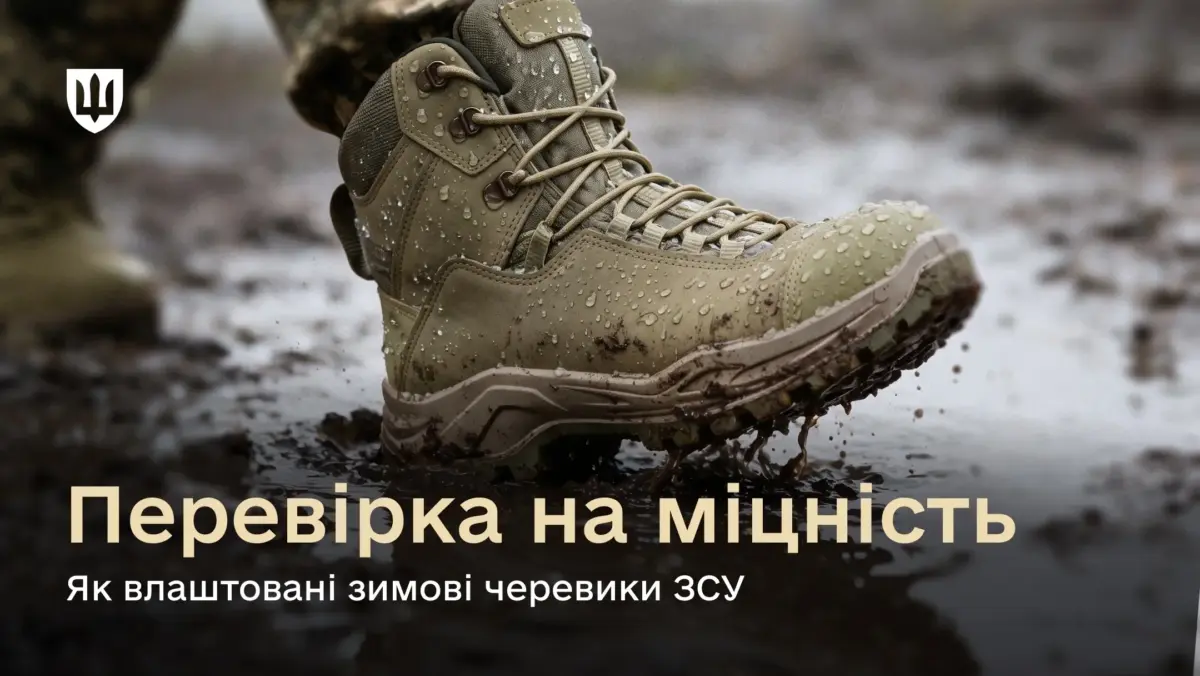
The upper boot is constructed from nubuck leather combined with synthetic Cordura-type fabric, reinforced with protective covers at the toe and heel. A bellows tongue prevents snow from entering the interior, while a waterproof membrane lining with heat-sealed seams covers at least 75% of the boot’s total height.
Sole construction and thermal insulation
The outsole is attached via direct injection moulding, providing a minimum bond strength of 4 N/mm. It features a dual-layer build: a polyurethane midsole absorbs mechanical shocks during marching, and a durable rubber outsole with a minimum tread depth of 4.7 mm guarantees traction.
A puncture-resistant layer designed to withstand penetration forces of at least 1,100 N is built into the base. Positioned above it is a 4 mm neoprene insulation layer and a moulded foil insole, with every shipped pair including replacement laces, water-repellent spray, and a cleaning brush.
Laboratory testing of material durability
A single size 42 boot cannot exceed 850 grams in weight, nubuck thickness must measure between 2 and 2.6 mm, and the leather must withstand water exposure for over 180 minutes. The membrane is verified for water resistance of no less than 4,500 mbar and seam integrity under 1 bar of pressure.
The rubber tread undergoes a 60,000-cycle flexing test, after which incision cut growth cannot exceed 4 mm. The outsole material is also evaluated for resistance to petroleum products, abrasion, and low temperatures, ensuring insole surface cooling remains within a 10°C limit during freezing tests.
Dynamic waterproof performance testing
Beyond component inspections, assembled boots are secured in test apparatuses and submerged in water above the lowest lacing loop. The mechanical rig flexes the forefoot at a 25-degree angle at a speed of roughly 60 cycles per minute with 600 N of applied force.
A complete test routine can run for up to 44 continuous hours, enduring 158,400 flexes without any water entering the interior chamber. This environment simulates sustained movement through wet snow, deep puddles, and muddy soil under constant mechanical stress.
Photo: Ministry of Defence of Ukraine
Read also: 12,412 Tanks Destroyed Since the Start of the War — Enemy Combat Losses as of October 13, 2026