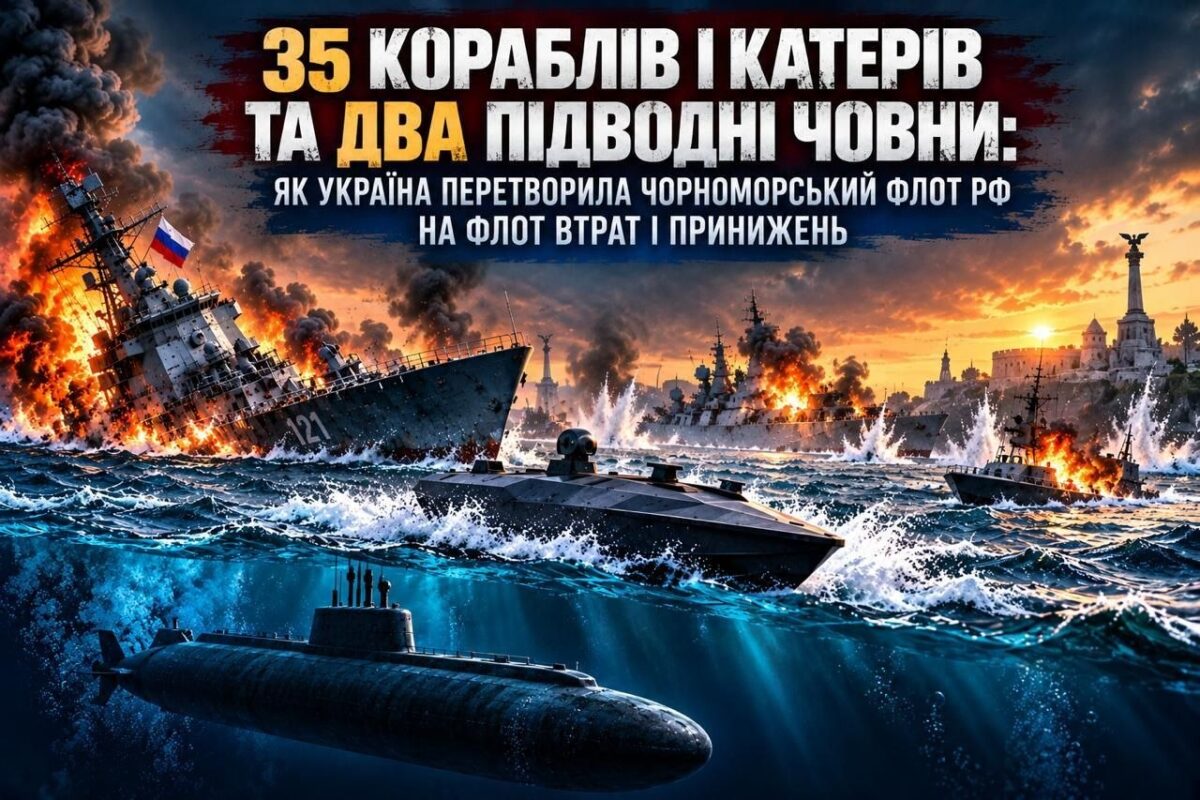
Over four years of war, Ukraine has turned Russia’s Black Sea Fleet into a fleet of losses and humiliation, destroying and damaging 35 ships and boats, along with two submarines.
How have Ukrainian technologies changed the rules of naval warfare, and why are the Kremlin’s billion-dollar military ambitions going under? This analysis by Ivan Arefiev is brought to you exclusively by the PromPolitinform portal.
Once upon a time, the Russian Black Sea Fleet was considered one of the main instruments of Moscow’s military dominance in the region. Its warships showed the flag, threatened neighbors, blockaded Ukrainian ports, and launched missiles at our cities. But the full-scale war demonstrated what the Kremlin stubbornly refused to admit: even a large military fleet can be forced to retreat if it is fought not with parade traditions, but with technology, intelligence, and unconventional solutions.
As of October 21, 2026, according to official data from the General Staff of the Armed Forces of Ukraine, the total combat losses of the Russian army since the beginning of the full-scale invasion stand at approximately 1,570,540 military personnel, 12,436 tanks, and thousands of other weapons.
However, among these figures, two categories deserve special attention. At first glance, 37 naval units against the background of thousands of destroyed tanks might seem like an insignificant number. But in naval affairs, arithmetic works differently.
A single destroyed missile ship can mean the loss of launchers, radar equipment, a trained crew, combat potential, and years of shipbuilding industry labor.
And the loss of a large landing ship is not just minus one unit in the statistics. It is a reduction in the capacity to transport personnel, armored vehicles, ammunition, and supplies by sea.
Most importantly, Ukraine achieved these results without having a traditional large surface fleet comparable to Russia’s.
From Moskva to Marine Drones: How Russian Confidence Shattered
April 14, 2022, became one of the turning points in the modern history of naval warfare. Russia lost the missile cruiser Moskva, the flagship of its Black Sea Fleet.
This was no ordinary vessel, but a symbol of the Russian naval presence, equipped with anti-ship missiles and air defense systems.
The Ukrainian side reported hitting the cruiser with Neptune anti-ship missiles. Russia initially blamed the disaster on a fire and ammunition detonation, but later confirmed the ship’s sinking.
There is an important detail here. The cruiser, meant to provide air cover for other ships, failed to defend itself against the strike.
For the military, this meant much more than the loss of expensive weaponry. It cast doubt on the effectiveness of shipboard air defense, combat duty organization, threat assessment, and the command’s readiness to act in modern warfare conditions.
The Moskva was meant to demonstrate Russia’s strength. Instead, it demonstrated to the entire world that Russian military self-confidence does not guarantee combat resilience. After this, the Black Sea Fleet could no longer feel unpunished near the Ukrainian coast.
Marine Drones: When a Small Machine Makes a Large Ship Sink
The next stage was the advent of Ukrainian strike naval drones. MAGURA V5 systems, developed in Ukraine, became one of the brightest examples of asymmetric warfare. Their main advantage lies not only in speed, stealth, or the ability to attack ships, but in altering the cost ratio between the attack asset and the target.
According to official information from the Main Directorate of Intelligence of the Ministry of Defence of Ukraine (DIU), marine drones participated in a series of successful operations against the Russian fleet. Among the most indicative are the destruction of Serna-class and Akula-class landing craft, the Ivanovets missile boat, the Caesar Kunikov large landing ship, and the Sergey Kotov patrol ship.
The story of the Ivanovets was particularly telling. On February 1, 2024, Ukrainian marine drones attacked the missile boat near temporarily occupied Crimea. According to then-DIU chief Kyrylo Budanov, six direct hits led to the sinking of the vessel.
This is not just a successful attack. It is a demonstration of a new model of naval combat, in which an expensive warship can prove vulnerable to a group of much cheaper robotic platforms.
The Russian command is forced to spend resources on protecting ships, ports, base points, boom barriers, surveillance, and anti-sabotage measures. In other words, even when a Ukrainian drone does not destroy a ship, the mere threat of its appearance changes the enemy’s behavior. Russia built a fleet to control the sea. Ukraine forced this fleet to think primarily about its own survival.
Caesar Kunikov: The Landing Ship That Never Saw a Landing
On February 14, 2024, near Alupka, MAGURA V5 marine drones destroyed the Project 775 large landing ship Caesar Kunikov. According to the DIU, the ship received critical holes on its port side and began to sink. It was designed for a crew of up to 87 people and had previously been used by Russia in military operations against Georgia, Syria, and Ukraine.
Why is this loss important? Because a landing ship is a component of military logistics. It can provide the transportation of equipment, military personnel, and cargo, as well as support amphibious assault operations. Following the loss of part of its landing capabilities, it became harder for Russia to view the Black Sea as a safe space for large-scale troop deployment.
The psychological effect is also worth mentioning. A ship that for decades was associated with the capability to land a Russian assault force became the target of Ukrainian drones itself. There is a certain historical irony here: the Russians prepared to land troops on the Ukrainian coast, and ended up spending more and more time saving their own ships.
Sergey Kotov: 65 Million Dollars That Failed to Provide Protection
On March 5, 2024, the DIU special unit Group 13, in cooperation with the Naval Forces of Ukraine, attacked the Project 22160 patrol ship Sergey Kotov.
According to official DIU data, marine drones hit the stern, starboard, and port sides of the ship near the Kerch Strait. Intelligence estimated the cost of the vessel at approximately 65 million dollars.
This operation revealed another problem of the Russian fleet. A military ship may have modern communication, navigation, and weapon systems, but this does not guarantee protection against small-sized surface targets.
Countering such threats requires a comprehensive system: timely detection, target designation, short-range defense assets, a trained crew, and effective management. It is not enough to simply have machine guns on board. One must detect the threat in time, correctly classify it, and strike it before it closes in.
This is where the difference between having weaponry and real combat capability becomes apparent. And if a ship worth tens of million dollars is unable to effectively counter marine drones, questions arise not only for the crew, but for the designers, fleet command, personnel training system, and the military-political leadership of Russia.
Two Submarines: A Blow to the Hidden Power of the Russian Fleet
The losses of the Russian submarine fleet deserve special attention. According to the General Staff of the ZSU, as of October 21, 2026, the enemy has lost two submarines.
For Russia, this is a particularly painful issue, as Project 636.3 Varshavyanka-class submarines are used as carriers of Kalibr cruise missiles.
One of the most famous examples is the Rostov-on-Don submarine. In September 2023, it was damaged during an attack on a ship repair yard in Sevastopol. In August 2024, the General Staff of the ZSU reported its final destruction.
Interestingly, satellite images later appeared in open sources which, according to OSINT analysts, indicated an attempt by Russians to disguise the loss of the submarine with a wooden mockup. This information was also covered by materials from the Ukrainian Navy Institute.
The irony here is practically print-ready.
When a state talks for years about the invincibility of its submarine fleet and then has to camouflage losses with wooden structures, this is no longer a demonstration of military might. These are mere props for its own propaganda.
At the same time, it is important to understand that a submarine is an extremely complex military system. Its loss means not only a reduction in the number of missile carriers, but a blow to the capabilities of covert maneuvering, combat patrolling, and missile strikes. The official statistics indicate two submarines, but do not contain a breakdown of these losses by name. Therefore, equating both units with specific submarines without additional confirmation would be incorrect.
2026: Even Novorossiysk No Longer Guarantees Safety
Another important stage of the confrontation is the extension of Ukrainian strikes to Russian naval facilities in Novorossiysk.
On August 12, 2026, the DIU reported on a joint operation by the Defense Forces, resulting in strikes against the frigates Admiral Essen and Admiral Makarov, the patrol ship Vasily Bykov, as well as port and other military infrastructure.
On September 9, 2026, the DIU reported a repeated strike on the frigate Admiral Essen, whose deck superstructure caught fire.
An important clarification: these reports refer to the striking of ships, not their confirmed sinking.
However, from an operational perspective, this is no less interesting. The Russian fleet, which previously used Sevastopol as one of its main deployment hubs, was forced to change deployment areas and defense systems.
As early as March 2024, DIU representative Vadym Skibitsky stated that Ukraine, without a powerful traditional fleet, had forced Russian warships to leave Crimea.
Now, strikes are reaching areas where the Russian command tried to relocate its ships. This means geographic relocation does not solve the main problem: the vulnerability of naval infrastructure to Ukrainian strike assets.
The Kremlin can move ships from one port to another. But it has not yet managed to move the Black Sea further away from Ukrainian technologies.
What do 35 ships and boats and two submarines actually mean?
The main mistake when evaluating naval losses is to count exclusively the number of destroyed units. In naval warfare, not only ships matter, but also the functions they perform.
Missile ships provide the ability to strike from a great distance. Landing ships provide the transportation of troops and equipment. Patrol boats secure maritime areas and communications. Submarines provide covert weapon deployment and constant threat creation. When the enemy loses these platforms or is forced to limit their use, several processes unfold simultaneously.
First, the number of assets capable of performing combat missions simultaneously decreases.
Second, the load on the remaining ships in service increases.
Third, the enemy is forced to spend additional resources on defending base points, repairs, camouflage, and restoring combat readiness.
Fourth, the very logic of fleet deployment changes. Instead of active control over the sea space, the command is increasingly forced to consider the risk of losing expensive combat units.
Finally, the destruction of ships creates long-term problems for the Russian defense industry.
A tank, despite production complexity, can be manufactured much faster than a modern warship. Restoring the submarine fleet requires specialized shipyards, equipment, trained specialists, and a multi-year production cycle. Therefore, losses at sea are strategic in nature.
The Main Lesson: Technology Defeats Naval Arrogance
There is another point that often remains overlooked. Ukrainian successes at sea became possible not thanks to a single universal type of weapon. They are the result of a combination of anti-ship missiles, reconnaissance assets, long-range high-precision weapons, marine drones, and the joint work of various components of the Defense Forces.
It is telling that the DIU reported not only on striking ships with marine drones, but also on new capabilities of these platforms in combating aerial targets. In particular, the use of MAGURA against Russian helicopters in late 2024 and Su-30 fighters in May 2025 was officially recorded.
This indicates the gradual transformation of marine unmanned platforms from narrow-purpose strike assets into multifunctional combat systems.
For the navies of many countries around the world, the Ukrainian experience has served as a serious reason to review traditional approaches to ship defense. After all, even a significant distance from the enemy coast, powerful weaponry, and large tonnage no longer guarantee safety.
At the same time, speaking of the complete destruction of the Russian Black Sea Fleet would be an exaggeration. The enemy retains ships, submarines, coastal missile systems, and the ability to strike from maritime directions. Therefore, Ukraine’s main task is not to rest on laurels, but to continue technological development, strengthen intelligence, and maintain its own edge in asymmetric means of naval warfare.
Conclusion:
35 ships and boats. Two submarines. Behind every figure is a specific combat operation, the work of Ukrainian military personnel, engineers, intelligence officers, and unmanned systems operators.
Yet the most important thing is not even the number of destroyed units. Ukraine has shattered the myth that naval superiority is determined solely by the number of ships, their tonnage, and the size of missile launchers.
For decades, Russia poured huge resources into its fleet, held naval parades, showcased cruisers and frigates, and boasted of absolute control over the Black Sea. Then Ukrainian engineers, naval sailors, and marine drone operators came along and proved in practice that large ships are not a sign of great military intellect.
At the same time, these results give no grounds to underestimate the enemy. Russia is adapting, developing base point defenses, changing tactics, and continuing to use maritime missile carriers. Therefore, a difficult struggle still lies ahead. And yet, the main strategic result is already obvious: Russia has lost the ability to use the Black Sea unhindered as it planned at the start of the full-scale invasion.
Once upon a time, Russian admirals dreamed of controlling the Ukrainian coast. Now they are forced to monitor ever more closely whether another Ukrainian marine drone is approaching their ships.
As for Russian propaganda, the tried-and-true old tactic remains: if a ship sinks, announce that it simply changed its deployment area to the seabed.
And finally. A fleet is measured not by the number of ships at a parade, but by its ability to perform combat missions during a war. It is precisely this exam that the Russian Black Sea Fleet is failing with massive losses.
Author: Ivan Arefiev
Collage: Andriy Atlantov
Photo: Флот потоплених кораблів рф